Bitcoin, Ethereum and Ripple are struggling to sustain their recovery on Friday, reflecting a sticky bearish sentiment. Since the October 10 flash crash, which liquidated over $19 billion in crypto assets in a single day, retail interest in crypto assets has been significantly suppressed.
Gold firm above $4,200 on broad dovish repricing for December
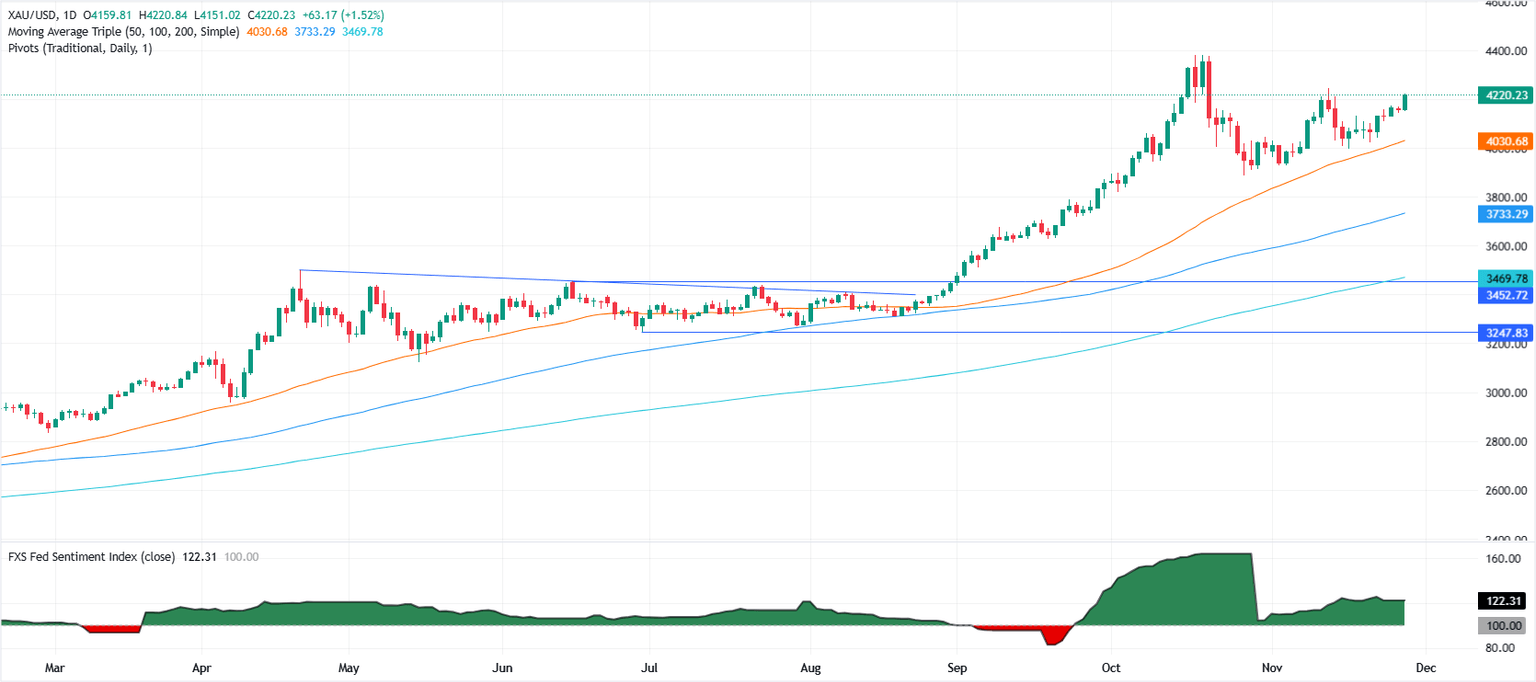
Gold (XAU/USD) rises over 1% on Friday amid a scarce economic docket, but traders are pricing further easing by the Federal Reserve (Fed) at the next meeting, pushing the non-yielding metal past the $4,200 mark for the first time in the last ten days.
Bullion surges over 1% in thin holiday trade as easing expectations climb toward 87% despite mixed US data
Expectations that the Federal Reserve would continue its easing cycle increased as the CME FedWatch Tool shows odds for a 0.25% reduction at the December 9-10 meeting at 87%,. Meanwhile, Fed officials remained muted since Wednesday, heading for Thanksgiving, as the blackout period begins on Saturday.
Policymakers at the Federal Open Market Committee (FOMC) remain split about the next move. Nonetheless, the latest comments from New York Fed John Williams and Fed Governor Christopher Waller poured cold water on the hawks and strengthened the doves’ position ahead of the meeting.
US data has been mixed, with inflation on the producer side seeming to be stalling after the PPI rose to 3.1% YoY in July, before printing back-to-back readings of 2.7%. Even though this opens the door for further easing, the latest Initial Jobless Claims print shows the jobs market remains solid, despite giving signs of weakness.
Given the backdrop, Gold prices could continue to edge up. However, developments pointing towards peace talks between Russia and Ukraine, led by the White House, could cap bullion’s advance amid an obvious sentiment shift.
Next week, the US economic docket will feature the November ISM Manufacturing and Services PMIs, Industrial Production, the ADP Employment Change and Initial Jobless Claims for the week ending November 29.
Daily market moves: Gold advances, but threatened by Russia-Ukraine war de-escalation
- The US Dollar Index (DXY), which tracks the buck’s performance versus six currencies, is down 0.04% at 99.49. At the same time, US Treasury yields recovered, with the 10-year US Treasury note yield up three basis points to 4.023%. US real yields, which correlate inversely to Gold prices, are also up two and a half basis points to 1.785%.
- Ukrainian President Zelensky said that Ukraine and US delegations will meet this week to work out a formula for peace and security, as discussed in Geneva. Meanwhile, Russia wants to move towards peace in Ukraine, despite its belief that Ukrainian President Zelensky is not legitimate.
- Russian President Vladimir Putin said Thursday that President Donald Trump’s proposal “could serve as a basis” for future negotiations but emphasized that no final version exists. Putin reiterated that hostilities will cease only if Ukrainian forces withdraw.
- Physical Gold exports from Hong Kong to China dipped, an indication that the Bullion might remain subdued in the near term.
Technical analysis: Buyers push Gold price above $4,200, eyes on record high
Gold price cleared $4,200, poised to test the November 13 high of $4,245 ahead of the $4,250 figure. Buyers are gathering momentum, as depicted by the Relative Strength Index (RSI), suggesting further upside.
Given the backdrop, if XAU/USD climbs past $4,300, the next resistance would be the record high of $4,381. On the flip side, if Gold tumbles below $4,200, the next support would be the November 25 low of $4,109, followed by the 20-day Simple Moving Average (SMA) at $4,078.
Gold FAQs
Gold has played a key role in human’s history as it has been widely used as a store of value and medium of exchange. Currently, apart from its shine and usage for jewelry, the precious metal is widely seen as a safe-haven asset, meaning that it is considered a good investment during turbulent times. Gold is also widely seen as a hedge against inflation and against depreciating currencies as it doesn’t rely on any specific issuer or government.
Central banks are the biggest Gold holders. In their aim to support their currencies in turbulent times, central banks tend to diversify their reserves and buy Gold to improve the perceived strength of the economy and the currency. High Gold reserves can be a source of trust for a country’s solvency. Central banks added 1,136 tonnes of Gold worth around $70 billion to their reserves in 2022, according to data from the World Gold Council. This is the highest yearly purchase since records began. Central banks from emerging economies such as China, India and Turkey are quickly increasing their Gold reserves.
Gold has an inverse correlation with the US Dollar and US Treasuries, which are both major reserve and safe-haven assets. When the Dollar depreciates, Gold tends to rise, enabling investors and central banks to diversify their assets in turbulent times. Gold is also inversely correlated with risk assets. A rally in the stock market tends to weaken Gold price, while sell-offs in riskier markets tend to favor the precious metal.
The price can move due to a wide range of factors. Geopolitical instability or fears of a deep recession can quickly make Gold price escalate due to its safe-haven status. As a yield-less asset, Gold tends to rise with lower interest rates, while higher cost of money usually weighs down on the yellow metal. Still, most moves depend on how the US Dollar (USD) behaves as the asset is priced in dollars (XAU/USD). A strong Dollar tends to keep the price of Gold controlled, whereas a weaker Dollar is likely to push Gold prices up.
Silver Price Forecast: XAG/USD surges to record high above $56 amid bullish momentum
Silver (XAG/USD) climbs to a fresh all-time high on Friday, buoyed by dovish Federal Reserve (Fed) expectations alongside strong industrial and investment demand. At the time of writing, XAG/USD is trading around $56.40, with prices up over 12% this week and on track to log a seventh straight monthly gain.
A tightening supply backdrop is adding further support to the rally, with reports indicating that inventories at Shanghai Futures Exchange warehouses have dropped to their lowest level since 2015. Market data also show that physical Silver turnover on the Shanghai Gold Exchange has slipped to a nine-year low.
According to the Silver Institute, 2025 is on track to mark the fifth consecutive year of a structural supply deficit, with global output from mining and recycling still struggling to keep pace with rising demand from solar, electronics and investment channels.

From a technical standpoint, bulls remain firmly in control, driving XAG/USD deeper into uncharted territory after a clean breakout from the falling-wedge formation. The rally comes after a period of subdued momentum, marking a clear shift back in favour of upward continuation.
XAG/USD continues to trade comfortably above all major moving averages, reinforcing the strength of the prevailing uptrend. The 21-day Simple Moving Average (SMA) near $50.72 is rising steadily and remains the first layer of dynamic support, while the 50-day and 100-day SMAs sit much lower.
On the downside, any pullback is likely to attract fresh dip-buying interest, with initial support at the $55.00-$54.00 zone. A break below this area would shift attention toward the $50.70-$50.00 region, reinforced by the rising 21-day SMA.
Momentum indicators support the bullish narrative. The Moving Average Convergence Divergence (MACD) extends above the Signal line, with both in positive territory and a widening histogram, suggesting strengthening bullish momentum. The Relative Strength Index (RSI) has climbed to 71, entering overbought territory, although there are no clear signs of exhaustion.
Silver FAQs
Silver is a precious metal highly traded among investors. It has been historically used as a store of value and a medium of exchange. Although less popular than Gold, traders may turn to Silver to diversify their investment portfolio, for its intrinsic value or as a potential hedge during high-inflation periods. Investors can buy physical Silver, in coins or in bars, or trade it through vehicles such as Exchange Traded Funds, which track its price on international markets.
Silver prices can move due to a wide range of factors. Geopolitical instability or fears of a deep recession can make Silver price escalate due to its safe-haven status, although to a lesser extent than Gold’s. As a yieldless asset, Silver tends to rise with lower interest rates. Its moves also depend on how the US Dollar (USD) behaves as the asset is priced in dollars (XAG/USD). A strong Dollar tends to keep the price of Silver at bay, whereas a weaker Dollar is likely to propel prices up. Other factors such as investment demand, mining supply – Silver is much more abundant than Gold – and recycling rates can also affect prices.
Silver is widely used in industry, particularly in sectors such as electronics or solar energy, as it has one of the highest electric conductivity of all metals – more than Copper and Gold. A surge in demand can increase prices, while a decline tends to lower them. Dynamics in the US, Chinese and Indian economies can also contribute to price swings: for the US and particularly China, their big industrial sectors use Silver in various processes; in India, consumers’ demand for the precious metal for jewellery also plays a key role in setting prices.
Silver prices tend to follow Gold’s moves. When Gold prices rise, Silver typically follows suit, as their status as safe-haven assets is similar. The Gold/Silver ratio, which shows the number of ounces of Silver needed to equal the value of one ounce of Gold, may help to determine the relative valuation between both metals. Some investors may consider a high ratio as an indicator that Silver is undervalued, or Gold is overvalued. On the contrary, a low ratio might suggest that Gold is undervalued relative to Silver.
US Dollar Weekly Forecast: Strong resistance emerges around 100.40
The week that was
This week, the US Dollar has faced significant challenges. It spent every session on the defensive, pulling the Dollar Index (DXY) back from last week’s gains and putting the focus firmly on the downside for now.
The pressure has been broad-based, with US Treasury yields slipping across the curve, and holiday-thinned trading around Thanksgiving giving little support for the Greenback. The market’s ongoing shift toward pricing in more Federal Reserve (Fed) rate cuts has been the dominant driver, leaving the DXY struggling to push beyond what now looks like a short-term ceiling around 100.40.
Adding to the currency’s challenges, Fed officials have maintained a divided stance on the monetary policy outlook, particularly regarding the pace and extent of rate cuts, which has left investors cautious and the Greenback vulnerable.
The Fed’s cautious view seems to be fizzling out
The Fed’s late-October meeting delivered exactly what markets had expected, a quarter-point rate cut, passed by a solid 10–2 vote. That move took the benchmark rate down to 3.75–4.00%, broadly in line with forecasts, but still enough to stir some internal debate.
What surprised many wasn’t the cut itself, but the Fed’s quiet decision to resume small-scale Treasury purchases. Officials said it was a technical move to ease emerging strains in money markets. The deeper message, however, was unmistakable: Liquidity had tightened more than they were comfortable with.
At his press conference, Chair Jerome Powell emphasised the uncertainty. He acknowledged the division within the committee and cautioned investors against taking the December cut for granted. The tone was cautious, a clear sign that policymakers are still wrestling with mixed signals: Inflation remains sticky while the labour market is cooling, but it is not collapsing.
Markets took Powell at his word, mostly, but not entirely. That said, there is still nearly an 80% chance of another cut at the December 10 meeting, and roughly 90 basis points for easing are pencilled in by the end of 2026.
December rate cut: A close call
Federal Reserve officials continued to lay out their views this week ahead of the blackout period, which kicks off on Saturday. The verdict for the next decision appears far from clear.
That said, Fed Governor Christopher Waller said on Monday that the latest figures pointed to a still-fragile US labour market, weak enough, in his view, to justify another 25-basis-point rate cut when policymakers meet on December 9–10. He also noted that what happens next would depend heavily on a “flood” of upcoming data as agencies clear backlogs left by the government shutdown.
Meanwhile, Federal Reserve Governor Stephen Miran suggested that the softening in employment was a direct result of the Fed’s current short-term rate setting. Miran was said to have renewed his push for more forceful rate cuts, arguing that inflation pressures should continue to fade over time.
What’s in store for the US Dollar
With recent data disruptions still causing uncertainty, markets are left guessing not only what the numbers will show but also when they’ll actually arrive. Even so, attention remains firmly on two key releases: The Fed’s preferred inflation gauge, the PCE index, and the upcoming ISM surveys on business activity.
From here, though, the narrative will quiet down. Fed officials have now entered their pre-meeting ‘radio silence’, leaving markets without fresh policy signals until the next interest rate decision on December 10.
Technical landscape
Since pushing above the 100.00 mark earlier this month, the US Dollar Index (DXY) has been in a corrective phase.
For the outlook to turn convincingly bullish again, the index still needs to clear the key 200-day SMA at 99.70 in a convincing fashion. Thereafter, it will have to overcome its recent high at 100.39 (November 21), ahead of the weekly peak at 100.54 (May 29) and the next major level at 101.97 (May 12).
On the downside, there is immediate contention on the November floor at 98.99 (November 13), prior to the provisional 55- and 100-day SMAs at 98.84 and 98.54, respectively. The loss of this region could spark a deeper pullback to the weekly trough at 98.03 (October 17) before the 2025 bottom at 96.21 (September 17). Extra losses from here should retarget the February 2022 valley at 95.13 (February 4) and the 2022 base at 94.62 (January 14).
Momentum signals have cooled slightly: The Relative Strength Index (RSI) remains just below the 50 yardstick, while the Average Directional Index (ADX) around 14 suggests the current trend is modest in strength, but not gone.
-1764354127090-1764354127091.png&w=1536&q=95)
Bottom line
The US Dollar’s short-term outlook has taken a knock in recent days, with momentum clearly no longer on its side. Still, it’s not all downside risk. A few Fed officials are maintaining a hawkish stance, which should help stabilise the Greenback temporarily.
What’s complicating things most is the hangover from the record-breaking government shutdown. On paper, the US economy appears reasonably balanced, but the absence of fresh data has left investors uncertain. Once those delayed reports finally land, they could carry even greater weight than usual, potentially reshaping expectations for the Fed’s next steps.
For now, policymakers appear to be watching the labour market most closely. But inflation hasn’t left the stage; it’s still hotter than the Fed is comfortable with. If those price pressures remain stubborn, officials may have to swing back toward inflation control sooner than markets anticipate, and that would almost certainly mean a more cautious Fed, regardless of the political noise.
US Dollar FAQs
The US Dollar (USD) is the official currency of the United States of America, and the ‘de facto’ currency of a significant number of other countries where it is found in circulation alongside local notes. It is the most heavily traded currency in the world, accounting for over 88% of all global foreign exchange turnover, or an average of $6.6 trillion in transactions per day, according to data from 2022.
Following the second world war, the USD took over from the British Pound as the world’s reserve currency. For most of its history, the US Dollar was backed by Gold, until the Bretton Woods Agreement in 1971 when the Gold Standard went away.
The most important single factor impacting on the value of the US Dollar is monetary policy, which is shaped by the Federal Reserve (Fed). The Fed has two mandates: to achieve price stability (control inflation) and foster full employment. Its primary tool to achieve these two goals is by adjusting interest rates.
When prices are rising too quickly and inflation is above the Fed’s 2% target, the Fed will raise rates, which helps the USD value. When inflation falls below 2% or the Unemployment Rate is too high, the Fed may lower interest rates, which weighs on the Greenback.
In extreme situations, the Federal Reserve can also print more Dollars and enact quantitative easing (QE). QE is the process by which the Fed substantially increases the flow of credit in a stuck financial system.
It is a non-standard policy measure used when credit has dried up because banks will not lend to each other (out of the fear of counterparty default). It is a last resort when simply lowering interest rates is unlikely to achieve the necessary result. It was the Fed’s weapon of choice to combat the credit crunch that occurred during the Great Financial Crisis in 2008. It involves the Fed printing more Dollars and using them to buy US government bonds predominantly from financial institutions. QE usually leads to a weaker US Dollar.
Quantitative tightening (QT) is the reverse process whereby the Federal Reserve stops buying bonds from financial institutions and does not reinvest the principal from the bonds it holds maturing in new purchases. It is usually positive for the US Dollar.
Forecasting the upcoming week: Focus will be on US ISM prints and PCE data

The US Dollar (USD) came under renewed downside pressure, partially eroding the previous week’s strong uptick, as investors continued to pencil in the likelihood that the Federal Reserve could lower its interest rates once again at its December 10 gathering.
The US Dollar Index (DXY) managed to regain some composure on Friday, although it ended the week with decent losses alongside declining US Treasury yields and steady bets for extra easing by the Fed. The ISM Manufacturing PMI takes centre stage on December 1, seconded by Construction Spending and the final S&P Global Manufacturing PMI. On December 2 comes the RCM/TIPP Economic Optimism Index and the API’s weekly report on US crude oil inventories. The usual weekly MBA Mortgage Applications are due on December 3, followed by the ADP Employment Change, Export/Import Prices, the ISM Services PMI, Industrial and Manufacturing Production, Capacity Utilisation, the final S&P Global Services PMI and the EIA’s weekly report on US crude oil stockpiles. The Challenger Job Cuts are expected on December 4, along with the weekly Initial Jobless Claims and Balance of Trade results. The publication of the PCE will wrap up the calendar on December 5 alongside Personal Income/Spending, the flash U-Mich Consumer Sentiment and Factory Orders.
Despite Friday’s pullback, EUR/USD clocked solid gains on the weekly chart, always underpinned by the persistent selling pressure on the Greenback. The final HCOB Manufacturing PMI in Germany and the eurozone will kickstart the weekly docket on December 1. The advanced Inflation Rate in the Euroland is due on December 2 along with the Unemployment Rate. The final HCOB Services PMI in Germany and the euro area will be released on December 3, seconded by Producer Prices in the region. The HCOB Construction PMI in Germany and the euro zone is due on December 4 ahead of EMU’s Retail Sales. German Factory Orders is expected on December 5, followed by EMU’s final Q3 Employment Change and the third estimate of the Q3 GDP Growth Rate.
Quite a robust performance lifted GBP/USD to fresh four-week highs near 1.3270, just to ease a tad afterwards and eventually end the week with strong gains. The final S&P Global Manufacturing PMI is due on December 1, ahead of Mortgage Approvals, Mortgage Lending and the BoE’s M4 Money Supply. The BRC Shop Price Inflation comes out on December 2 along with the Nationwide Housing Prices. The final S&P Global Services PMI is due on December 3, while the S&P Global Construction PMI and the BoE’s DMP survey will be published on December 4. Closing the UK docket, the BBA Mortgage Rate and the Halifax House Price Index are due on December 5.
USD/JPY ended the week almost unchanged after two consecutive advances, coming under renewed downside pressure after faltering just ahead of the 158.00 mark. Capital Spending figures and the final S&P Global Manufacturing PMI are due on December 1. The Consumer Confidence gauge comes on December 2, while the final S&P Global Services PMI is expected on December 3. The weekly Foreign Bond Investment prints will be released on December 4. The key Reuters Tankan Index, Current Account results, the final Q3 GDP Growth Rate, Bank Lending figures and the Eco Watchers Survey will wrap up the calendar on December 5.
A stellar week saw AUD/USD regain strong upside impulse and reclaim the 0.6500 barrier and well above, advancing for the sixth consecutive day on Friday. Business Inventories and Commodity Prices will come on December 1. Building Permits, the Current Account results, Private House Approvals, the Ai Group Industry and the final S&P Global Manufacturing PMI are expected on December 2. The release of Q3 GDP Growth Rate will take centre stage on December 3, while Balance of Trade results and Household Spending data will close the domestic docket on December 4.
Anticipating economic perspectives: Voices on the horizon
- The BoJ’s Ueda speaks on December 1.
- The Fed’s Powell and Bowman speak on December 2.
- The ECB’s Lagarde will speak on December 3 alongside the BoE’s Mann.
- The Fed’s Bowman is due to speak on December 4.
Central banks: Upcoming meetings to shape monetary policies
- The NBP will meet on December 3 (4.25% act. vs. 4.00% exp).
- The RBI will decide on rates on December 5 (5.50% act. vs. 5.25% exp.).
WTI Crude Oil rises amid Russia-Ukraine peace efforts as focus turns to OPEC+ meeting

West Texas Intermediate (WTI) US Oil trades around $59.30 on Friday at the time of writing, posting a 0.50% daily gain as investors adopt a cautious stance while monitoring ongoing efforts toward a Russia-Ukraine peace agreement.
Market participants note that any potential breakthrough could eventually ease sanctions on Russian Crude Oil and release some restricted supply, although meaningful changes would likely be gradual and contingent on a concrete deal.
Russian President Vladimir Putin indicated that proposals conveyed by US President Donald Trump could help shape a future security framework, expressing openness to further negotiations. On the Ukrainian side, President Volodymyr Zelenskiy confirmed that Ukrainian and US delegations will meet this week to deepen the Geneva-based framework aimed at stabilizing the situation and establishing security guarantees.
Markets are also turning their attention to Sunday’s virtual OPEC+ meeting. The group is expected to maintain its plan to pause production increases in early 2026, while discussions may shift toward a broader review of long-term member capacity.
Oil prices also benefit from a more accommodative monetary outlook. Expectations of easing from the Federal Reserve (Fed) have risen sharply. According to the CME FedWatch tool, markets now assign over an 87% chance of a 25-basis-point rate cut in December, compared with 39% a week ago. This prospect weighs on the US Dollar (USD), adding support to the USD-dominated Crude Oil.
WTI Oil FAQs
WTI Oil is a type of Crude Oil sold on international markets. The WTI stands for West Texas Intermediate, one of three major types including Brent and Dubai Crude. WTI is also referred to as “light” and “sweet” because of its relatively low gravity and sulfur content respectively. It is considered a high quality Oil that is easily refined. It is sourced in the United States and distributed via the Cushing hub, which is considered “The Pipeline Crossroads of the World”. It is a benchmark for the Oil market and WTI price is frequently quoted in the media.
Like all assets, supply and demand are the key drivers of WTI Oil price. As such, global growth can be a driver of increased demand and vice versa for weak global growth. Political instability, wars, and sanctions can disrupt supply and impact prices. The decisions of OPEC, a group of major Oil-producing countries, is another key driver of price. The value of the US Dollar influences the price of WTI Crude Oil, since Oil is predominantly traded in US Dollars, thus a weaker US Dollar can make Oil more affordable and vice versa.
The weekly Oil inventory reports published by the American Petroleum Institute (API) and the Energy Information Agency (EIA) impact the price of WTI Oil. Changes in inventories reflect fluctuating supply and demand. If the data shows a drop in inventories it can indicate increased demand, pushing up Oil price. Higher inventories can reflect increased supply, pushing down prices. API’s report is published every Tuesday and EIA’s the day after. Their results are usually similar, falling within 1% of each other 75% of the time. The EIA data is considered more reliable, since it is a government agency.
OPEC (Organization of the Petroleum Exporting Countries) is a group of 12 Oil-producing nations who collectively decide production quotas for member countries at twice-yearly meetings. Their decisions often impact WTI Oil prices. When OPEC decides to lower quotas, it can tighten supply, pushing up Oil prices. When OPEC increases production, it has the opposite effect. OPEC+ refers to an expanded group that includes ten extra non-OPEC members, the most notable of which is Russia.
Gold and Silver prices climb on expected Fed easing – Commerzbank

Silver is approaching its record high, with Gold also rising, as markets price in further interest rate cuts and declining inventories in China boost momentum, Commerzbank’s commodity analyst Barbara Lambrecht notes.
Silver nears all-time high amid rate-cut optimism
“Precious metal prices have also risen recently, driven by significantly increased expectations for interest rate cuts. While Gold remains more than $200 — or roughly 5% — below its record high, Silver is already within striking distance: At close to $54 per ounce, it is nearly back to its all-time high from mid-October.”
“The Gold/Silver ratio has fallen to a new yearly low as a result. In the short term, a further price increase cannot be ruled out if registered Silver inventories in China continue to decline. Furthermore, Silver could continue to advance on Gold’s momentum if optimism over lower interest rates intensifies further.”
Pi Network Price Forecast: PI dips after rally as 186 million token unlock looms in December
Pi Network (PI) is down 4% by press time on Friday, after three days of an uptrend fueled by the CiDi Games partnership announcement on Wednesday. The intraday pullback risks erasing this week’s gains as Centralized Exchanges (CEXs) witness large deposits ahead of the scheduled unlock of 186 million PI tokens in December.
CiDi Games’ announcement loses its charm ahead of the December token unlock
Pi Network’s partnership with CiDi Games expands the real-world utility of the PI token in the gaming industry. Building on the mobile mining cryptocurrency, the PI token will now serve as the primary currency for payments, transactions, and incentives across CiDi Games’ titles.
Beyond this, an open framework is in the works by CiDi Games to extend Pi Network, which is scheduled for initial testing in early 2026.
However, the intraday pullback in PI aligns with a surge in CEXs’ wallet balances, reaching 1.71 million tokens over the last 24 hours, indicating large deposits from traders losing confidence.

The sudden supply shock after the gaming expansion boost aligns with the upcoming 186 million PI tokens to be unlocked in December, which accounts for 43% of the total supply of 431.48 million PI available on CEXs. Typically, token unlocks can boost selling pressure when investors’ confidence is low.

Pi Network loses strength near the 100-day EMA
Pi Network trades near the $0.2600 mark after a 4% drop by press time on Friday, nearly erasing the 6.88% gains from Thursday. A bearish close to the day would mark the end of the short-term recovery run, threatening the reclaimed 50-day Exponential Moving Average (EMA) at $0.2446.
If PI drops below $0.2446, it could further extend the pullback to the $0.2000 psychological level.
The technical indicators on the daily chart suggest that buying pressure has cooled, as the Relative Strength Index (RSI) has dropped to 61, signaling a retracement from the overbought territory.
However, the Moving Average Convergence Divergence (MACD) and signal line are holding steady above the zero line. If the pullback extends, the red line could cross below the blue one, triggering a sell signal.

Looking up, a potential rebound in PI could test the 100-day EMA at $0.2921, followed by the August 1 low at $0.3220.
Crypto ETF FAQs
An Exchange-Traded Fund (ETF) is an investment vehicle or an index that tracks the price of an underlying asset. ETFs can not only track a single asset, but a group of assets and sectors. For example, a Bitcoin ETF tracks Bitcoin’s price. ETF is a tool used by investors to gain exposure to a certain asset.
Yes. The first Bitcoin futures ETF in the US was approved by the US Securities & Exchange Commission in October 2021. A total of seven Bitcoin futures ETFs have been approved, with more than 20 still waiting for the regulator’s permission. The SEC says that the cryptocurrency industry is new and subject to manipulation, which is why it has been delaying crypto-related futures ETFs for the last few years.
Yes. The SEC approved in January 2024 the listing and trading of several Bitcoin spot Exchange-Traded Funds, opening the door to institutional capital and mainstream investors to trade the main crypto currency. The decision was hailed by the industry as a game changer.
The main advantage of crypto ETFs is the possibility of gaining exposure to a cryptocurrency without ownership, reducing the risk and cost of holding the asset. Other pros are a lower learning curve and higher security for investors since ETFs take charge of securing the underlying asset holdings. As for the main drawbacks, the main one is that as an investor you can’t have direct ownership of the asset, or, as they say in crypto, “not your keys, not your coins.” Other disadvantages are higher costs associated with holding crypto since ETFs charge fees for active management. Finally, even though investing in ETFs reduces the risk of holding an asset, price swings in the underlying cryptocurrency are likely to be reflected in the investment vehicle too.
Zcash Price Forecast: ZEC risks a 30% drop as retail volume overheats the futures market
Zcash (ZEC) extends the pullback by over 3% at press time on Friday, recording over 17% loss so far this week. The second straight bearish week for the privacy coin comes on the back of stagnancy in shielded pools and the congested retail demand, which could serve as exit liquidity for large wallet investors looking to take profits.
Windless activity in Shielded ZEC pools warns of reduced demand
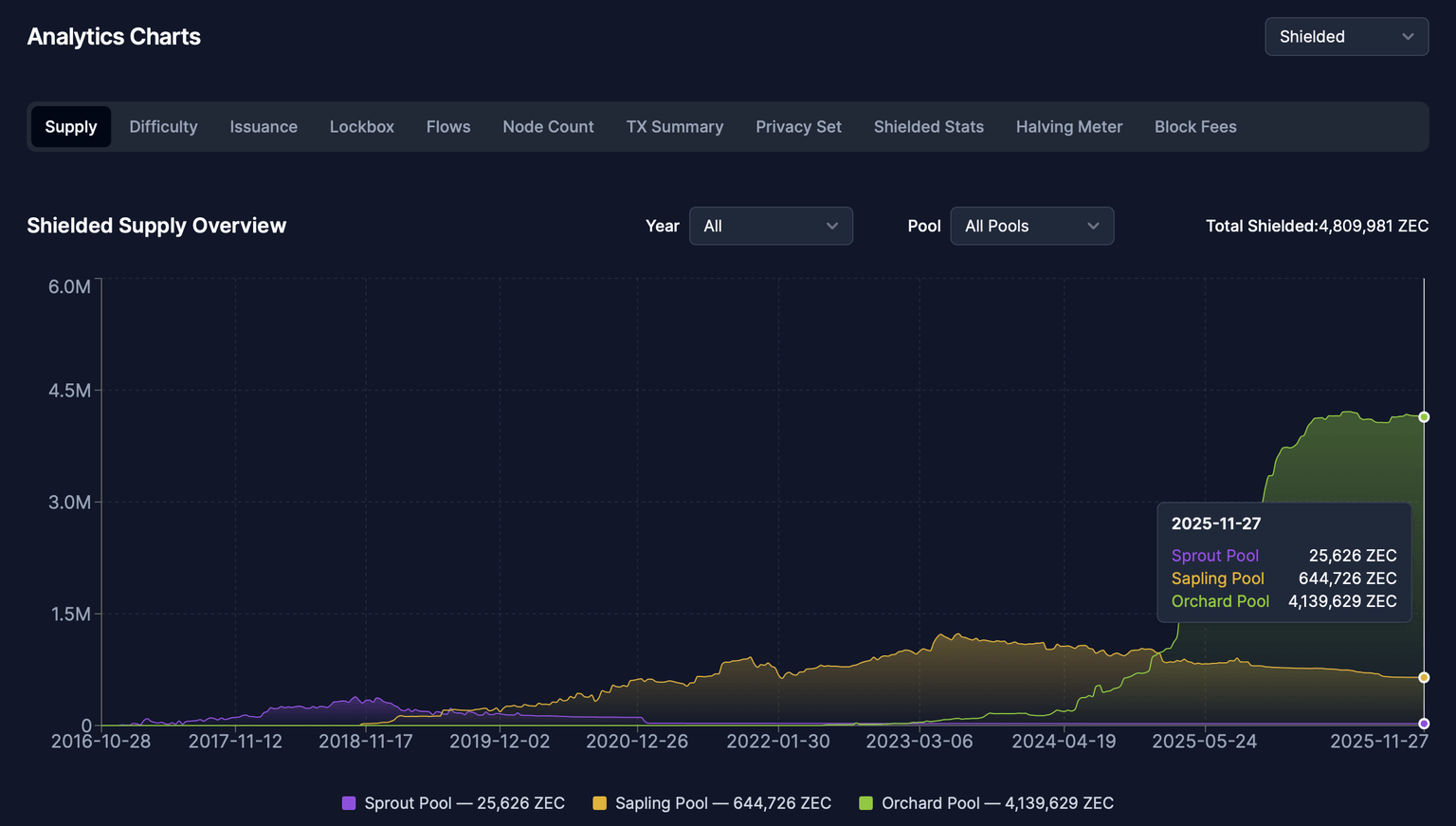
The surge in demand for ZEC as a privacy coin catalyzed the nearly 1000% rally between September and October. The ZECHUB data shows a significant increase in shielded ZEC tokens in the Orchard pool during the rally, effectively reducing supply and creating a positive feedback loop to increase demand.
However, the Orchard pool has plateaued after reaching a high of 4.21 million ZEC tokens on November 4, signaling reduced demand. If the plateau in Orchard pool extends, a lack of renewed demand could negatively affect ZEC prices. Meanwhile, the older pool, Sapling, is shrinking as users unshield their ZEC tokens.
Retail demand surge warns a sharp correction
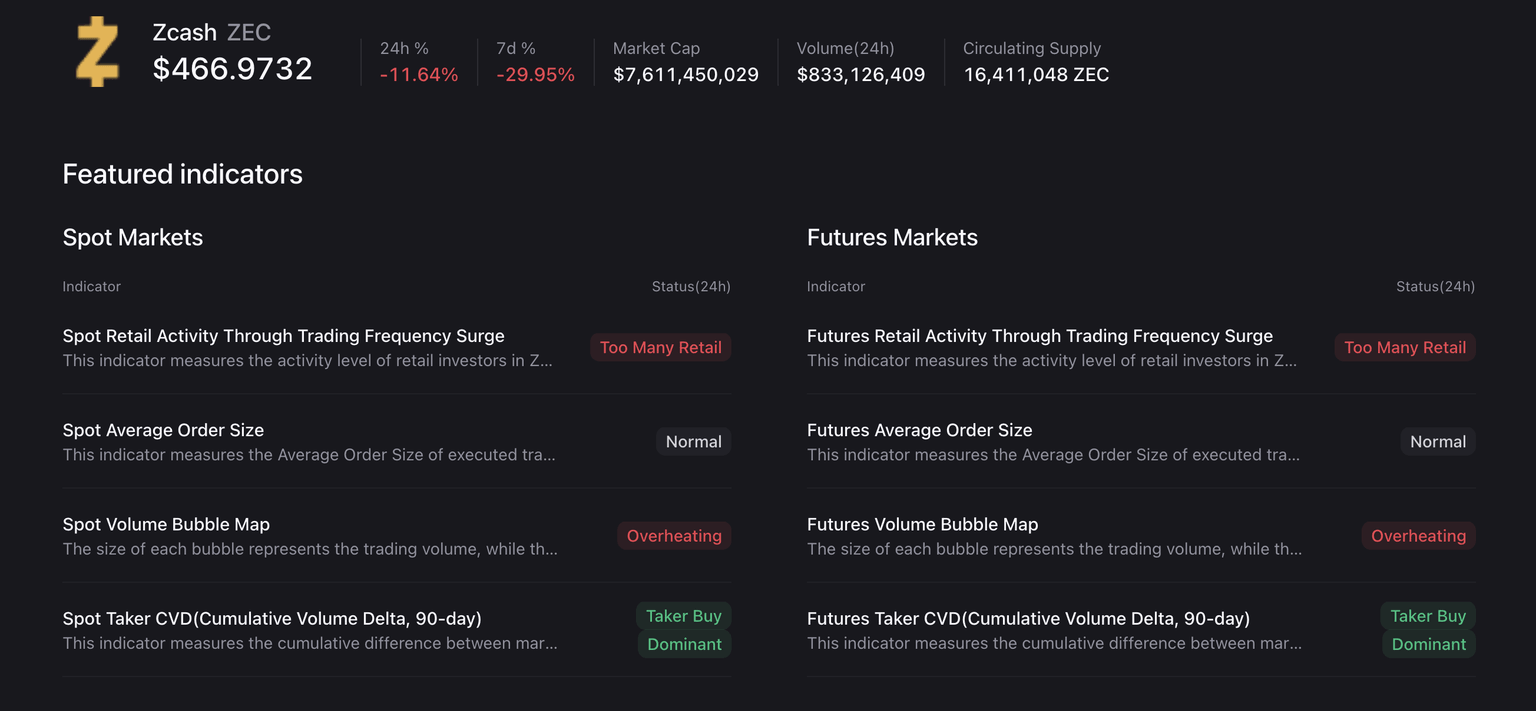
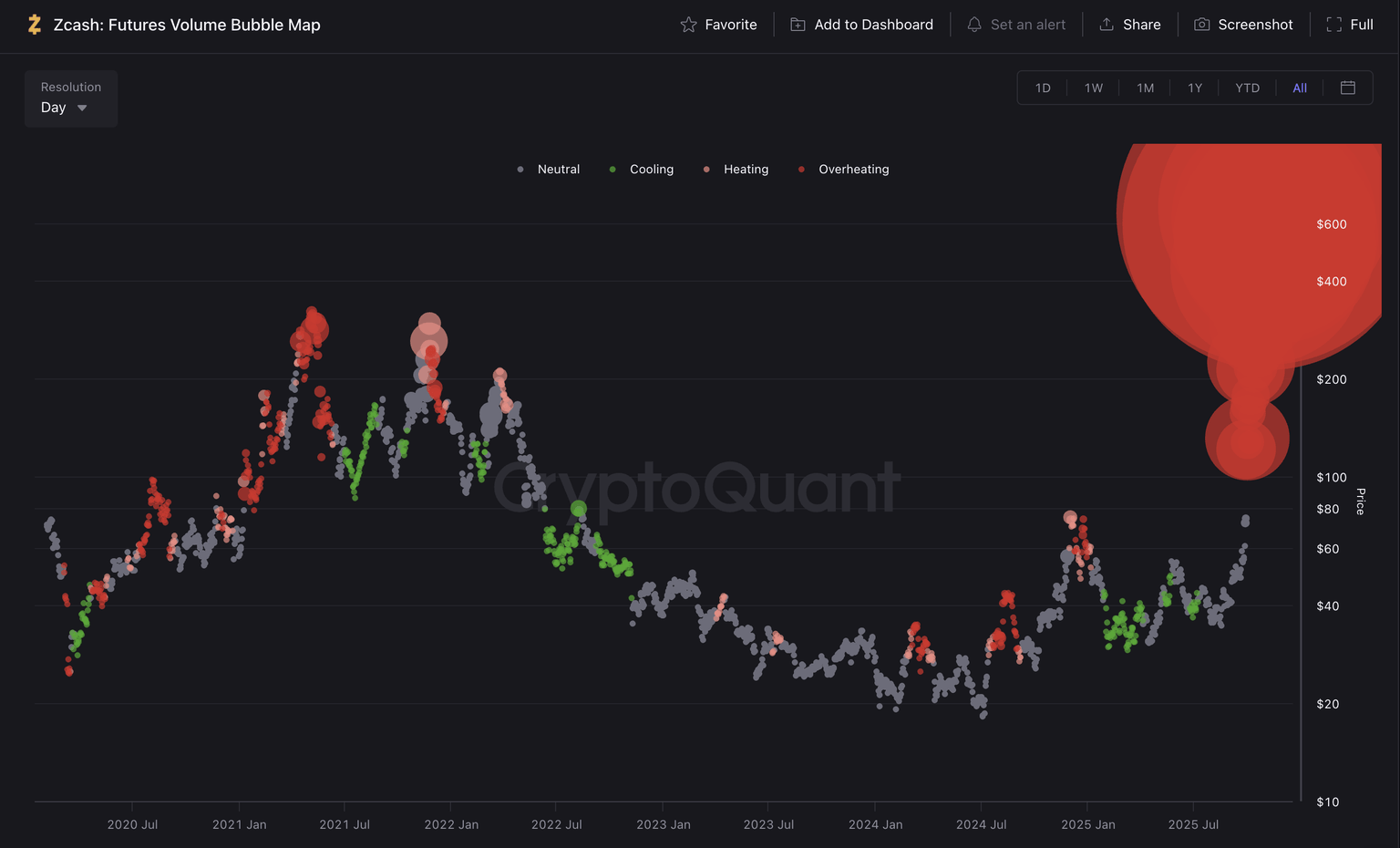
Despite a reduction in on-chain demand, retail demand for Zcash is growing stronger, which could allow smart investors to book profits. CryptoQuant’s data shows that the futures and spot markets are overheated by retail volume, leading to overcrowding in the acquisition of privacy coins.
Historically, a surge in retail activity often leads to sharp corrections in a crypto asset, previously seen during the May and November 2021 cycle tops.
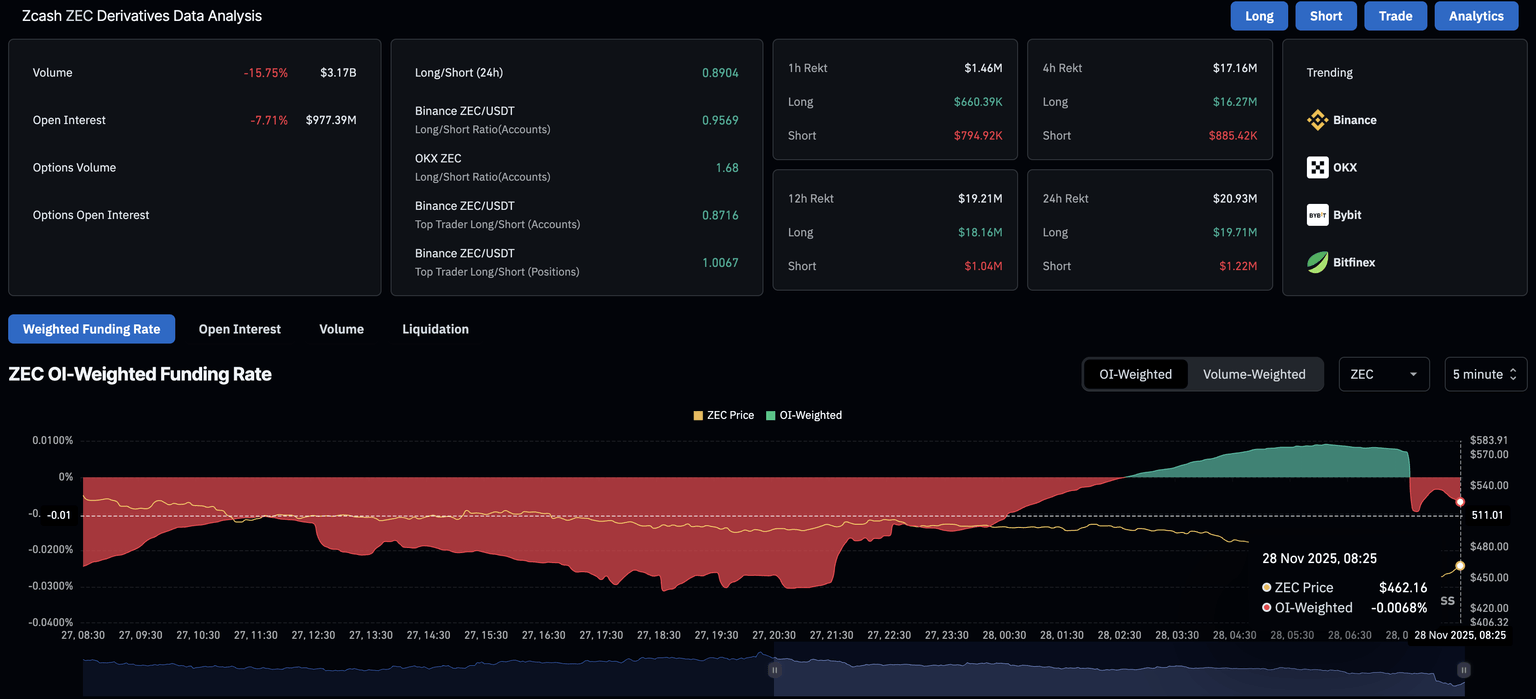
CoinGlass data shows that ZEC futures Open Interest (OI) is down 7.71% over the last 24 hours, to $977.39 million. A decline in futures OI for any asset suggests that traders are reducing capital at risk amid the possibility of a pullback or uncertain conditions.
Technical outlook: Zcash at crucial support risks a 30% drop
Zcash is extending the pullback below the $500 psychological level, approaching the 50-day Exponential Moving Average (EMA) at $436. The declining trend aligns with renewed selling pressure, as indicated by the Relative Strength Index (RSI) at 46 on the daily chart, which has crossed below the midline and is poised to move further on the downside before reaching the oversold zone.
Meanwhile, the Moving Average Convergence Divergence (MACD) and its signal line decline, approaching the zero line after a crossover on November 20. If the lines cross into the negative territory, it would confirm a bearish trend in motion.
If ZEC slips below the 50-day EMA at $436 on a successful daily close, it could extend the decline to the 100-day EMA retest at $315, which would represent an over 30% drop from the current market price.
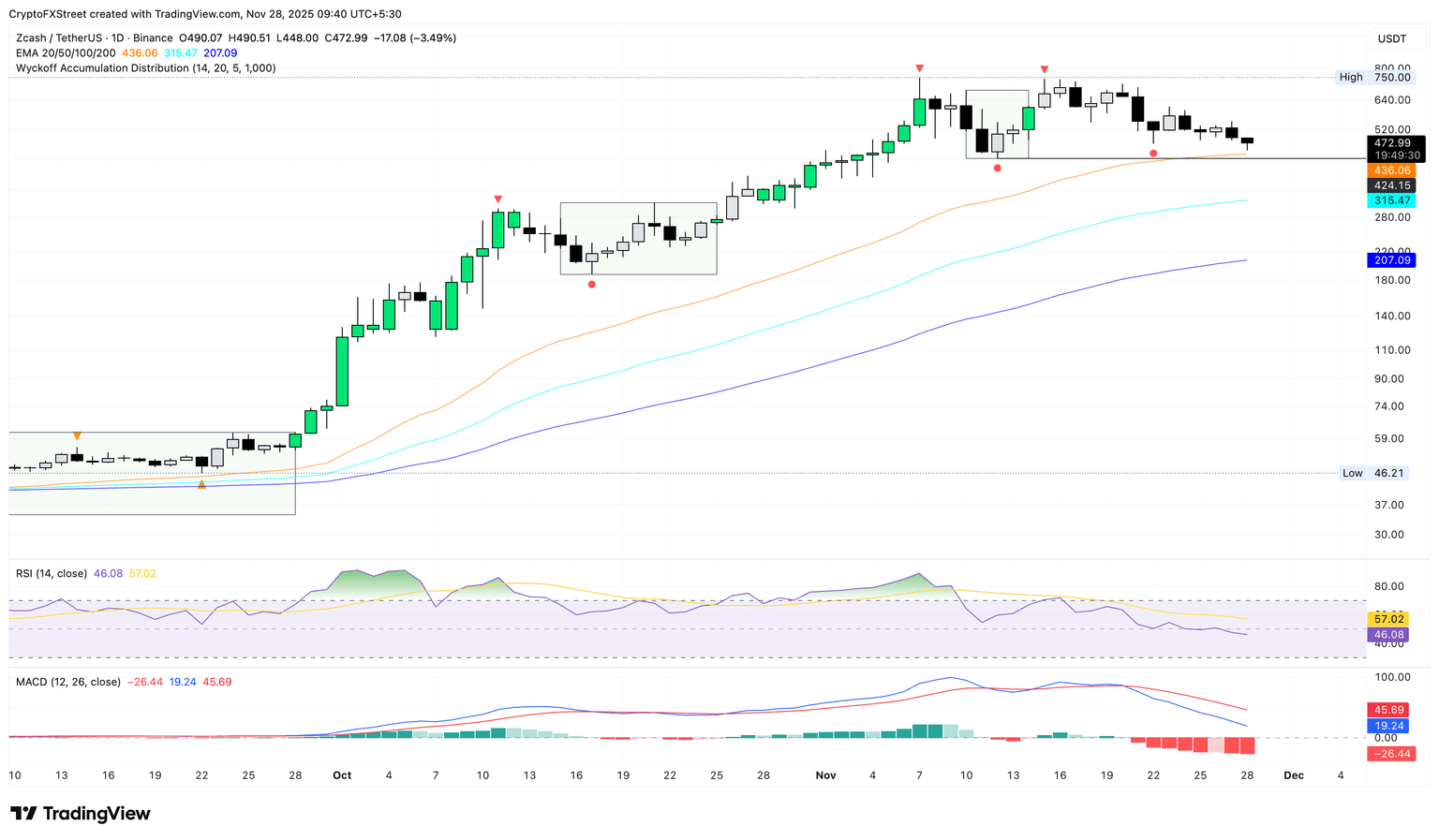
However, a bounce back in ZEC could reclaim the $500 mark, targeting the $600 round figure, followed by the $750 high from November 7.
Upbit hit with $37 million loss following Solana wallet breach

Crypto exchange Upbit suffered a $37 million hack after one of its Solana (SOL) wallets was compromised. The exchange halted withdrawals and deposits on its platform following the incident.
Upbit suffers $37 million hack via its Solana wallet
South Korea’s largest crypto exchange, Upbit, suffered a security breach that resulted in the loss of roughly 54 billion KRW, or $36.8 million, according to a Thursday statement.
The exchange suspended deposits and withdrawals shortly after detecting what it described as an abnormal outflow of assets on one of its wallets via the Solana network.
The affected assets span a wide range of Solana-based tokens, including meme coins such as Bonk (BONK), Moodeng (MOODENG), and Official Trump (TRUMP), as well as DeFi assets like Sonic SVM (SONIC), Access Protocol (ACS), Jito (JTO), Raydium (RAY) and native SOL.
Upbit outlined a series of immediate containment measures it followed in response to the breach. The exchange said it moved all digital assets into cold storage to block any further unauthorized transfers and began coordinating with law enforcement and blockchain partners to freeze compromised funds.
These efforts have so far led to the successful seizure of assets linked to the Solayer (LAYER) token valued at roughly 12 billion KRW. Upbit added that it has also initiated a comprehensive review of its digital asset transfer infrastructure to identify and address any vulnerabilities.
The exchange noted that withdrawal services will be restored gradually once all security checks are complete. It also encouraged customers to remain vigilant and report any unusual account activity to its support team.
“To prevent any damage to member assets, the entire amount will be covered by Upbit’s holdings,” Oh Kyung-seok, CEO of Dunamu, said in a statement.
The exchange reportedly revised its loss to around $30.43 million (44.5 billion KRW) tied to Solana-based assets, while the amount successfully frozen has been updated to approximately $1.57 million (2.3 billion KRW).
The incident has drawn the attention of South Korea’s Virtual Asset Supervision Bureau, which launched an immediate on-site inspection of Upbit, a review expected to continue through next Friday.
Upbit’s hack adds to a series of exploits on crypto exchanges this year. The incident is notable as it occurred a day after Naver Financial announced a $10.3 billion all-stock acquisition of Dunamu, Upbit’s parent company. The deal is expected to be completed in June 2026.