The Australian Dollar (AUD) prolongs a two-week-old uptrend against a broadly weaker US Dollar (USD) and climbs to its highest level since late October during the Asian session on Wednesday. Diminishing odds for more policy easing by the Reserve Bank of Australia (RBA) offset the disappointing Australian economic growth figures and turn out to be a key factor that continues to underpin the Aussie.
Apart from this, a generally positive tone around the equity markets acts as a tailwind for the risk-sensitive AUD, which seems unaffected by China’s unimpressive Services PMI. The USD, on the other hand, hangs near its lowest level in over two weeks amid bets that the Federal Reserve (Fed) will cut interest rates next week. This contributes to the bid tone surrounding the AUD/USD pair and favors bullish traders.
Australian Dollar buying remains unabated as RBA’s hawkish tilt offsets dismal Q3 GDP growth figures
- The Australian Bureau of Statistics reported this Wednesday that the economy grew by 0.4% during the July-September period, down from the 0.6% rise seen in the second quarter. The annual Gross Domestic Product growth rate stood at 2.1% compared to 1.8% in the previous quarter. Both the quarterly and the yearly print missed expectations, prompting some intraday selling around the Australian Dollar during the Asian session.
- Speaking before a parliamentary committee earlier today, Reserve Bank of Australia Governor Michele Bullock said that the central bank is looking very hard at recent inflation numbers to see if some of the price pressures are temporary. Bullock added that if inflation proves to be persistent, it would have implications for future monetary policy. This dampens hopes for more policy easing and lends support to the Aussie.
- In fact, Australia’s headline Consumer Price Index (CPI) accelerated from a 3.5% increase reported in the previous month to 3.8% YoY in October. Moreover, the RBA Trimmed Mean CPI rose 3.3% during the reported month from 3.2% in September. This indicated that inflation remains above the RBA’s 2% to 3% annual target and raises questions about just how much headroom the central bank has to cut rates further.
- The latest data published by RatingDog showed that China’s Services Purchasing Managers’ Index (PMI) dropped to 52.1 in November from 52.6 in October. This, however, was better than consensus estimates for a reading of 52 and does little to dent the underlying bullish sentiment surrounding the China-proxy AUD.
- The US Dollar hangs near its lowest level since November 14, touched on Monday, amid dovish Federal Reserve expectations, and contributes to limiting the downside for the AUD/USD pair. According to the CME Group’s FedWatch Tool, traders are pricing in a nearly 90% chance of a 25-basis-point rate cut on December 10. Moreover, speculations of a dovish pick for the next Fed Chair undermine the Greenback.
- Meanwhile, the prospects for lower US interest rates, along with hopes for a peace deal between Russia and Ukraine, remain supportive of a generally positive tone around the equity markets. This further dents the safe-haven buck and benefits the risk-sensitive Aussie. Traders now look to the release of the US ADP report on private-sector employment and the US ISM Services PMI for a fresh impetus.
- The market attention, however, will remain glued to the US Personal Consumption Expenditure (PCE) Price Index, due on Friday, which will be scrutinized for cues about the Fed’s future rate-cut path. This, in turn, will play a key role in influencing the USD and determining the next leg of a directional move for the AUD/USD pair. The fundamental backdrop, meanwhile, remains tilted in favor of bullish traders.
AUD/USD could accelerate the positive momentum once the 0.6600 mark is conquered
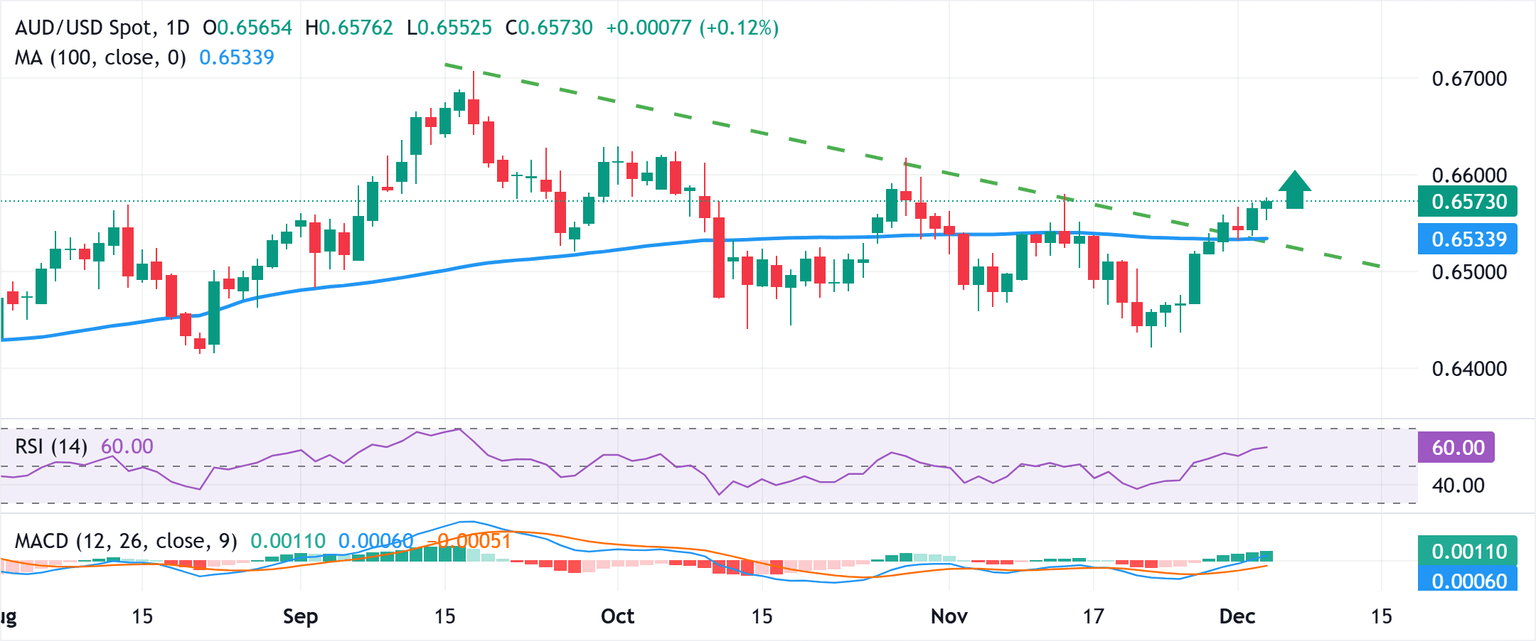
The recent breakout through a descending trend-line hurdle extending from the September swing high and acceptance above the 100-day Simple Moving Average (SMA) favors the AUD/USD bulls. Moreover, oscillators on the daily chart have been gaining positive traction and are still away from being in the overbought territory. This, in turn, validates the near-term positive outlook, suggesting that any corrective pullback could be seen as a buying opportunity near the aforementioned confluence resistance breakpoint, currently around the 0.6535-0.6530 region.
This is closely followed by the 0.6500 psychological mark. A convincing break below the latter could make the AUD/USD pair vulnerable to weaken further below the 200-day SMA, currently pegged near the 0.6465 zone, toward challenging a multi-month low, around the 0.6420 region, touched in November. Some follow-through selling, leading to a subsequent fall below the 0.6400 mark, will be seen as a fresh trigger for bearish traders and pave the way for deeper losses.
Nevertheless, the AUD/USD pair seems poised to prolong a two-week-old uptrend and aim to reclaim the 0.6600 mark, above which the momentum could extend further towards the next relevant hurdle near the 0.6660-0.6665 region. Spot prices could eventually climb to test the year-to-date high, levels just above the 0.6700 mark, touched in September.
RBA FAQs
The Reserve Bank of Australia (RBA) sets interest rates and manages monetary policy for Australia. Decisions are made by a board of governors at 11 meetings a year and ad hoc emergency meetings as required. The RBA’s primary mandate is to maintain price stability, which means an inflation rate of 2-3%, but also “..to contribute to the stability of the currency, full employment, and the economic prosperity and welfare of the Australian people.” Its main tool for achieving this is by raising or lowering interest rates. Relatively high interest rates will strengthen the Australian Dollar (AUD) and vice versa. Other RBA tools include quantitative easing and tightening.
While inflation had always traditionally been thought of as a negative factor for currencies since it lowers the value of money in general, the opposite has actually been the case in modern times with the relaxation of cross-border capital controls. Moderately higher inflation now tends to lead central banks to put up their interest rates, which in turn has the effect of attracting more capital inflows from global investors seeking a lucrative place to keep their money. This increases demand for the local currency, which in the case of Australia is the Aussie Dollar.
Macroeconomic data gauges the health of an economy and can have an impact on the value of its currency. Investors prefer to invest their capital in economies that are safe and growing rather than precarious and shrinking. Greater capital inflows increase the aggregate demand and value of the domestic currency. Classic indicators, such as GDP, Manufacturing and Services PMIs, employment, and consumer sentiment surveys can influence AUD. A strong economy may encourage the Reserve Bank of Australia to put up interest rates, also supporting AUD.
Quantitative Easing (QE) is a tool used in extreme situations when lowering interest rates is not enough to restore the flow of credit in the economy. QE is the process by which the Reserve Bank of Australia (RBA) prints Australian Dollars (AUD) for the purpose of buying assets – usually government or corporate bonds – from financial institutions, thereby providing them with much-needed liquidity. QE usually results in a weaker AUD.
Quantitative tightening (QT) is the reverse of QE. It is undertaken after QE when an economic recovery is underway and inflation starts rising. Whilst in QE the Reserve Bank of Australia (RBA) purchases government and corporate bonds from financial institutions to provide them with liquidity, in QT the RBA stops buying more assets, and stops reinvesting the principal maturing on the bonds it already holds. It would be positive (or bullish) for the Australian Dollar.