Australia will release the August monthly employment report on Thursday at 01:30 GMT. Ahead of the announcement, analysts expect the country to have added 20K new jobs in the month, while the Unemployment Rate is expected to remain steady at 4.5%. The Australian Bureau of Statistics (ABS) report is also expected to show that the Participation Rate stood at 66.9%, unchanged from the previous month.
ABS separately reports full-time and part-time positions through the monthly Employment Change. Generally speaking, full-time jobs entail working 38 hours or more per week, usually include additional benefits, and typically provide a consistent income. On the other hand, part-time employment generally means higher hourly rates but lacks consistency and benefits. That’s why the economy prefers full-time jobs. In July, Australia lost 32.2K part-time positions and added a modest 16.3K full-time ones.
Australian unemployment rate seen steady in August
The anticipated figures are a modest improvement from the discouraging data posted in July, yet once again, the employment report is unlikely to have a relevant, sustainable effect on the Australian Dollar (AUD).
Employment data will come a week ahead of the Reserve Bank of Australia (RBA) monetary policy meeting. When policymakers met in August, the Board left the Official Cash Rate (OCR) unchanged at 4.35%, citing a softer-than-anticipated impact of the Middle East conflict on inflation. Officials, however, expressed continued concerns, clarifying that “headline inflation is still too high.”
Regarding employment, however, concerns are less: “Labour market conditions have eased by a little more than expected in recent months. Labour market leading indicators point to only limited easing in the near term.”
The Board mandate is to deliver price stability and full employment, yet it remains focused on “ensuring that high inflation does not become embedded,” according to the RBA’s monetary policy statement, which means employment figures have little to no chance of shaping the upcoming central bank decision.
Meanwhile, the US Dollar (USD) trades with a firmer tone across the FX board, pushing AUD/USD to one-month lows below the 0.7100 mark. The Greenback surged amid hawkish comments from Federal Reserve (Fed) officials, and despite hopes for de-escalation in the Middle East.
The Fed pulled the trigger at its early September meeting, hiking the benchmark rate for the first time in three years, now floating in a 3.75%–4.00% range. The widely anticipated move still pushed the Greenback higher, as investors remained uncertain whether policymakers would dare to challenge US President Donald Trump’s wishes for lower rates. Now that they opened the door, market players continue to price in additional hikes before year-end.
Regarding the Middle East war, hopes surged after Iran declared that it could reopen the Strait of Hormuz in a matter of days if the United States (US) eases military pressure and lifts its blockade on Iranian ports. Talks seem to be on between the two countries, boosting expectations of a soon-to-come resolution.
Back to the Australian employment data release, the anticipated figures are expected to have a positive, yet temporary impact. A much better-than-anticipated outcome could spur near-term AUD demand, but whether the currency can sustain those gains will depend on risk sentiment and the current strength of the US Dollar (USD).
When will the Australian employment report be released and how could it affect AUD/USD?
The ABS August employment report will be released early on Thursday. As previously noted, the Australian economy is expected to have added 20K new jobs in the month, while the Unemployment Rate is forecast at 4.5%. Market participants will also watch the breakdown of full-time and part-time positions.
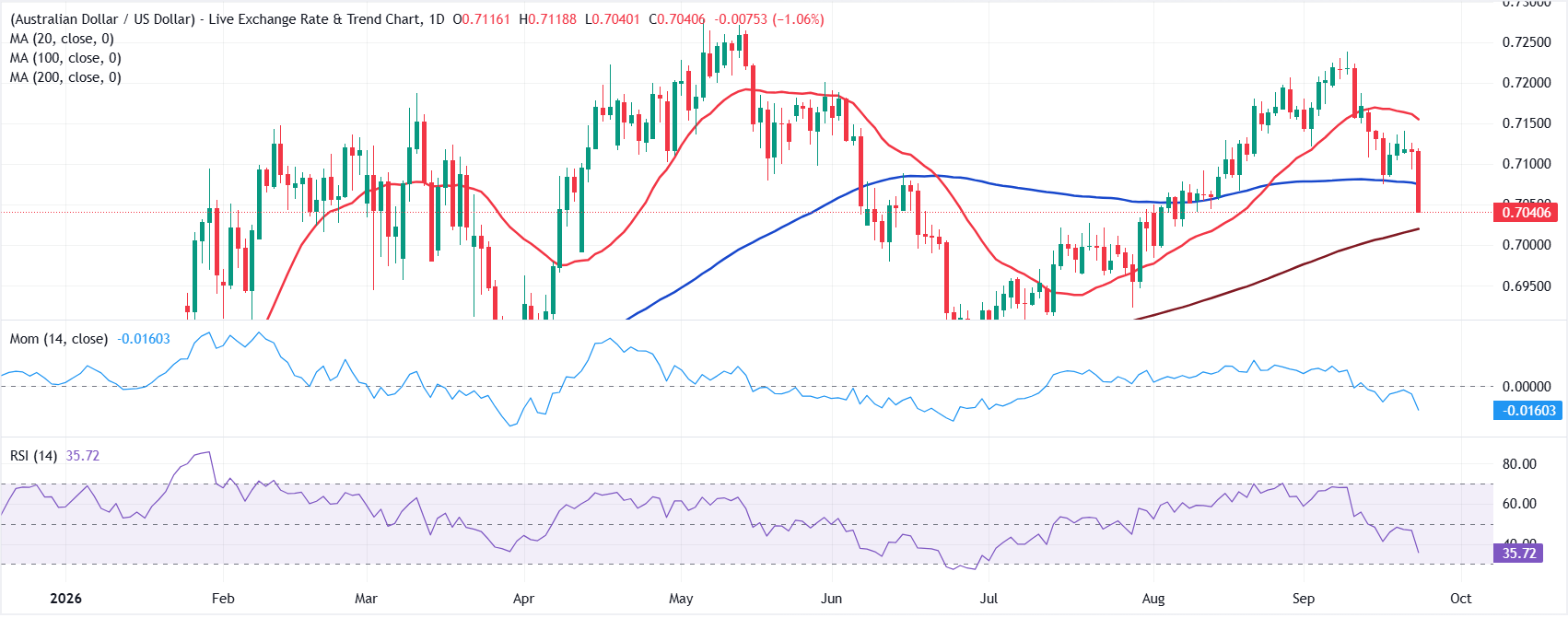
Valeria Bednarik, Chief Analyst at FXStreet, notes: “The AUD/USD pair trades around the 0.7050 region ahead of the announcement, with a clear bearish bias amid persistent USD demand. The pair is currently piercing its 100-day Simple Moving Average (SMA), which slowly turns south, reflecting continued selling interest. AUD/USD is also far below a bearish 20-day SMA currently at around 0.7160. Technical indicators, in the meantime, have turned sharply lower within negative levels, also in line with mounting selling pressure and hinting at lower lows ahead.”
Bednarik adds: “The risk of additional declines will increase if the pair breaks below the 0.7030 level, an immediate support area, while the next relevant hurdle comes at 0.6970. The first line of sellers is located at 0.7100, followed by a stronger one in the 0.7130 region.”
RBA FAQs
The Reserve Bank of Australia (RBA) sets interest rates and manages monetary policy for Australia. Decisions are made by a board of governors at 11 meetings a year and ad hoc emergency meetings as required. The RBA’s primary mandate is to maintain price stability, which means an inflation rate of 2-3%, but also “..to contribute to the stability of the currency, full employment, and the economic prosperity and welfare of the Australian people.” Its main tool for achieving this is by raising or lowering interest rates. Relatively high interest rates will strengthen the Australian Dollar (AUD) and vice versa. Other RBA tools include quantitative easing and tightening.
While inflation had always traditionally been thought of as a negative factor for currencies since it lowers the value of money in general, the opposite has actually been the case in modern times with the relaxation of cross-border capital controls. Moderately higher inflation now tends to lead central banks to put up their interest rates, which in turn has the effect of attracting more capital inflows from global investors seeking a lucrative place to keep their money. This increases demand for the local currency, which in the case of Australia is the Aussie Dollar.
Macroeconomic data gauges the health of an economy and can have an impact on the value of its currency. Investors prefer to invest their capital in economies that are safe and growing rather than precarious and shrinking. Greater capital inflows increase the aggregate demand and value of the domestic currency. Classic indicators, such as GDP, Manufacturing and Services PMIs, employment, and consumer sentiment surveys can influence AUD. A strong economy may encourage the Reserve Bank of Australia to put up interest rates, also supporting AUD.
Quantitative Easing (QE) is a tool used in extreme situations when lowering interest rates is not enough to restore the flow of credit in the economy. QE is the process by which the Reserve Bank of Australia (RBA) prints Australian Dollars (AUD) for the purpose of buying assets – usually government or corporate bonds – from financial institutions, thereby providing them with much-needed liquidity. QE usually results in a weaker AUD.
Quantitative tightening (QT) is the reverse of QE. It is undertaken after QE when an economic recovery is underway and inflation starts rising. Whilst in QE the Reserve Bank of Australia (RBA) purchases government and corporate bonds from financial institutions to provide them with liquidity, in QT the RBA stops buying more assets, and stops reinvesting the principal maturing on the bonds it already holds. It would be positive (or bullish) for the Australian Dollar.
Economic Indicator
Employment Change s.a.
The Employment Change released by the Australian Bureau of Statistics is a measure of the change in the number of employed people in Australia. The statistic is adjusted to remove the influence of seasonal trends. Generally speaking, a rise in Employment Change has positive implications for consumer spending, stimulates economic growth, and is bullish for the Australian Dollar (AUD). A low reading, on the other hand, is seen as bearish.