The US Bureau of Labor Statistics (BLS) will publish the October Consumer Price Index (CPI) data on Tuesday, a release that could influence the US Dollar (USD) valuation as investors reassess the Federal Reserve’s (Fed) interest-rate outlook.

The report won’t include 12-month percentage changes for most CPI series in this release, due to missing October 2025 monthly data because of the lack of collection during the government shutdown from October 1, 2025, to November 12, 2025.
“For most CPI series, BLS could not publish October 2025 indexes. As a result, BLS will not publish 12-month percent changes for October 2026 for indexes where October 2025 data are not available,” the BLS noted in a press release.
On a monthly basis, headline CPI is forecast to rise 0.3% following the 0.6% increase recorded in September, while the core CPI is seen increasing 0.2%, compared to 0.3% in the previous month.
Economists at Deutsche Bank see a clear moderation in the upcoming US inflation data. They note that “headline CPI [is] to rise by 0.20% month-on-month, down from 0.65% previously, with core CPI also up 0.20% after 0.33% last time.” Despite the anticipated softer prints, the bank’s team “continue[s] to expect 25bp rate increases at the December and March FOMC meetings, absent a further material tightening in financial conditions.”
How could the US Consumer Price Index report affect EUR/USD?
According to the CME FedWatch Tool, markets currently see about an 80% chance of the Federal Reserve (Fed) raising the policy rate by another 25 basis points (bps) at the last meeting of the year.
Speaking at a news conference after the Fed’s decision to leave interest rates unchanged at a range of 3.75%-4.00% in October, Fed Chair Kevin Warsh described labor market conditions as “positive,” and added that the discussion among policymakers is focused mainly on the price stability mandate. The October employment report confirmed a robust labor market, with Nonfarm Payrolls (NFP) rising by 165K and the Unemployment Rate declining to 4.1% despite an uptick in the Labor Force Participation Rate.
In the meantime, crude Oil prices declined sharply last week as markets grew optimistic about a diplomatic resolution to the conflict in the Middle East following the Republicans’ defeat in the midterm elections. Although this recent fall won’t be reflected in October inflation figures, a notable downward surprise in the monthly CPI, with a print of 0.1% or lower, combined with an extended slide in energy prices could cause market participants to refrain from pricing in a rate hike in December. In this scenario, the US Dollar (USD) could come under sudden selling pressure and help EUR/USD gather bullish momentum in the near term.
Conversely, a reading at or above market expectations, coupled with a lack of progress in ceasefire negotiations with Iran, could reinforce an increase in interest rates next month. However, the market positioning suggests that the USD’s upside potential could remain limited in this scenario, paving the way for a short-lasting bearish reaction in EUR/USD.
At the same time, the action in stock markets could further influence the USD’s valuation and impact EUR/USD’s performance. An extended selloff in technology stocks could support the USD and cap EUR/USD gains even if inflation data arrive soft and reinforce a cautious Fed policy-tightening path.
Strategists at ING argue that the recent US Dollar strength is heavily contingent on risk sentiment, noting that “we think the dollar rally requires the risk-off mood to persist this week.” They caution that “Friday’s move looked a bit too stretched relative to short-term market drivers,” leaving “some moderate correction risk” if market nerves ease. Even so, ING believes the broader backdrop remains Dollar-supportive, with the “macro story”
“We expect tomorrow’s October US CPI to come in at 0.3% month-on-month for both headline (consensus 0.3%) and core (0.3%),” they add and note that such an outcome “should help cement expectations for a December Fed hike (19bp priced in), making the swap curve more protected from other equity market shocks.”
Eren Sengezer, European Session Lead Analyst, shares a brief technical outlook for EUR/USD:
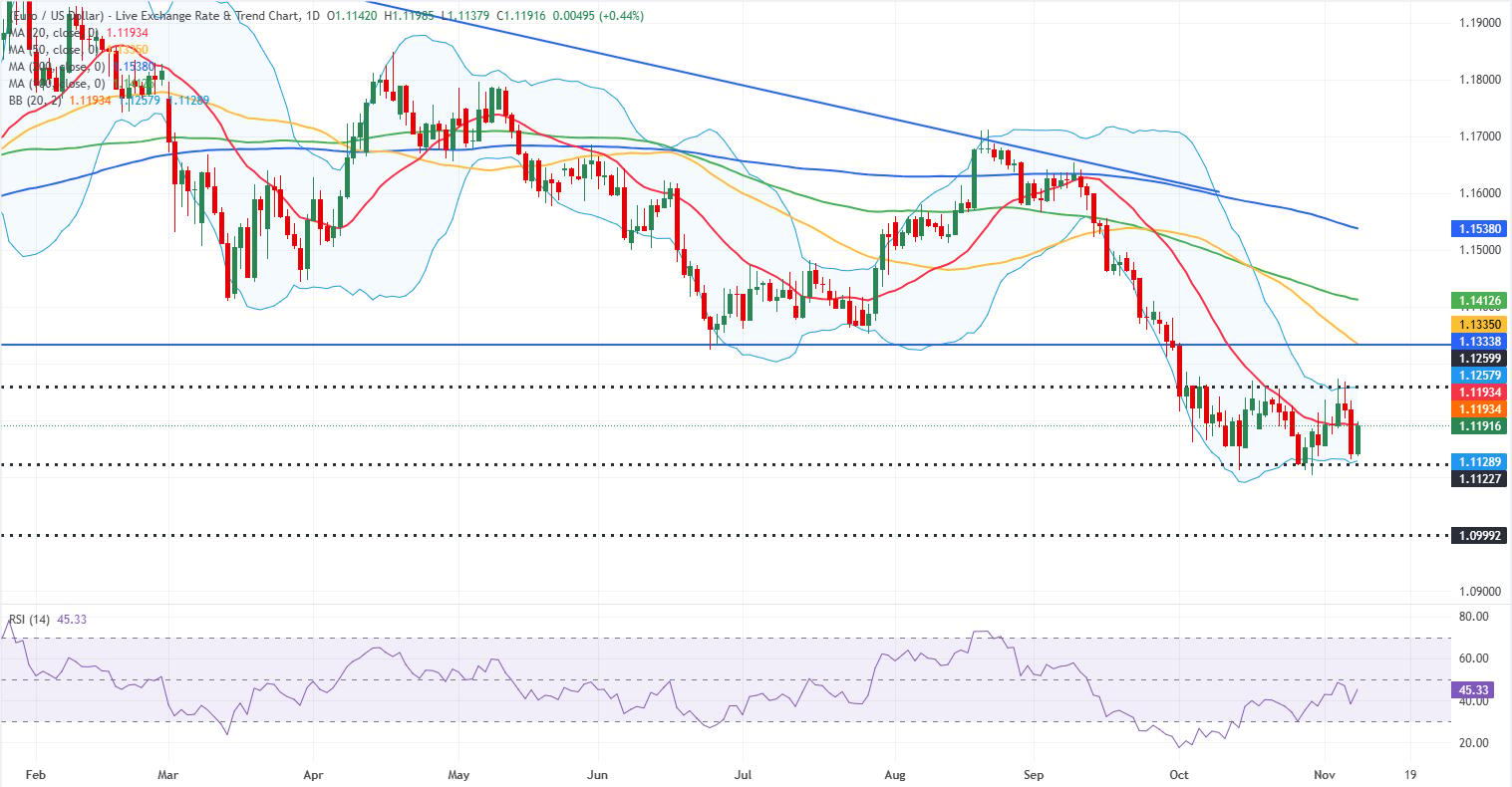
“The EUR/USD pair has been moving in a relatively narrow channel since the beginning of October. During last week’s post-midterm elections rally, the Relative Strength Index (RSI) indicator on the daily chart recovered toward 50 but failed to clear this level, highlighting buyers’ hesitancy.”
“On the upside, 1.1260 (upper arm of the Bollinger Bands, static level) aligns as the first resistance level ahead of 1.1335 (50-day Simple Moving Average (SMA), static level) and 1.1410 (100-day SMA). Looking south, the first support level could be spotted at 1.1130 (lower arm of the Bollinger Bands, static level). If this support fails and gets confirmed as resistance, technical sellers could take action and open the door for an extended drop toward 1.1000 (static level, round level).”
Fed FAQs
Monetary policy in the US is shaped by the Federal Reserve (Fed). The Fed has two mandates: to achieve price stability and foster full employment. Its primary tool to achieve these goals is by adjusting interest rates.
When prices are rising too quickly and inflation is above the Fed’s 2% target, it raises interest rates, increasing borrowing costs throughout the economy. This results in a stronger US Dollar (USD) as it makes the US a more attractive place for international investors to park their money.
When inflation falls below 2% or the Unemployment Rate is too high, the Fed may lower interest rates to encourage borrowing, which weighs on the Greenback.
The Federal Reserve (Fed) holds eight policy meetings a year, where the Federal Open Market Committee (FOMC) assesses economic conditions and makes monetary policy decisions.
The FOMC is attended by twelve Fed officials – the seven members of the Board of Governors, the president of the Federal Reserve Bank of New York, and four of the remaining eleven regional Reserve Bank presidents, who serve one-year terms on a rotating basis.
In extreme situations, the Federal Reserve may resort to a policy named Quantitative Easing (QE). QE is the process by which the Fed substantially increases the flow of credit in a stuck financial system.
It is a non-standard policy measure used during crises or when inflation is extremely low. It was the Fed’s weapon of choice during the Great Financial Crisis in 2008. It involves the Fed printing more Dollars and using them to buy high grade bonds from financial institutions. QE usually weakens the US Dollar.
Quantitative tightening (QT) is the reverse process of QE, whereby the Federal Reserve stops buying bonds from financial institutions and does not reinvest the principal from the bonds it holds maturing, to purchase new bonds. It is usually positive for the value of the US Dollar.