EUR/USD shows moderate losses heading into the European midday, trading near 1.1585 after rejection above 1.1600 earlier on Thursday. Eurozone Consumer Confidence data has failed to surprisinvestors although market confidence that the Federal Reserve will ease its monetary policy further over the coming months is keeping US Dollar, bulls in check.
Economic data released on Wednesday revealed a larger-than-expected increase in US Durable Goods Orders and a decline in weekly Initial Jobless Claims, but that did not alter the view that the US central bank will cut rates by 25 basis points after their December meeting.
Beyond that, rumours that White House National Economic Council Director Kevin Hassett – an open dove – will replace Jerome Powell as Fed Chair after the end of his term in May, cement hopes that the bank will cut rates at least two or three more times in 2026.
Trading volumes are expected to remain subdued on Thursday, with US markets closed for the Thanksgiving bank holiday. In Europe, the minutes of the European Central Bank’s (ECB) latest monetary policy meeting might provide some guidance to the Euro (EUR).
Euro Price Today
The table below shows the percentage change of Euro (EUR) against listed major currencies today. Euro was the strongest against the British Pound.
| USD | EUR | GBP | JPY | CAD | AUD | NZD | CHF | |
|---|---|---|---|---|---|---|---|---|
| USD | 0.14% | 0.18% | -0.05% | 0.01% | -0.11% | -0.37% | 0.15% | |
| EUR | -0.14% | 0.04% | -0.18% | -0.13% | -0.24% | -0.51% | 0.00% | |
| GBP | -0.18% | -0.04% | -0.23% | -0.17% | -0.28% | -0.55% | -0.03% | |
| JPY | 0.05% | 0.18% | 0.23% | 0.03% | -0.07% | -0.36% | 0.19% | |
| CAD | -0.01% | 0.13% | 0.17% | -0.03% | -0.10% | -0.36% | 0.14% | |
| AUD | 0.11% | 0.24% | 0.28% | 0.07% | 0.10% | -0.27% | 0.25% | |
| NZD | 0.37% | 0.51% | 0.55% | 0.36% | 0.36% | 0.27% | 0.52% | |
| CHF | -0.15% | -0.01% | 0.03% | -0.19% | -0.14% | -0.25% | -0.52% |
The heat map shows percentage changes of major currencies against each other. The base currency is picked from the left column, while the quote currency is picked from the top row. For example, if you pick the Euro from the left column and move along the horizontal line to the US Dollar, the percentage change displayed in the box will represent EUR (base)/USD (quote).
Monetary policy divergence keeps weighing on the US Dollar rallies
- While most of the world’s major central banks are at the end of their easing cycles, the Fed is widely expected to cut interest rates by at least a full point in the next 12 months. Unless this context changes radically, prospects of a lower yield are likely to weigh heavily on speculative demand for the US Dollar.
- Data from the European Commission released earlier on Thursday confirmed that Consumer Confidence remained at -14.2 in November, unchanged from the previous month. Industrial Confidence deteriorated further, to a reading of -9.3 from -8.5 in the previous month, while the Services Sentiment improved to 5.7 in November, from 4.2 in October.
- Earlier in the day, December’s German GfK Consumer Confidence Survey showed a moderate improvement to -23.2, from -24.1 in November. The impact on the Euro, however, has been marginal.
- On Wednesday, US Durable Goods Orders data showed a 0.5% growth in September, following an upwardly revised 3% growth in August, and beating expectations of a 0.3% increase. Excluding transportation, orders for all other products grew 0.6%, higher than the 0.2% market consensus.
- Apart from that, weekly US Initial Jobless Claims declined to a seven-month low of 216,000 in the week of November 22, from 222,000 in the previous week, against expectations of a moderate increase to 225,000 claims.
- Later in the day, the ECB will release the minutes of its October 30 monetary policy meeting, when the central bank’s committee agreed to keep its benchmark interest rate unchanged at the 2.0% level.
Technical Analysis: EUR/USD met resistance above 1.1600
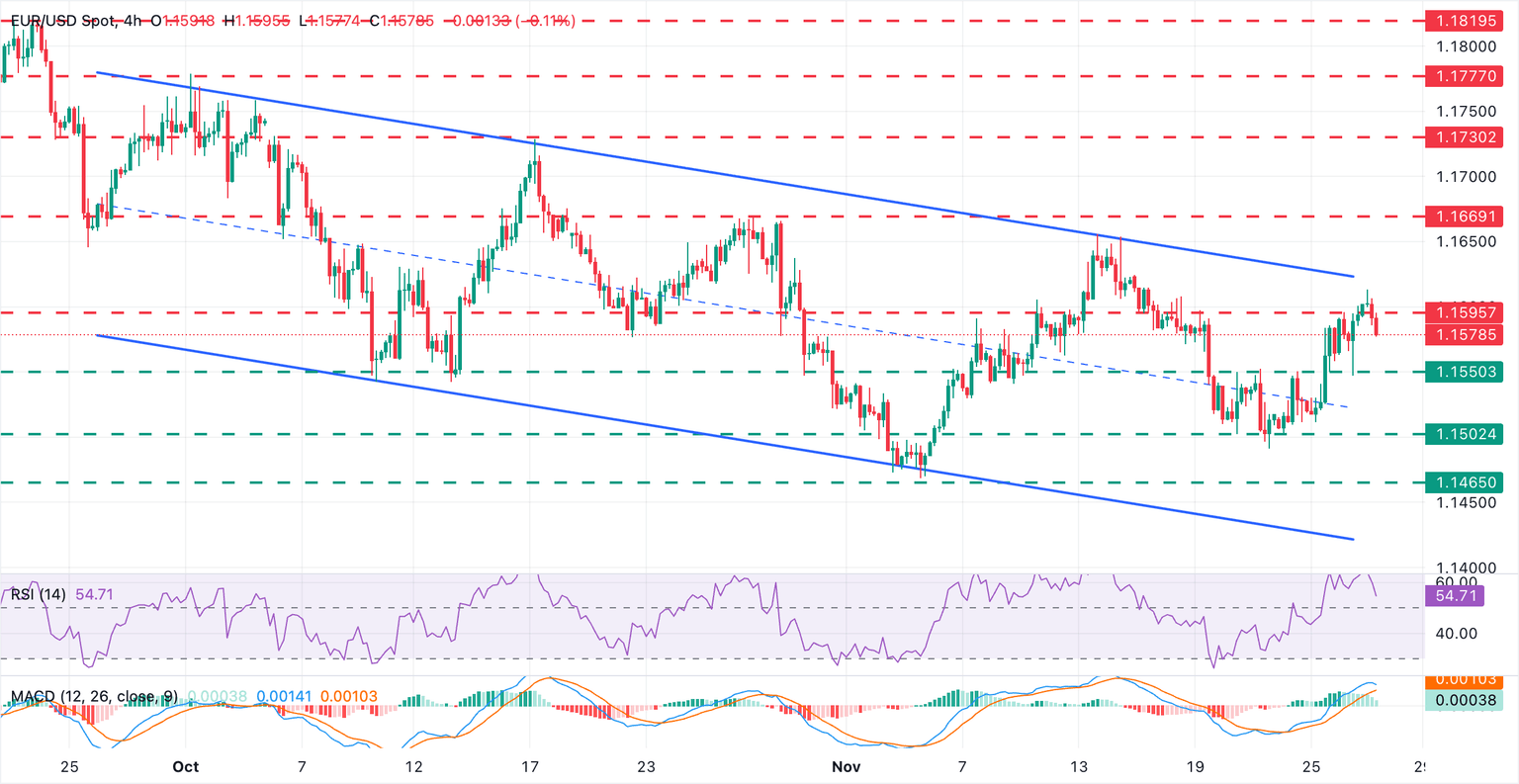
The EUR/USD pair is on a bullish trend from the 1.1500 area, but the top of the descending channel from early October highs, now around 1.1620, is likely to pose a significant resistance for Euro bulls.
Technical indicators are positive, the 4-hour Relative Strength Index (RSI) is trading near the 60 level, and the Moving Average Convergence Divergence (MACD) keeps trending higher above the zero line. Bulls, however, will have to breach trendline resistance above the mentioned 1.1620 to confirm a trend shift and aim towards the October 28 and 29 highs, near 1.1670, and the October 17 high, near 1.1730.
On the downside, immediate support is at the previous resistance level of 1.1550 (around November 21 and 24 highs). Further down, the 1.1500 psychological level and the November 5 lows, near 1.1470, will provide support before the channel bottom, now around 1.1420.
Economic Indicator
Consumer Confidence
The Consumer Confidence released by the European Commission is a leading index that measures the level of consumer confidence in economic activity. A high level of consumer confidence stimulates economic expansion while a low level drives to economic downturn. A high reading is seen as positive (or bullish) for the EUR, while a low reading is seen as negative (or bearish).
Last release: Thu Nov 27, 2025 10:00
Frequency: Monthly
Actual: -14.2
Consensus: -14.2
Previous: -14.2
Source: European Commission
Economic Indicator
Industrial Confidence
The Industrial Confidence released by the European Commission is an index that measures the level of industrial executives confidence in economic activity. The survey asks about orders and buildup of inventories. A high level of industrial confidence stimulates economic expansion while a low level drives to economic downturn. A high reading is seen as positive (or bullish) for the EUR, while a low reading is seen as negative (or bearish).
Last release: Thu Nov 27, 2025 10:00
Frequency: Monthly
Actual: -9.3
Consensus: -8
Previous: -8.2
Source: European Commission
Economic Indicator
Services Sentiment
Services sentiment indicator, released by European Comission, measures business sentiment in the services sector. The figure is derived from a survey asking firms in the service sector about current and expected demand. Since the service sector accounts for roughly two thirds of total Euro-zone GDP, Services Confidence provides an important confirmation of the health for the overall economy. High levels of Services Confidence suggest future upward trends for production and employment. The figure is determined by the difference between positive and negative answers. Therefore a headline above zero indicates positive service sector confidence, while a negative number shows negative confidence.
Last release: Thu Nov 27, 2025 10:00
Frequency: Monthly
Actual: 5.7
Consensus: 4.4
Previous: 4
Source: European Commission