The Japanese Yen (JPY) remains on the front foot through the Asian session on Wednesday in the wake of Japan’s Corporate Goods Price Index, which exceeded expectations and reaffirmed bets for an imminent rate hike by the Bank of Japan (BoJ). This marks a significant divergence in comparison to dovish US Federal Reserve (Fed) expectations, which prompts fresh US Dollar (USD) selling and benefits the lower-yielding JPY. Apart from this, the cautious market mood assists the safe-haven JPY to snap a three-day losing streak against its American counterpart and recover slightly from a two-week low, touched on Tuesday.
However, concerns about expansionary fiscal measures in Japan and growth worries might hold back the JPY bulls from placing aggressive bets. Investors also seem reluctant and opt to wait for the outcome of a two-day FOMC meeting later today for more cues about the central bank’s future rate-cut path. In the meantime, firming expectations for further policy easing by the Fed keep the US Dollar (USD) depressed near its lowest level since late October and act as a headwind for the USD/JPY pair. That said, it will be prudent to wait for the strong follow-through selling before confirming that the currency pair has topped out.
Japanese Yen draws some support from hawkish BoJ expectations; lacks bullish conviction
- Data published by the Bank of Japan on Wednesday showed that the Corporate Goods Price Index rose 2.7% YoY in October, down slightly from 2.8% in the previous month. The data, although it was in line with consensus estimates, indicated that inflation in Japan remains well above the historic levels.
- Moreover, BoJ Governor Kazuo Ueda reiterated on Tuesday that the likelihood of the central bank’s baseline economic and price outlook materialising had been gradually increasing. This backs the case for further BoJ policy normalization and offers some support to the Japanese Yen during the Asian session.
- Ueda added that the BoJ plans to ramp up government bond buying if long-term interest rates rise sharply. In fact, the yield on the benchmark 10-year Japanese government bond touched an 18-year high this week on the back of Japanese Prime Minister Sanae Takaichi’s big spending plans to boost sluggish growth.
- Japan’s revised Gross Domestic Product report released this week revealed that the economy shrank 0.6% in the third quarter compared with initial estimate of 0.4%. On a yearly basis, the economy contracted by 2.3%, or its fasted pace since Q3 2023, vs a fall of a 2.0% expected and 1.8% reported originally.
- Nevertheless, traders are still pricing in over a 75% chance that the BoJ will raise interest rates at its upcoming policy meeting on December 18-19. This marks a significant divergence in comparison to expectations for further policy easing by the US Federal Reserve and benefits the lower-yielding JPY.
- The US central bank is expected to lower borrowing costs by 25 basis points at the end of a two-day policy meeting later today. Hence, traders will scrutinize updated economic projections and Fed Chair Jerome Powell’s comments during the post-meeting presser for more cues about the future rate-cut path.
- The outlook will play a key role in influencing the near-term US Dollar price dynamics and provide some meaningful impetus to the USD/JPY pair. The market attention will then shift to the BoJ policy meeting next week, which should help determine the next leg of a directional move for the currency pair.
USD/JPY downside seems cushioned; Tuesday’s breakout above 155.30 confluence remains in play
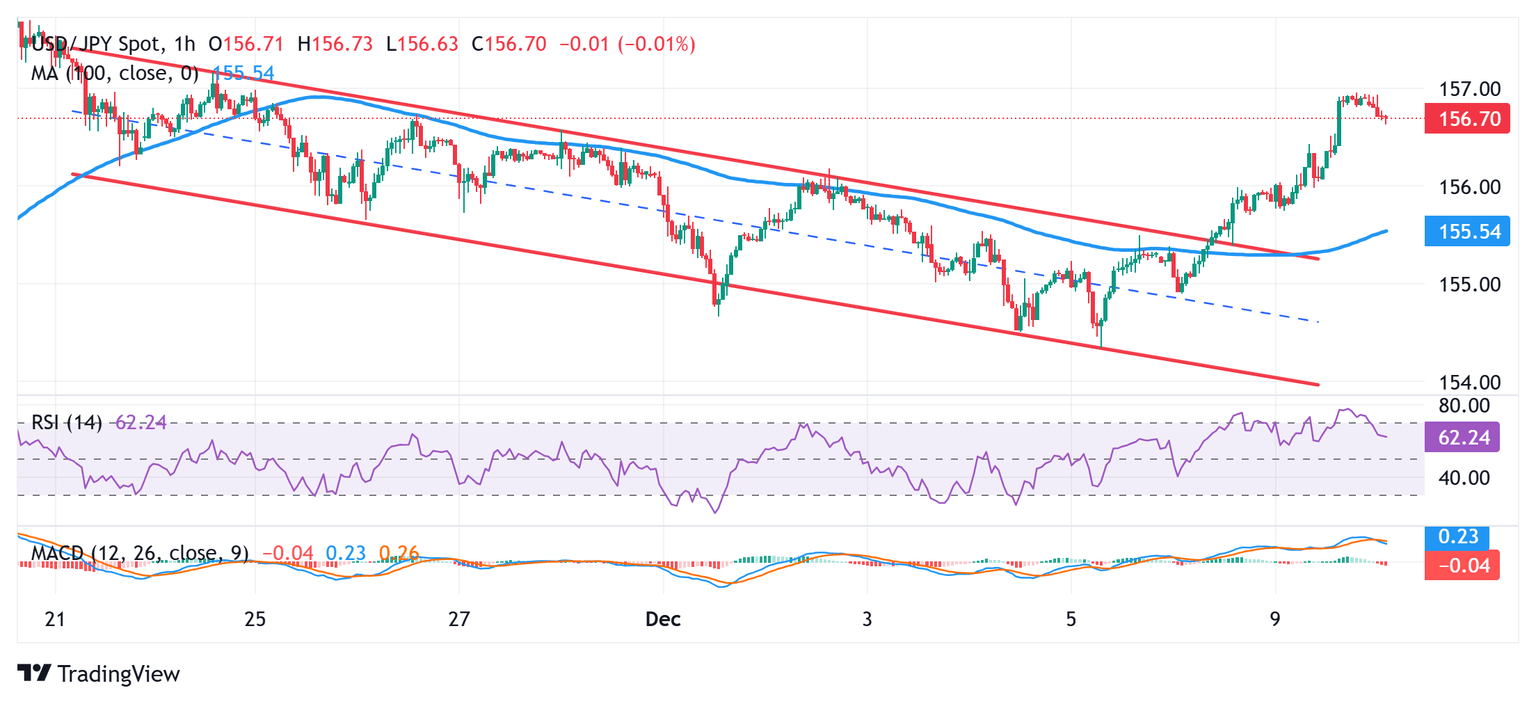
The overnight breakout through the 155.30 confluence – comprising the 100-hour Simple Moving Average (SMA) and the top end of a short-term descending trend-channel – was seen as a key trigger for the USD/JPY bulls. Furthermore, oscillators on hourly and daily charts are holding in positive territory and back the case for a further near-term appreciating move. Some follow-through buying beyond the 157.00 round figure will reaffirm the constructive outlook and lift spot prices to the 157.45 intermediate hurdle en route to the 158.00 neighborhood, or a multi-month peak, touched in November.
On the flip side, any further slide towards the 156.00 mark could be seen as a buying opportunity. This, in turn, should limit the downside for the USD/JPY pair near the 155.35-155.30 confluence resistance breakpoint, now turned support. However, some follow-through selling, leading to a subsequent weakness below the 155.00 psychological mark, might negate the positive outlook and shift the near-term bias in favor of bearish traders.
Bank of Japan FAQs
The Bank of Japan (BoJ) is the Japanese central bank, which sets monetary policy in the country. Its mandate is to issue banknotes and carry out currency and monetary control to ensure price stability, which means an inflation target of around 2%.
The Bank of Japan embarked in an ultra-loose monetary policy in 2013 in order to stimulate the economy and fuel inflation amid a low-inflationary environment. The bank’s policy is based on Quantitative and Qualitative Easing (QQE), or printing notes to buy assets such as government or corporate bonds to provide liquidity. In 2016, the bank doubled down on its strategy and further loosened policy by first introducing negative interest rates and then directly controlling the yield of its 10-year government bonds. In March 2024, the BoJ lifted interest rates, effectively retreating from the ultra-loose monetary policy stance.
The Bank’s massive stimulus caused the Yen to depreciate against its main currency peers. This process exacerbated in 2022 and 2023 due to an increasing policy divergence between the Bank of Japan and other main central banks, which opted to increase interest rates sharply to fight decades-high levels of inflation. The BoJ’s policy led to a widening differential with other currencies, dragging down the value of the Yen. This trend partly reversed in 2024, when the BoJ decided to abandon its ultra-loose policy stance.
A weaker Yen and the spike in global energy prices led to an increase in Japanese inflation, which exceeded the BoJ’s 2% target. The prospect of rising salaries in the country – a key element fuelling inflation – also contributed to the move.