Silver shed roughly 10% in the first week of June and it is almost 50% down from its January record peak. But why? All logic points to Silver trading closer to $200 per ounce than $61, its 2026 yearly low.
As with almost all financial assets, Silver price is affected by different factors. Which one weighs more at a certain time can be unpredictable, but easily explained once it happens.
Risk aversion and record rallies
Two main factors support the case for a Silver record run.
First is, of course, the risk-averse environment, a result of the war in Iran. The second is the still-alive tech boom, particularly the AI one.
Tech demand for the precious metal has not receded. Just take a look at Wall Street’s record rallies from early June, and the latest SpaceX IPO, scheduled for June 12, which has investors pricing it roughly 70% higher.
Silver is used not only for AI, but also for solar energy and electric vehicles, also booming industries. Lower prices are not coming from there.
Also, the white metal tends to benefit from risk-off sentiment, though not to the same extent as its big brother, Gold. The Middle East war grants a continued run to safety that, so far, has only benefited the US Dollar (USD).
Explaining the fall
Silver flirting with yearly lows could be explained by a combination of different factors, some directly linked to those that could have supported the bullish case.
Yes, the Persian Gulf war stands at the top of the list, as, alongside risk aversion, the conflict has sent Oil prices skyrocketing and created mounting inflationary pressures beyond central banks’ comfort zones. Policymakers around the globe were cautiously considering pausing monetary easing and are now suddenly taking a full U-turn, looking to hike interest rates.
The Reserve Bank of Australia (RBA) was the first one to kick the ball, hiking rates even before the war started amid stubborn inflation. The European Central Bank (ECB) will be next, with market players fully pricing in a 25-basis-point (bps) interest rate hike at the June meeting.
And what about the Federal Reserve (Fed)? Well, that’s a whole individual story, but to make it shorter, the Fed is unlikely to hike rates until later in the year, not because it does not need to, but because the central bank is also leading with a new Chairman, appointed by President Donald Trump to lower interest rates against common sense. Indeed, Kevin Warsh has repeatedly highlighted his belief that the Fed should be independent, but it remains to be seen how independent it will be.
And yet, the US Dollar is also strengthening on rate hike speculation, even against currencies whose central banks have already delivered or are about to.
Why is the USD then higher, despite the Fed holding its fire? Expectations. Markets move on expectations. Past, present, and future are all reflected by the current price, as Charles Dow once taught.
Lower lows ahead: $50 comes to play
From a fundamental standpoint, there’s nothing in sight that could make the market sentiment shift. Despite efforts, an end to the Iran conflict seems unlikely, given the multiple parties involved and the long-lasting conflict among most of them. The best markets can hope for these days is an extended ceasefire, though it won’t be a complete one. Investors could also hope for the Fed to hike rates by year’s end, but it is not crazy to think that US policymakers could act before then, delivering a shock that would boost demand for an already strong USD.
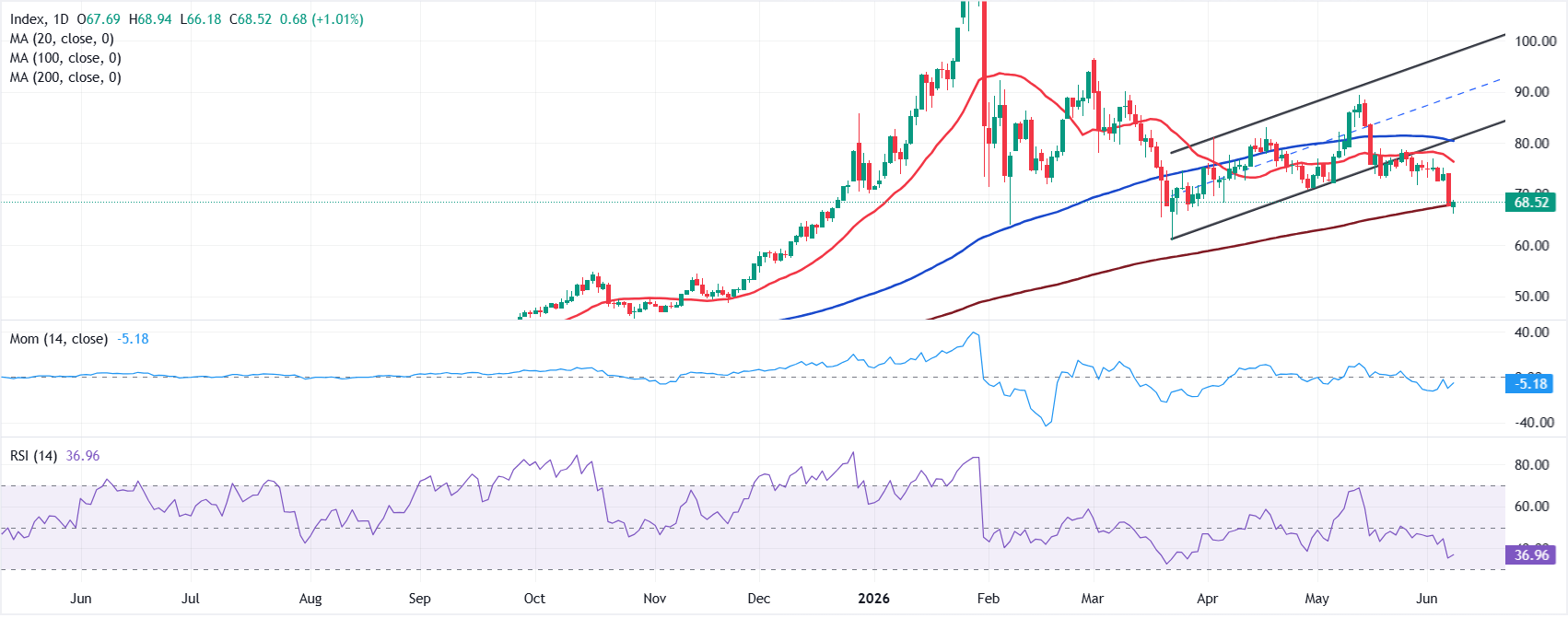
From a technical analysis perspective, XAG/USD is on track to pierce the yearly low, with the psychological $50 mark a potential target. Silver’s daily chart shows that it broke the base of an ascending channel by the end of May and even completed a pullback to it before turning south.
Furthermore, the pair is piercing the 200-day Simple Moving Average (SMA) at around $68.50, the first time it challenges the dynamic support in over a year.
The year low at $61 is the first support level to watch, followed by the $55 region, as it topped around it in October and November 2025 before finally breaking north. A clear break of this region exposes the aforementioned $50 level. Should Silver recover above $80, the case for a steady bearish extension will be in trouble, as the level should attract sellers to maintain the current trend alive.