Ripple (XRP) holds above support reclaimed at $1.10 at the time of writing on Wednesday, extending its rally after the US Producer Price Index (PPI) data for June showed that price pressures in the world’s largest economy are cooling. The report reinforced the trend seen in Tuesday’s Consumer Price Index (CPI) figures, fueling optimism across crypto markets.
Softer US PPI, CPI boost short-term outlook
The Bureau of Labor Statistics (BLS) CPI reported that inflation fell by 0.4% in June on a seasonally-adjusted basis, marking the sharpest monthly decrease since April 2020.
This pullback brought the annual headline inflation rate down to 3.5% from 4.2% in May. Core inflation, which excludes the more volatile food and energy prices, remained flat MoM, while the annual rate fell to 2.6% from 2.9% in May.
On Wednesday, additional US data showed that the Producer Price Index (PPI), a key gauge of future inflation pressures, rose at a lower pace than expected, easing market concerns over a persistent inflation wave and supporting risk assets.
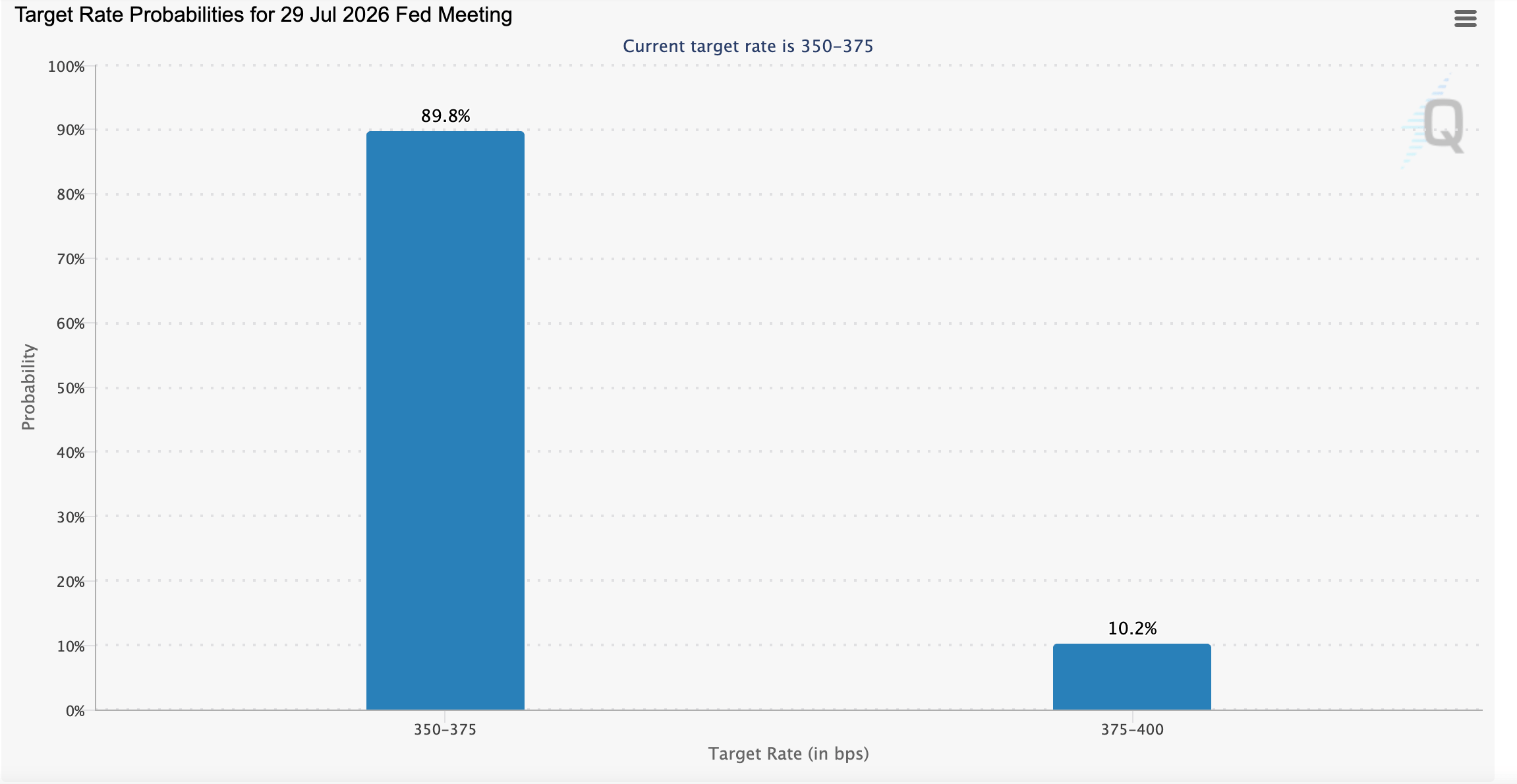
Market sentiment improved slightly, with investors currently pricing in an 90% probability that the Federal Reserve (US) will leave interest rates unchanged in the 3.50%-3.75% range at its next review cycle on July 29.
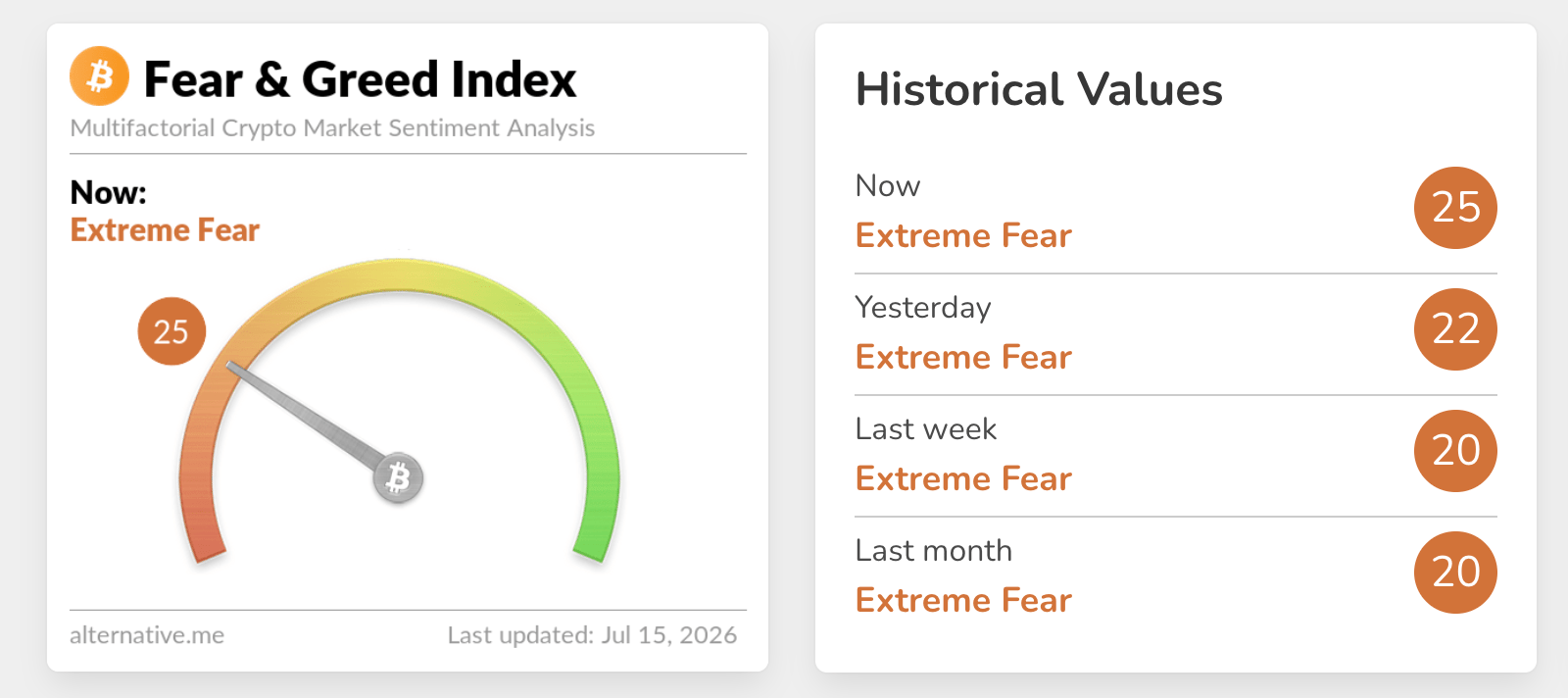
Appetite for crypto assets increased only marginally as reflected in the Fear & Greed Index. The index is embedded in the Extreme Fear territory at 25 on Wednesday, up from 22 the day before. If risk-on sentiment steadily increases, demand for risk assets, including XRP, would grow, intensifying the tailwind and supporting recovery in the short to medium term.
XRP absorbs supply as Binance reserves stabilize
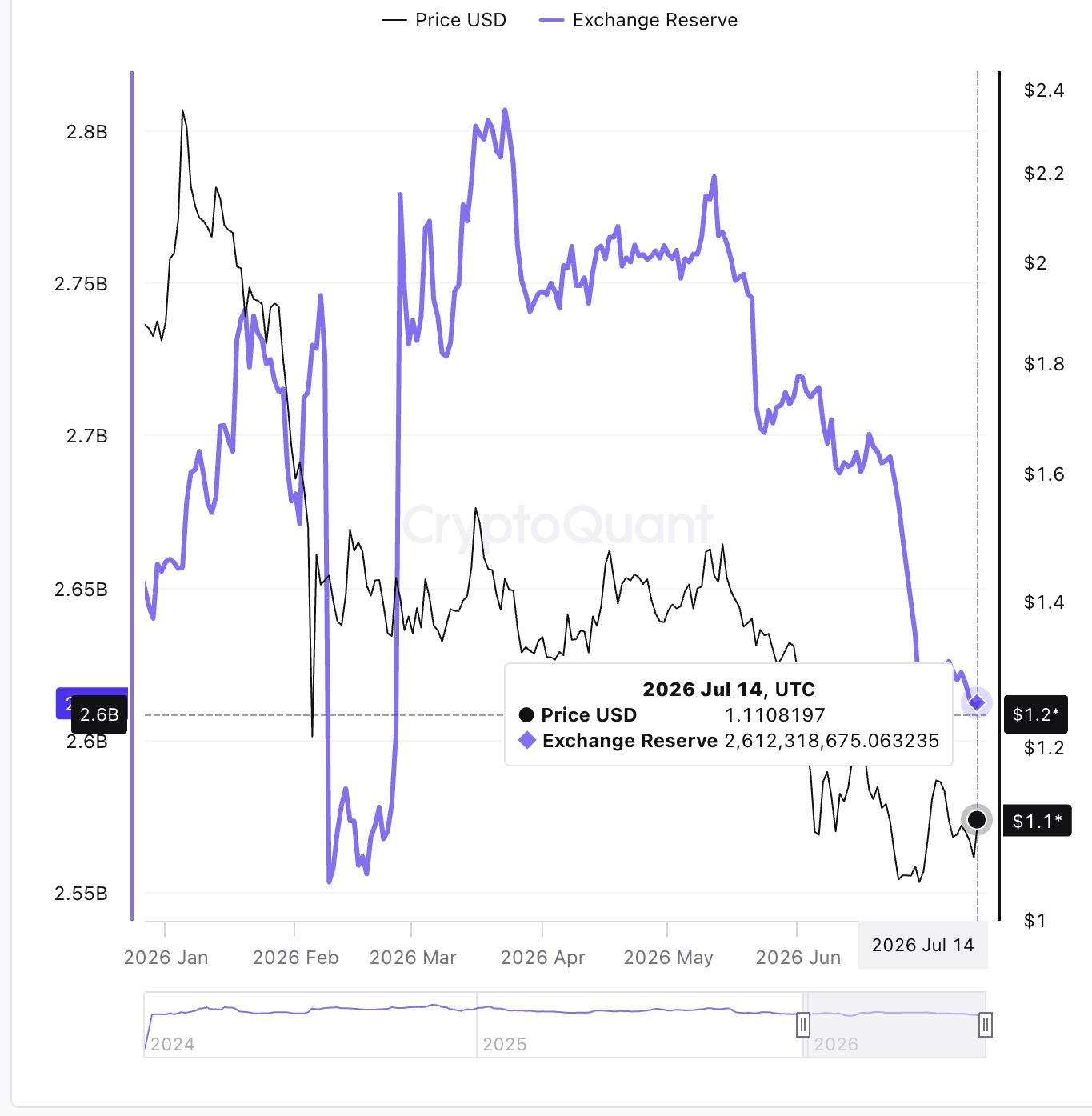
The number of tokens held in Binance wallets has remained relatively stable in July, averaging 2.61 billion XRP, valued at $2.9 billion on Wednesday. According to CryptoQuant data, the reserve’s stability indicates no major surge in immediate sell-side pressure.
If the price rises while exchange reserves fall or stay relatively flat, it often supports the notion that the market is absorbing supply. Hence, an increase in demand could boost XRP’s bullish outlook, paving the way for an extended rebound above $1.10.
Price analysis: XRP range-bound despite mild increase
XRP trades above $1.10, retaining a bearish near-term bias as it remains below the 50-day, 100-day and 200-day Moving Average Exponentials (EMAs), which fan out as layered resistance at $1.16, $1.26 and $1.46 respectively.
The Moving Average Convergence Divergence (MACD) indicator edges in positive territory on the daily chart and the Relative Strength Index (RSI) hovers near 49, suggesting only modest, indecisive momentum within a broader capped structure defined by the prevailing downward resistance trendline.
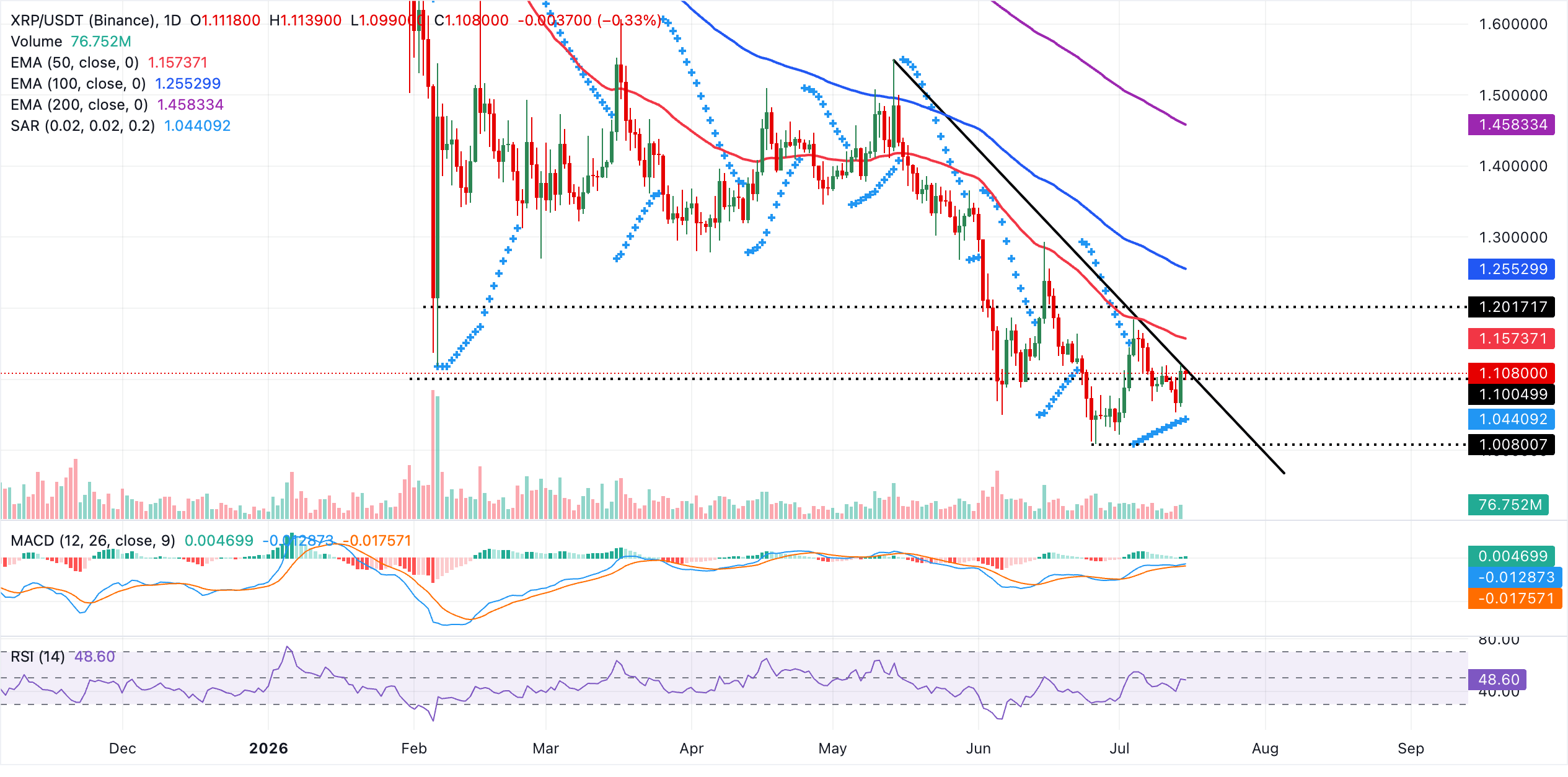
Initial resistance lies at the 50-day EMA around $1.16, with the 100-day EMA at $1.26 and the 200-day EMA near $1.46 reinforcing a wider bearish ceiling aligned with the descending trendline resistance overhead. Looking down, the first notable support emerges at the Parabolic SAR level near $1.04, and a clear break beneath this area would reopen scope for a deeper slide. Still, a recovery above the clustered moving average barriers would be needed to weaken the broader bearish bias.
(The technical analysis of this story was written with the help of an AI tool. Know more.)
Bitcoin, altcoins, stablecoins FAQs
Bitcoin is the largest cryptocurrency by market capitalization, a virtual currency designed to serve as money. This form of payment cannot be controlled by any one person, group, or entity, which eliminates the need for third-party participation during financial transactions.
Altcoins are any cryptocurrency apart from Bitcoin, but some also regard Ethereum as a non-altcoin because it is from these two cryptocurrencies that forking happens. If this is true, then Litecoin is the first altcoin, forked from the Bitcoin protocol and, therefore, an “improved” version of it.
Stablecoins are cryptocurrencies designed to have a stable price, with their value backed by a reserve of the asset it represents. To achieve this, the value of any one stablecoin is pegged to a commodity or financial instrument, such as the US Dollar (USD), with its supply regulated by an algorithm or demand. The main goal of stablecoins is to provide an on/off-ramp for investors willing to trade and invest in cryptocurrencies. Stablecoins also allow investors to store value since cryptocurrencies, in general, are subject to volatility.
Bitcoin dominance is the ratio of Bitcoin’s market capitalization to the total market capitalization of all cryptocurrencies combined. It provides a clear picture of Bitcoin’s interest among investors. A high BTC dominance typically happens before and during a bull run, in which investors resort to investing in relatively stable and high market capitalization cryptocurrency like Bitcoin. A drop in BTC dominance usually means that investors are moving their capital and/or profits to altcoins in a quest for higher returns, which usually triggers an explosion of altcoin rallies.