Ripple (XRP) retains a slightly bullish outlook on Wednesday despite logging a minor correction from the supply range near $1.15. The remittance token is down 0.5% on the day, reflecting a broader cryptocurrency market drawdown, primarily driven by persistent geopolitical tensions between the United States (US) and Iran in the Middle East.
“The absence of a near-term outlook for returning to diplomacy, let alone achieving a substantial and solid breakthrough regarding consensus on managing the Strait of Hormuz, keeps the risks of continued energy price inflation extremely high,” Simon-Peter Massabni, Head of Business Development at XS.com, said in a comment.
Crypto sentiment strengthens amid XRP capital inflows
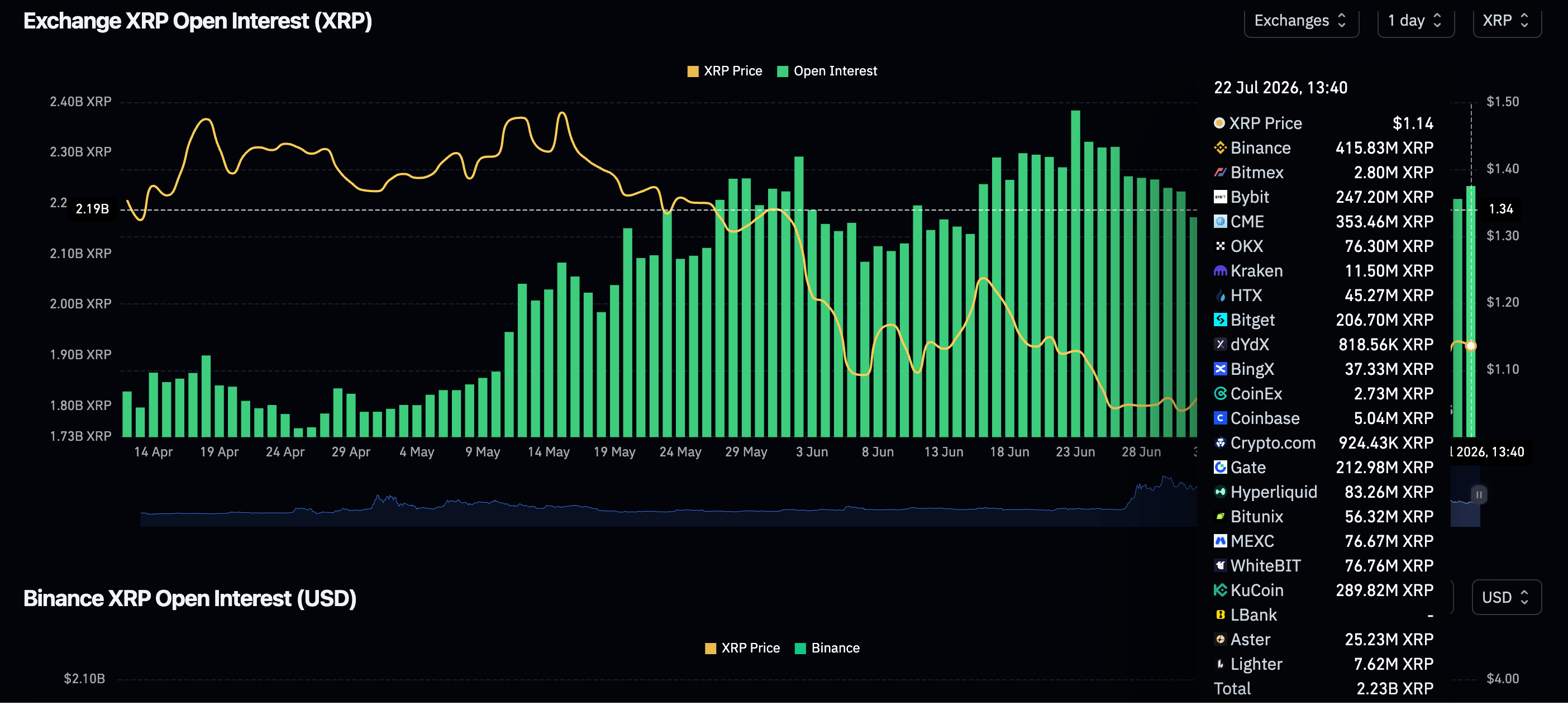
XRP derivatives are expanding, albeit gradually, with perpetual futures Open Interest (OI) averaging 2.23 billion XRP on Wednesday, up from 2.17 billion XRP the previous day. This increase in demand follows a recent drop from 2.37 billion XRP recorded on Monday, suggesting that despite profit-taking, appetite for XRP futures is relatively steady.
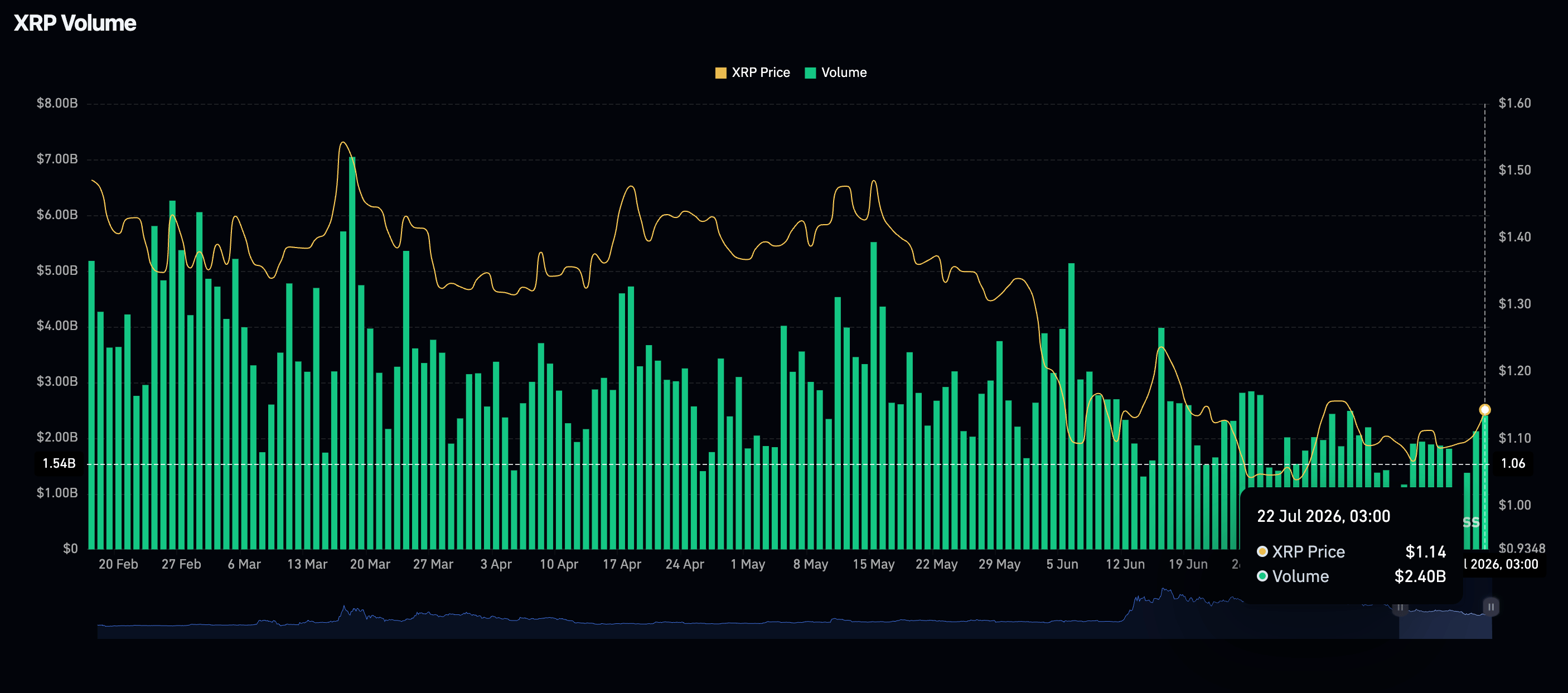
Meanwhile, the token continues to attract expanding trading volume, which held at $2.40 billion on Wednesday, up from $2.12 billion the day before. The alignment of increasing volume and perpetual futures OI supports XRP’s short-term bullish outlook.
Price analysis: XRP bulls absorb selling pressure
XRP trades at above $1.13, maintaining a bearish near-term bias as it remains capped beneath a dense layer of moving averages. The spot price is currently under the 50-day Exponential Moving Average (EMA) at $1.15, with the 100-day EMA at $1.24 and the 200-day EMA up at $1.46 reinforcing the broader downside structure.
The SuperTrend at $1.18 also sits overhead, suggesting rallies are likely to face selling pressure, even as the Relative Strength Index (RSI) near on the daily chart and the Moving Average Convergence Divergence (MACD) histogram show mildly constructive momentum that hints at a corrective rather than impulsive recovery.
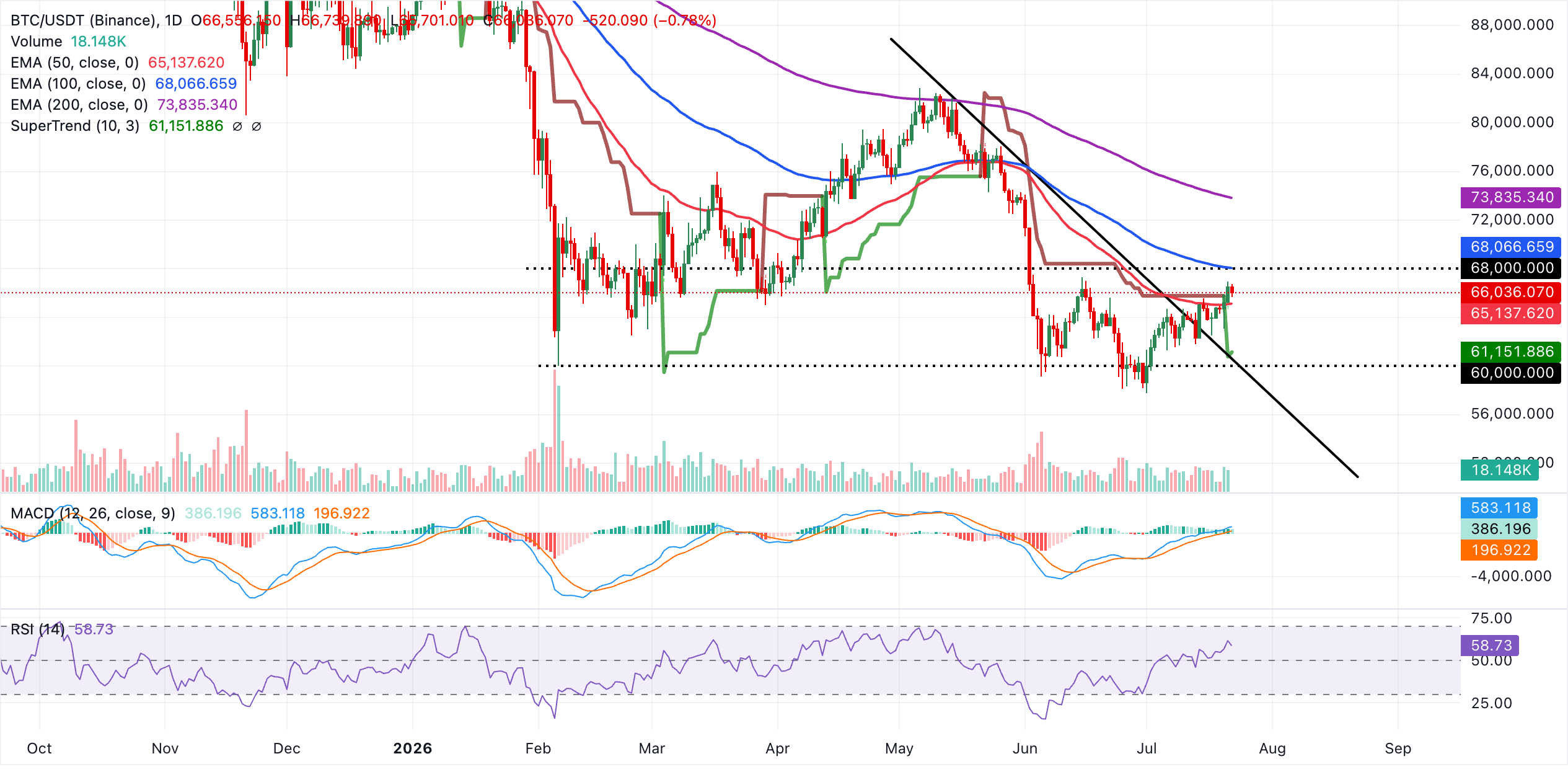
Immediate resistance lies at the 50-day EMA around $1.15, followed by the SuperTrend barrier near $1.18, where any rebound could stall. Above that, the 100-day EMA at $1.24 and the 200-day EMA at $1.46 define progressively stronger supply zones that would need to be reclaimed to soften the bearish technical tone. On the downside, the main structural support level lies around the downward trendline break price at $1.05, where a pullback could attract dip-buying. A decisive move below this floor would expose further weakness in the broader trend.
(The technical analysis of this story was written with the help of an AI tool. Know more.)
Bitcoin, altcoins, stablecoins FAQs
Bitcoin is the largest cryptocurrency by market capitalization, a virtual currency designed to serve as money. This form of payment cannot be controlled by any one person, group, or entity, which eliminates the need for third-party participation during financial transactions.
Altcoins are any cryptocurrency apart from Bitcoin, but some also regard Ethereum as a non-altcoin because it is from these two cryptocurrencies that forking happens. If this is true, then Litecoin is the first altcoin, forked from the Bitcoin protocol and, therefore, an “improved” version of it.
Stablecoins are cryptocurrencies designed to have a stable price, with their value backed by a reserve of the asset it represents. To achieve this, the value of any one stablecoin is pegged to a commodity or financial instrument, such as the US Dollar (USD), with its supply regulated by an algorithm or demand. The main goal of stablecoins is to provide an on/off-ramp for investors willing to trade and invest in cryptocurrencies. Stablecoins also allow investors to store value since cryptocurrencies, in general, are subject to volatility.
Bitcoin dominance is the ratio of Bitcoin’s market capitalization to the total market capitalization of all cryptocurrencies combined. It provides a clear picture of Bitcoin’s interest among investors. A high BTC dominance typically happens before and during a bull run, in which investors resort to investing in relatively stable and high market capitalization cryptocurrency like Bitcoin. A drop in BTC dominance usually means that investors are moving their capital and/or profits to altcoins in a quest for higher returns, which usually triggers an explosion of altcoin rallies.