Ripple (XRP) remains pressured, trading below $1.05 at the time of writing on Thursday. The token has declined for the fourth consecutive day this week, reflecting lethargic sentiment in the broader cryptocurrency market despite the possibility of easing geopolitical tensions in the Middle East.
XRP Ledger developers propose on-chain multi-signature upgrade
The XRP Ledger (XRPL) supports multi-signature transactions that allow multiple people to authorize an account. According to Ayo Akinyele, Engineering head at RippleX, the current process ensures that a transaction is executed only when enough approvals have been collected.
Akinyele highlights a point of failure in the current process when “Someone creates the transaction, shares it with every signer, collects signatures, assembles them, and submits the final transaction.”
If that person goes offline, loses a signature, or makes a mistake, the entire process can still fail or force a do-over.
The On-Chain Cosigner proposal moves the coordination process onto the XRPL. Once the proposal has been submitted on the ledger, signers can add their approval, which is then validated by the protocol. Once the required quorum of approvals is reached, anyone can submit it.
Ripple is targeting institutions, custodians and treasury teams or even multiple organizations that may need to authorize a similar transaction.
“The proposal is also designed to complement other work in progress, including batched transactions and lending flows that require approvals from multiple parties,” Akinyele added.
XRP ETF outflows return
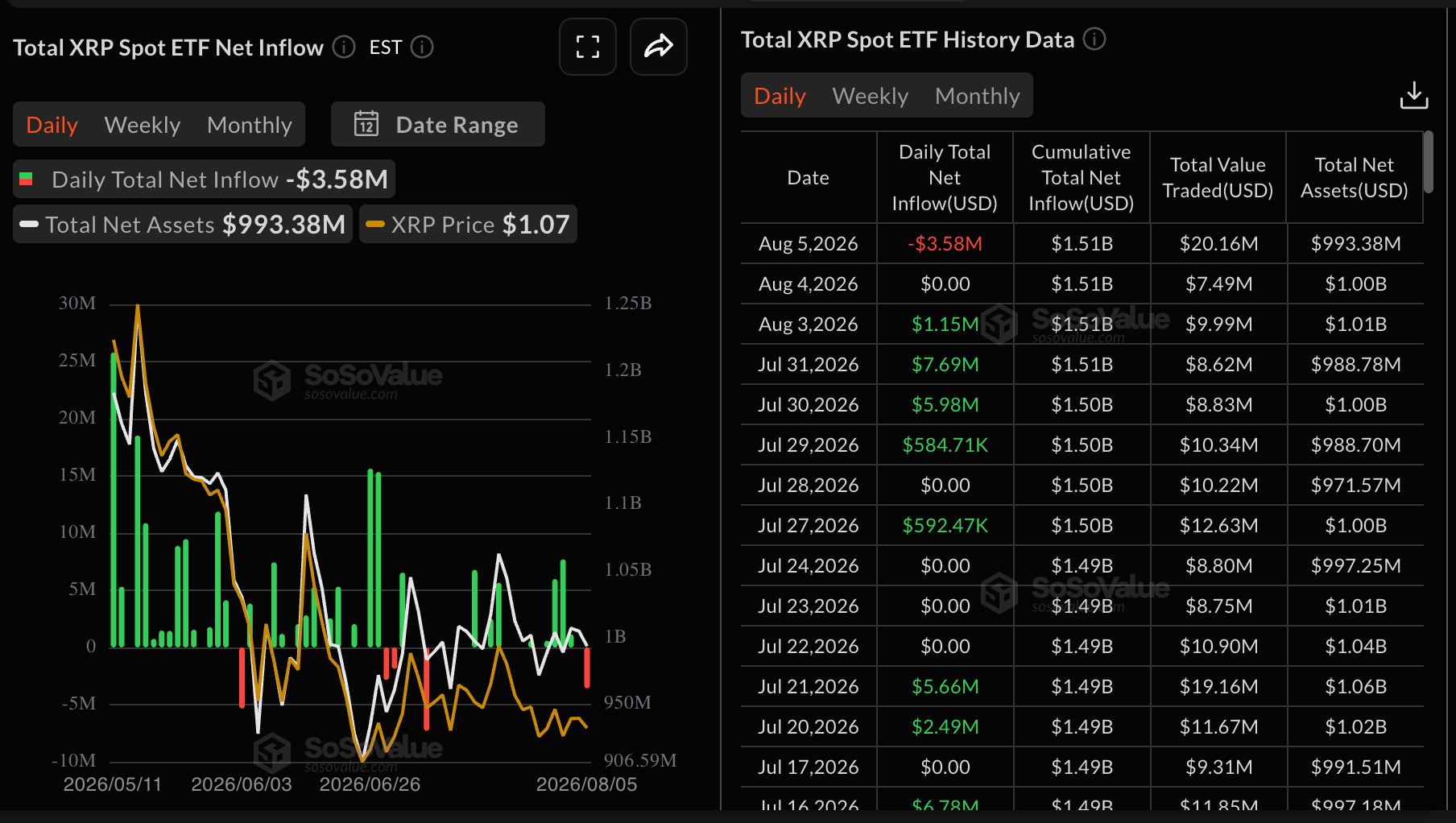
XRP spot Exchange-Traded Funds (ETFs) experienced outflows totaling $3.58 million on Wednesday, following muted activity the day before. This shows that interest in the remittance token is fading, aligning with a weakening technical outlook. In other words, investors are struggling to stay bullish as the price falls incessantly.
XRP approaches lifeline support
XRP trades around $1.05, keeping a bearish near-term tone as it remains below all key Exponential Moving Averages. The 50-day EMA at $1.11, the 100-day EMA at $1.20, and the 200-day EMA at $1.39 stack overhead as a layered resistance complex, while price also trades under the Bollinger Bands’ middle line at $1.088, reinforcing a capped structure.
Momentum stays soft, with the Relative Strength Index (RSI) hovering near 39 and the Moving Average Convergence Divergence (MACD) in negative territory, which together suggest downside pressure remains in play despite the pair approaching modest oversold conditions.
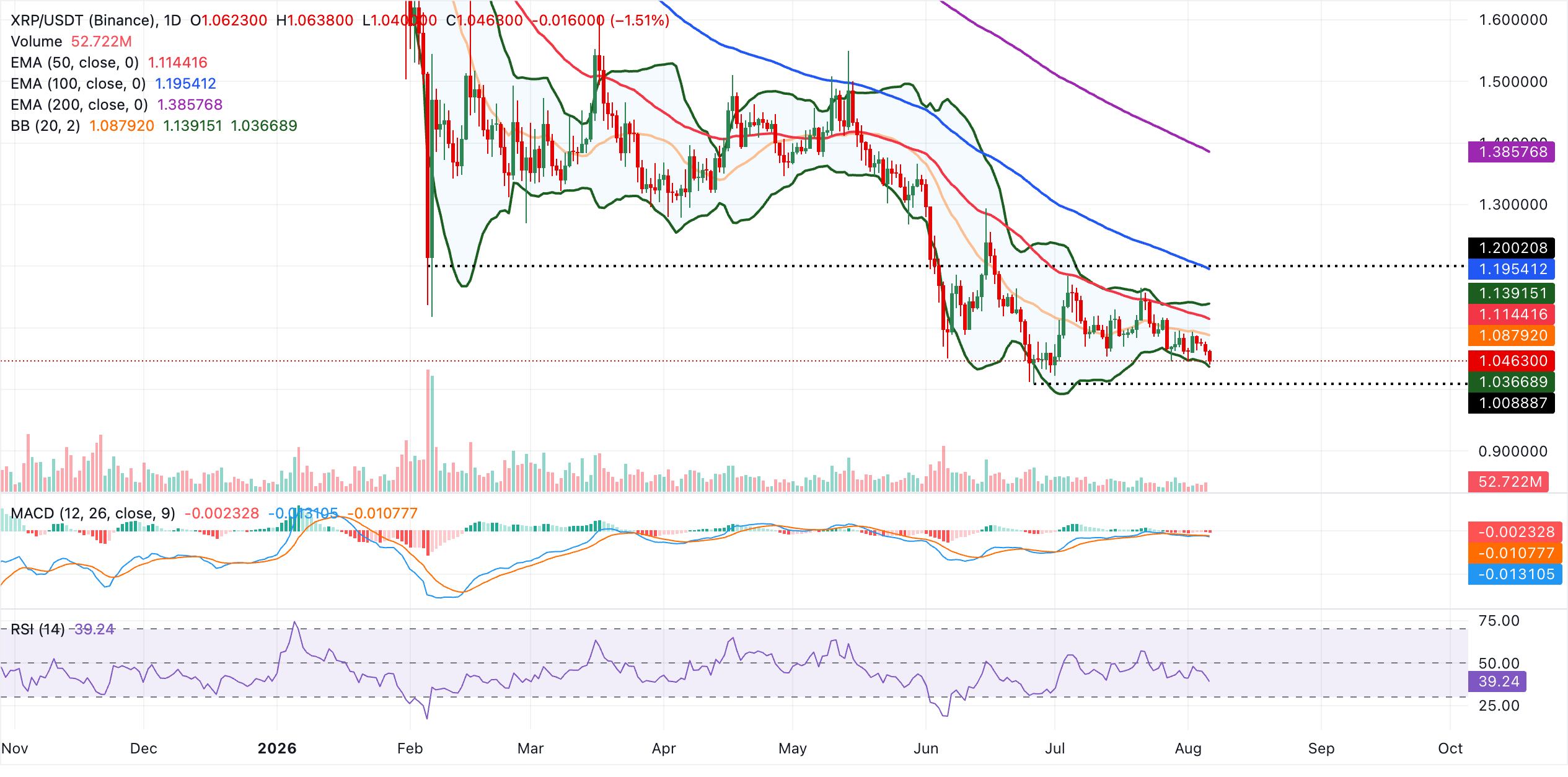
Initial resistance is seen at the Bollinger middle boundary near $1.09, followed by the 50-day EMA at $1.11 and the Bollinger upper band at $1.14, before a more substantial barrier emerges at the 100-day EMA around $1.20 and the 200-day EMA near $1.39. On the downside, immediate support appears at the Bollinger lower band around $1.04.
A decisive break below this floor would open the door for a deeper correction, while holding above it could allow the pair to attempt another test of the $1.08-$1.11 resistance cluster overhead.
(The technical analysis of this story was written with the help of an AI tool. Know more.)
Bitcoin, altcoins, stablecoins FAQs
Bitcoin is the largest cryptocurrency by market capitalization, a virtual currency designed to serve as money. This form of payment cannot be controlled by any one person, group, or entity, which eliminates the need for third-party participation during financial transactions.
Altcoins are any cryptocurrency apart from Bitcoin, but some also regard Ethereum as a non-altcoin because it is from these two cryptocurrencies that forking happens. If this is true, then Litecoin is the first altcoin, forked from the Bitcoin protocol and, therefore, an “improved” version of it.
Stablecoins are cryptocurrencies designed to have a stable price, with their value backed by a reserve of the asset it represents. To achieve this, the value of any one stablecoin is pegged to a commodity or financial instrument, such as the US Dollar (USD), with its supply regulated by an algorithm or demand. The main goal of stablecoins is to provide an on/off-ramp for investors willing to trade and invest in cryptocurrencies. Stablecoins also allow investors to store value since cryptocurrencies, in general, are subject to volatility.
Bitcoin dominance is the ratio of Bitcoin’s market capitalization to the total market capitalization of all cryptocurrencies combined. It provides a clear picture of Bitcoin’s interest among investors. A high BTC dominance typically happens before and during a bull run, in which investors resort to investing in relatively stable and high market capitalization cryptocurrency like Bitcoin. A drop in BTC dominance usually means that investors are moving their capital and/or profits to altcoins in a quest for higher returns, which usually triggers an explosion of altcoin rallies.