EUR/USD rapidly left behind Monday’s optimism, slipping back to the mid-1.1600s amid the intense recovery in the Greenback. US inflation data remained well above the Fed’s target in December, although consumer prices lost some momentum, reinforcing the view of further Fed rate cuts in the upcoming months.
Australian Dollar Price Forecast: Some consolidation appears likely
AUD/USD appears to be pausing for air. After Monday’s rebound, the pair quickly ran out of steam and slipped back below the 0.6700 mark, with a firmer US dollar once again taking centre stage.
The Aussie Dollar (AUD) came under renewed pressure on Tuesday, wiping out the early-week optimism and dragging AUD/USD back through the key 0.6700 level. The move felt less like a change in narrative and more like a reminder of who’s still driving near-term price action.
At the centre of it all is the US Dollar’s renewed bid. The greenback has managed, at least for now, to shake off lingering worries about Federal Reserve (Fed) independence, as investors digest December’s US CPI data. That release has reinforced the view that further Fed rate cuts remain very much on the roadmap, even if the timing is still up for debate.
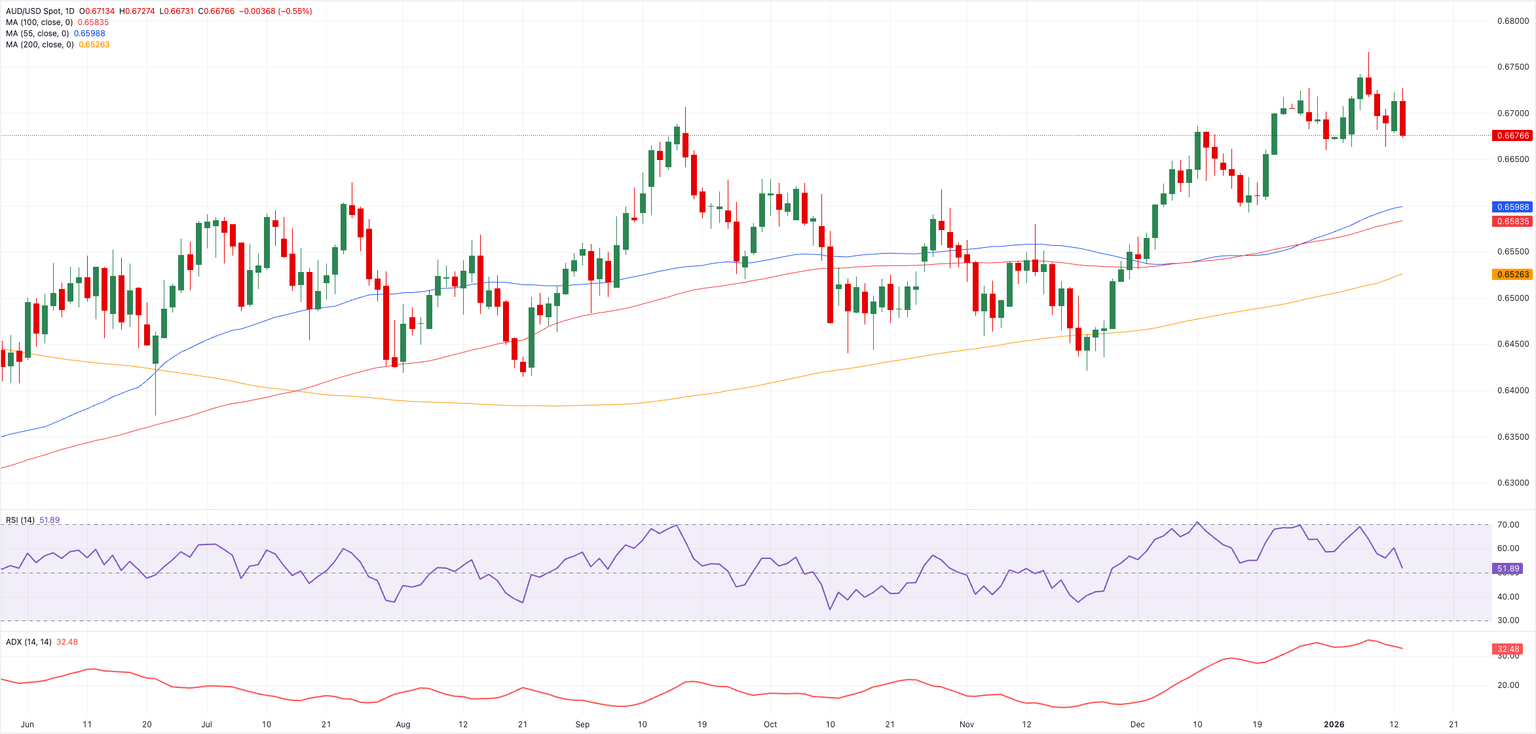
Taking a step back, the bigger picture for AUD/USD still looks fairly solid. The pair is holding comfortably above both its 200-week and 200-day moving averages, at 0.6624 and 0.6518 respectively, which keeps the medium-term bias tilted to the upside and suggests the latest dip is more noise than a shift in trend.
Australia: ticking over, not turning heads
Australia’s recent data haven’t exactly sparked excitement, but they haven’t raised alarms either. Growth is slowing, but in an orderly way, and the numbers continue to fit the soft-landing narrative.
December PMI readings echoed that theme. Both Manufacturing and Services eased slightly in the preliminary prints, but they remain firmly in expansion territory. Retail Sales are holding up reasonably well, and while the trade surplus narrowed to A$2.936 billion in November from A$4.356 billion, it’s still comfortably positive.
Growth has cooled a little. GDP expanded by 0.4% QoQ in Q3, down from 0.7% previously. Even so, annual growth held at a solid 2.1%, broadly in line with what the Reserve Bank of Australia (RBA) had pencilled in.
The labour market is also beginning to lose a bit of steam. Employment fell by 21.3K in November, though the unemployment rate held steady at 4.3%, suggesting cooling rather than cracking.
Inflation remains the awkward piece of the puzzle. Price pressures are easing, but only gradually. Headline CPI slowed to 3.4% in November, while the trimmed mean edged down to 3.2%, still well above the RBA’s comfort zone.
China lends a hand, but with limits
China continues to offer some support to the Aussie, though it’s no longer the powerhouse it once was.
GDP growth held at 4.0% from a year earlier in the July–September quarter, while Retail Sales rose 1.3% YoY in November. Decent numbers, but far from the kind of momentum that used to turbocharge the AUD.
More recent data hint at a mild improvement. Both the official Manufacturing PMI and the Caixin index edged back into expansion at 50.1 in December. Services activity has also picked up, with the non-manufacturing PMI at 50.2 and Caixin’s Services PMI holding firm at 52.0.
Trade data were another bright spot. The surplus widened to $111.68 billion in November, with exports up nearly 6% and imports down close to 2%.
Inflation still sends mixed signals: Headline CPI was steady at 0.8% over the last twelve months in December, but Producer Prices remain in the red, down 1.9% from a year earlier, a reminder that deflationary pressures haven’t fully faded.
For now, the People’s Bank of China (PBoC) is staying patient. Loan Prime Rates (LPR) were left unchanged in December, reinforcing the idea that any policy support will come gradually rather than in one big push.
The RBA stays firm, and patient
The RBA delivered exactly what markets expected at its latest meeting: a hawkish hold.
The cash rate was left unchanged at 3.60% in December, but the tone remained firm. Policymakers continue to flag capacity constraints and weak productivity as medium-term risks, even as the labour market shows early signs of cooling.
Governor Michele Bullock pushed back against expectations for near-term rate cuts, stressing that the Board is comfortable with an extended pause, and hasn’t ruled out further tightening if inflation proves stubborn. Q4 trimmed mean CPI was flagged as a key input, though that data won’t arrive until late January.
The December minutes revealed healthy internal debate, including questions about whether financial conditions are restrictive enough. Bottom line: rate cuts this year are far from guaranteed.
That makes the late-January inflation print a potentially pivotal moment for AUD pricing. For now, markets are pricing in around 36 basis points of tightening by year-end, with the RBA widely expected to sit tight again at its February 3 meeting.
Positioning: sentiment is improving, but confidence is thin
Speculators are clearly easing off the bearish bets, but they’re not ready to flip bullish just yet. The Commodity Futures Trading Commission (CFTC) data for the week ending January 6 show net shorts in the Aussie trimmed back to around 19K contracts, the lightest positioning since September 2024.
Open interest has also climbed for a second week in a row, edging close to 231K contracts. That suggests fresh interest is coming back into the market, though conviction remains tentative rather than outright optimistic.
What’s on the radar next
In the near term, the focus shifts to the US data calendar on Wednesday. Retail Sales and Producer Prices could set the tone for the dollar and, by extension, AUD/USD.
On the risk side, it wouldn’t take much to knock the Aussie off balance. A sudden risk-off move, fresh doubts about China’s outlook, or a stronger-than-expected rebound in the US dollar could all put a quick lid on any upside.
Technical landscape
Immediately to the downside for AUD/USD emerge the weekly troughs at 0.6659 (December 31) and 0.6592 (December 18), while a deeper pullback could expose a move toward the 0.6595-0.6575 band, where sit the transitory 55-day and 100-day SMAs. South from here emerges the key 200-day SMA at 0.6517, seconded by the November base at 0.6421 (November 21).
In case bulls regain the upper hand, spot could challenge its 2026 ceiling of 0.6766 (January 7), ahead of the 2024 high at 0.6942 (September 30), all preceding the 0.7000 yardstick.
Looking at the broader scenario, the pair’s near-term positive outlook is expected to persist as long as it trades above its 200-day SMA.
Furthermore, momentum indicators keep favouring further gains, although some warnings have emerged: The Relative Strength Index (RSI) retreats toward the 53 region, while the Average Directional Index (ADX) near the 30 keeps indicating a robust trend.
Bottom line
No fireworks, but no reason to turn bearish either.
AUD/USD remains tightly linked to global risk sentiment and China’s outlook. A clean break above 0.6800 would be needed to signal something more convincing on the upside.
For now, a choppy US Dollar, steady domestic data, an RBA that isn’t blinking, and modest help from China keep the balance tilted toward gradual gains rather than a decisive breakout.
RBA FAQs
The Reserve Bank of Australia (RBA) sets interest rates and manages monetary policy for Australia. Decisions are made by a board of governors at 11 meetings a year and ad hoc emergency meetings as required. The RBA’s primary mandate is to maintain price stability, which means an inflation rate of 2-3%, but also “..to contribute to the stability of the currency, full employment, and the economic prosperity and welfare of the Australian people.” Its main tool for achieving this is by raising or lowering interest rates. Relatively high interest rates will strengthen the Australian Dollar (AUD) and vice versa. Other RBA tools include quantitative easing and tightening.
While inflation had always traditionally been thought of as a negative factor for currencies since it lowers the value of money in general, the opposite has actually been the case in modern times with the relaxation of cross-border capital controls. Moderately higher inflation now tends to lead central banks to put up their interest rates, which in turn has the effect of attracting more capital inflows from global investors seeking a lucrative place to keep their money. This increases demand for the local currency, which in the case of Australia is the Aussie Dollar.
Macroeconomic data gauges the health of an economy and can have an impact on the value of its currency. Investors prefer to invest their capital in economies that are safe and growing rather than precarious and shrinking. Greater capital inflows increase the aggregate demand and value of the domestic currency. Classic indicators, such as GDP, Manufacturing and Services PMIs, employment, and consumer sentiment surveys can influence AUD. A strong economy may encourage the Reserve Bank of Australia to put up interest rates, also supporting AUD.
Quantitative Easing (QE) is a tool used in extreme situations when lowering interest rates is not enough to restore the flow of credit in the economy. QE is the process by which the Reserve Bank of Australia (RBA) prints Australian Dollars (AUD) for the purpose of buying assets – usually government or corporate bonds – from financial institutions, thereby providing them with much-needed liquidity. QE usually results in a weaker AUD.
Quantitative tightening (QT) is the reverse of QE. It is undertaken after QE when an economic recovery is underway and inflation starts rising. Whilst in QE the Reserve Bank of Australia (RBA) purchases government and corporate bonds from financial institutions to provide them with liquidity, in QT the RBA stops buying more assets, and stops reinvesting the principal maturing on the bonds it already holds. It would be positive (or bullish) for the Australian Dollar.
JPY drops to weakest since July 2024 – ING

The Japanese Yen (JPY) fell 0.5% to 158.91 per US Dollar (USD), hitting its weakest level since July 2024, as speculation of a snap election under PM Takaichi triggered renewed selling, ING’s FX analyst Francesco Pesole notes.
US-Japan yield gap and outflows pressure yen
“The yen fell 0.5% to 158.91 per dollar, its weakest since July 2024, as speculation that Japanese PM Sanae Takaichi may call a snap election triggered renewed selling. The move surpassed January’s low of 158.87 and intensified concerns over potential intervention, with Japanese officials warning against excessive and speculative FX moves.”
“Persistent US-Japan yield gaps, negative real rates, and capital outflows continue to weigh on the currency, with a potential slide above 160 USD/JPY. Intervention risk remains in focus after past actions when volatility spiked.”
Gold trades with modest losses amid firmer USD; focus remains on US CPI report
Gold (XAU/USD) sticks to intraday losses through the early part of the European session on Tuesday, though the downside remains cushioned amid a supportive fundamental backdrop. The US Dollar (USD) gains some positive traction following the previous day’s decline and turns out to be a key factor acting as a headwind for the commodity. That said, concerns about the US Federal Reserve’s (Fed) independence might keep a lid on any meaningful USD appreciation. This, along with bets for more Fed rate cuts, might continue to benefit the non-yielding yellow metal.
Apart from this, persistent geopolitical uncertainties should help limit the downside for the safe-haven Gold. Traders might also refrain from placing aggressive directional bets and opt to wait for the release of the latest US consumer inflation figures later today. The crucial data will play a key role in influencing market expectations about the Fed’s future rate-cut path, which will drive the USD demand and provide a fresh impetus to the XAU/USD pair. Nevertheless, the fundamental backdrop suggests that any corrective decline might still be seen as a buying opportunity.
Daily Digest Market Movers: Gold bulls turn cautious as USD attracts some buyers ahead of US CPI
- A Trump administration criminal probe into Federal Reserve Chair Jerome Powell fueled uncertainty about the US central bank’s independence and pushed the safe-haven Gold to a fresh all-time high at the start of this week.
- Fed Chair, in a rare statement, said that the threat of criminal charges against him is a consequence of US President Donald Trump’s anger over the central bank’s refusal to cut interest rates despite repeated public pressure.
- Geopolitical tensions also remained elevated after Trump told reporters that he was considering a range of options, including potential military action, in response to Iran’s crackdown on mass anti-government demonstrators.
- Adding to this, Trump announced late Monday that any country doing business with Iran will face a new tariff of 25% on its exports to the US. This turns out to be another factor acting as a tailwind for the XAU/USD pair.
- The closely-watched US Nonfarm Payrolls report released last Friday backed the case for potentially stagnant policy in the first quarter. Traders, however, are still pricing in two more interest rate cuts by the Fed later this year.
- The outlook, in turn, fails to assist the US Dollar in attracting any meaningful buyers and further lends support to the commodity. The XAU/USD bulls, however, opt to wait for the release of the latest US consumer inflation figures.
- The headline US Consumer Price Index (CPI) is expected to have risen by 0.3% in December, and the yearly rate is seen holding steady at 2.7%. Excluding Food and Energy, the core CPI is estimated to edge higher to 2.7% YoY.
- Any significant divergence in comparison to the broader consensus would lead to a shift in the likelihood of a Fed rate cut at the January 28 meeting, which, in turn, would infuse volatility around the USD and the precious metal.
Gold seems poised to prolong the uptrend along an ascending channel
The ascending channel from $3,920.24 guides the uptrend, with resistance near $4,656.02. The 50-day Simple Moving Average (SMA) trends higher, underscoring firm buying bias. The XAU/USD pair holds above the SMA, preserving bullish control. The Moving Average Convergence Divergence (MACD) line stands above the Signal line, and both lie in positive territory. The widening positive histogram suggests strengthening momentum, while the Relative Strength Index (RSI) prints at 70.26 (overbought), which could cap gains into the channel ceiling.
Trend conditions remain favorable while the 50-day Simple Moving Average (SMA) rises and price respects it, with the SMA at $4,255.80 acting as nearby support. The MACD above zero reinforces the bullish tone, though momentum could cool as the RSI holds in overbought territory. A pullback would be expected to remain contained above the SMA, whereas a close above the channel cap would open the path for continuation.
(The technical analysis of this story was written with the help of an AI tool.)
US Dollar Price Today
The table below shows the percentage change of US Dollar (USD) against listed major currencies today. US Dollar was the strongest against the Japanese Yen.
| USD | EUR | GBP | JPY | CAD | AUD | NZD | CHF | |
|---|---|---|---|---|---|---|---|---|
| USD | 0.02% | -0.04% | 0.43% | -0.01% | 0.10% | -0.11% | -0.01% | |
| EUR | -0.02% | -0.05% | 0.43% | -0.03% | 0.07% | -0.13% | -0.03% | |
| GBP | 0.04% | 0.05% | 0.45% | 0.03% | 0.13% | -0.08% | 0.02% | |
| JPY | -0.43% | -0.43% | -0.45% | -0.43% | -0.33% | -0.54% | -0.43% | |
| CAD | 0.01% | 0.03% | -0.03% | 0.43% | 0.10% | -0.11% | -0.00% | |
| AUD | -0.10% | -0.07% | -0.13% | 0.33% | -0.10% | -0.20% | -0.10% | |
| NZD | 0.11% | 0.13% | 0.08% | 0.54% | 0.11% | 0.20% | 0.10% | |
| CHF | 0.00% | 0.03% | -0.02% | 0.43% | 0.00% | 0.10% | -0.10% |
The heat map shows percentage changes of major currencies against each other. The base currency is picked from the left column, while the quote currency is picked from the top row. For example, if you pick the US Dollar from the left column and move along the horizontal line to the Japanese Yen, the percentage change displayed in the box will represent USD (base)/JPY (quote).
Japanese Yen drops to fresh one-year low vs. USD amid BoJ uncertainty, election risks
The Japanese Yen (JPY) continues its relative underperformance amid speculation that Prime Minister Sanae Takaichi may soon call a snap election to take advantage of strong approval ratings. With Takaichi’s popularity running high, a win would likely cement her authority to further boost the expansionary fiscal policy. These expectations lifted Japan’s Nikkei 225 to a record high and undermined the JPY’s safe-haven status. Apart from this, the uncertainty over the likely timing of the next interest rate hike by the Bank of Japan (BoJ) and the deepening Japan–China diplomatic crisis turned out to be other factors weighing on the JPY.
The aforementioned fundamental backdrop drags the JPY to a fresh one-year low against its American counterpart during the Asian session on Tuesday. However, speculations that Japanese authorities will step in to stem further weakness in the domestic currency might hold back the JPY bears from placing fresh bets. The US Dollar (USD), on the other hand, struggles to attract any meaningful buyers amid concerns about the US Federal Reserve’s (Fed) independence, which might contribute to capping the USD/JPY pair. Traders now look forward to the release of the latest US consumer inflation figures for a fresh impetus later today.
Japanese Yen bears retain control amid BoJ rate hike doubts, political uncertainty
- Reports suggest that Japan’s Prime Minister Sanae Takaichi may call an early election in the first half of February to bolster her coalition government’s parliamentary majority, fueling hopes for additional stimulus.
- Last week, China prohibited some rare earth elements from being exported to Japan with immediate effect. The ban follows a diplomatic row over Taiwan and heightens supply-chain risk for Japanese manufacturers.
- Despite the Bank of Japan’s (BoJ) hawkish outlook, investors remain uncertain about the likely timing of the next rate hike. This, along with the risk-on impulse, is seen undermining demand for the safe-haven Japanese Yen.
- Japan’s Finance Minister Satsuki Katayama said this Tuesday that she shared concerns over the JPY’s recent one-sided decline with US Treasury Secretary Scott Bessent and added that the tolerance for weakness was limited.
- Concerns about the Federal Reserve’s independence resurfaced on Monday after prosecutors opened a criminal investigation against Jerome Powell over his testimony about the central bank building renovation project.
- Powell, in a rate statement, called the probe unprecedented and said that he believed it was opened due to US President Donald Trump’s anger over the Fed’s refusal to cut interest rates despite repeated public pressure.
- This keeps the US Dollar bulls on the defensive despite firming expectations for a less aggressive monetary policy easing by the US central bank this year, bolstered by the latest monthly employment details released last Friday.
- Traders are pricing in the possibility of two more rate cuts by the Fed in 2026. This marks a significant divergence compared to expectations that the BoJ will stick to its policy normalization path and should cap the USD/JPY pair.
- BoJ Governor Kazuo Ueda reiterated last week that the central bank would continue to raise interest rates if economic and price developments move in line with forecasts, leaving the door open for further policy tightening.
- Investors might also refrain from placing aggressive directional bets and opt to wait for more cues about the Fed’s rate-cut path. Hence, the focus will remain glued to the release of the latest US consumer inflation figures.
USD/JPY technical setup backs the case for a further near-term appreciating move
The 50-day Simple Moving Average (SMA) continues to rise, with the USD/JPY pair holding above it, reinforcing a firm bullish bias. The SMA, around the 156.00 mark, offers nearby dynamic support as buyers retain control. The Moving Average Convergence Divergence (MACD) shows a bullish crossover near the zero line, with the histogram turning positive and momentum improving.
The Relative Strength Index (RSI) stands at 67.47, strong but not overbought, supporting the upside while leaving room before stretched conditions emerge. As long as USD/JPY holds above its rising SMA, pullbacks would remain contained, and the pair could extend higher; a close back below the average would hint at waning momentum and a move into consolidation.
(The technical analysis of this story was written with the help of an AI tool.)
Japanese Yen FAQs
The Japanese Yen (JPY) is one of the world’s most traded currencies. Its value is broadly determined by the performance of the Japanese economy, but more specifically by the Bank of Japan’s policy, the differential between Japanese and US bond yields, or risk sentiment among traders, among other factors.
One of the Bank of Japan’s mandates is currency control, so its moves are key for the Yen. The BoJ has directly intervened in currency markets sometimes, generally to lower the value of the Yen, although it refrains from doing it often due to political concerns of its main trading partners. The BoJ ultra-loose monetary policy between 2013 and 2024 caused the Yen to depreciate against its main currency peers due to an increasing policy divergence between the Bank of Japan and other main central banks. More recently, the gradually unwinding of this ultra-loose policy has given some support to the Yen.
Over the last decade, the BoJ’s stance of sticking to ultra-loose monetary policy has led to a widening policy divergence with other central banks, particularly with the US Federal Reserve. This supported a widening of the differential between the 10-year US and Japanese bonds, which favored the US Dollar against the Japanese Yen. The BoJ decision in 2024 to gradually abandon the ultra-loose policy, coupled with interest-rate cuts in other major central banks, is narrowing this differential.
The Japanese Yen is often seen as a safe-haven investment. This means that in times of market stress, investors are more likely to put their money in the Japanese currency due to its supposed reliability and stability. Turbulent times are likely to strengthen the Yen’s value against other currencies seen as more risky to invest in.
GBP/JPY Price Forecast: Breaks higher to 213.00 as risk-off sinks JPY
The GBP/JPY rises on Monday, courtesy of a risk-off mood that weighed on safe-haven peers like the Japanese Yen and the Dollar, which are trading softer against most currencies. At the time of writing the cross-pair trade at 212.88 up 0.61%.
Japanese Yen Price This week
The table below shows the percentage change of Japanese Yen (JPY) against listed major currencies this week. Japanese Yen was the strongest against the Australian Dollar.
| USD | EUR | GBP | JPY | CAD | AUD | NZD | CHF | |
|---|---|---|---|---|---|---|---|---|
| USD | -0.03% | -0.02% | -0.06% | 0.00% | 0.06% | -0.08% | -0.05% | |
| EUR | 0.03% | 0.02% | -0.04% | 0.03% | 0.10% | -0.03% | -0.01% | |
| GBP | 0.02% | -0.02% | -0.02% | 0.02% | 0.08% | -0.07% | -0.01% | |
| JPY | 0.06% | 0.04% | 0.02% | 0.05% | 0.11% | -0.05% | 0.02% | |
| CAD | -0.01% | -0.03% | -0.02% | -0.05% | 0.06% | -0.09% | -0.02% | |
| AUD | -0.06% | -0.10% | -0.08% | -0.11% | -0.06% | -0.14% | -0.09% | |
| NZD | 0.08% | 0.03% | 0.07% | 0.05% | 0.09% | 0.14% | 0.06% | |
| CHF | 0.05% | 0.01% | 0.00% | -0.02% | 0.02% | 0.09% | -0.06% |
The heat map shows percentage changes of major currencies against each other. The base currency is picked from the left column, while the quote currency is picked from the top row. For example, if you pick the Japanese Yen from the left column and move along the horizontal line to the US Dollar, the percentage change displayed in the box will represent JPY (base)/USD (quote).
GBP/JPY Price Forecast: Technical outlook
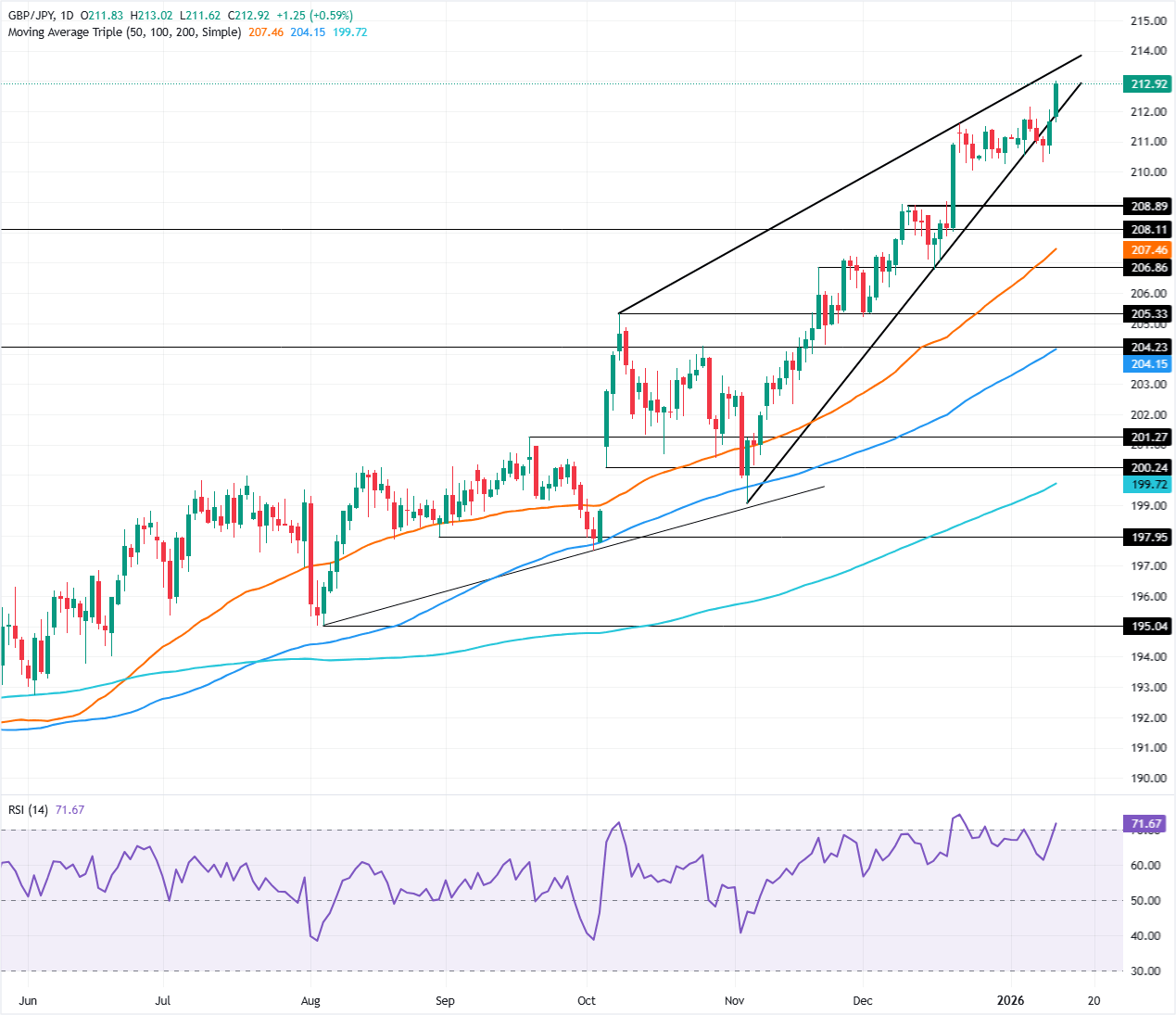
The GBP/JPY technical picture is bullish after the pair cleared the top of the 210.00-212.00 trading range, pushing the pair to new yearly highs of 212.93, with buyers eyeing the 213.00 mark. Once surpassed, the next stop would be 213.50 mark, ahead of 214.00.
On the flip side, the GBP/JPY first support would be the 212.00 figure. A breach of the latter would clear the way to challenge 211.00, followed by the 20-day Simple Moving Average (SMA) at 210.68. Once surpassed, the next stop would be the 50-day SMA at 207.36.
GBP/JPY Price Chart – Daily
Japanese Yen FAQs
The Japanese Yen (JPY) is one of the world’s most traded currencies. Its value is broadly determined by the performance of the Japanese economy, but more specifically by the Bank of Japan’s policy, the differential between Japanese and US bond yields, or risk sentiment among traders, among other factors.
One of the Bank of Japan’s mandates is currency control, so its moves are key for the Yen. The BoJ has directly intervened in currency markets sometimes, generally to lower the value of the Yen, although it refrains from doing it often due to political concerns of its main trading partners. The BoJ ultra-loose monetary policy between 2013 and 2024 caused the Yen to depreciate against its main currency peers due to an increasing policy divergence between the Bank of Japan and other main central banks. More recently, the gradually unwinding of this ultra-loose policy has given some support to the Yen.
Over the last decade, the BoJ’s stance of sticking to ultra-loose monetary policy has led to a widening policy divergence with other central banks, particularly with the US Federal Reserve. This supported a widening of the differential between the 10-year US and Japanese bonds, which favored the US Dollar against the Japanese Yen. The BoJ decision in 2024 to gradually abandon the ultra-loose policy, coupled with interest-rate cuts in other major central banks, is narrowing this differential.
The Japanese Yen is often seen as a safe-haven investment. This means that in times of market stress, investors are more likely to put their money in the Japanese currency due to its supposed reliability and stability. Turbulent times are likely to strengthen the Yen’s value against other currencies seen as more risky to invest in.
United States 10-Year Note Auction dipped from previous 4.175% to 4.173%
Information on these pages contains forward-looking statements that involve risks and uncertainties. Markets and instruments profiled on this page are for informational purposes only and should not in any way come across as a recommendation to buy or sell in these assets. You should do your own thorough research before making any investment decisions. FXStreet does not in any way guarantee that this information is free from mistakes, errors, or material misstatements. It also does not guarantee that this information is of a timely nature. Investing in Open Markets involves a great deal of risk, including the loss of all or a portion of your investment, as well as emotional distress. All risks, losses and costs associated with investing, including total loss of principal, are your responsibility. The views and opinions expressed in this article are those of the authors and do not necessarily reflect the official policy or position of FXStreet nor its advertisers. The author will not be held responsible for information that is found at the end of links posted on this page.
If not otherwise explicitly mentioned in the body of the article, at the time of writing, the author has no position in any stock mentioned in this article and no business relationship with any company mentioned. The author has not received compensation for writing this article, other than from FXStreet.
FXStreet and the author do not provide personalized recommendations. The author makes no representations as to the accuracy, completeness, or suitability of this information. FXStreet and the author will not be liable for any errors, omissions or any losses, injuries or damages arising from this information and its display or use. Errors and omissions excepted.
The author and FXStreet are not registered investment advisors and nothing in this article is intended to be investment advice.
CAD gains as USD pressure eases – Scotiabank

The Canadian Dollar (CAD) has picked up a little ground intraday, reflecting the broader pressure on the US Dollar (USD), Scotiabank’s Chief FX Strategists Shaun Osborne and Eric Theoret report.
Post-Christmas USD rally shows signs of stalling
“The CAD has struggled in the past few weeks, reflecting some weakening in CAD fundamentals (weaker oil prices, soft terms of trade) while CAD-supportive spreads have remained little changed. Spot losses so far today bring the USD closer to our assessment of fair value (1.3857) and may signal some potential for improvement in the CAD in the short run on the back of a generally softer USD.”
“Intraday price signals suggest the USD’s run higher over the post-Christmas period may be at least stalling. That was also the case on occasion last week but the broader context of the USD’s performance today suggests a stronger chance of the USD’s post-Christmas rally halting or even reversing.”
“Price is forming an inside range pattern on the daily chart. If confirmed, the pattern should strengthen USD resistance in the low/mid 1.39s. Support is 1.3850.”
USD/JPY Price Forecast: Bulls have the upper hand amid political risks, BoJ rate hike doubts
The USD/JPY pair touches a fresh one-year high, around the 158.20 region, at the start of a new week, though it lacks follow-through buying amid mixed fundamental cues. Against the backdrop of the uncertainty over the timing of the next interest rate hike by the Bank of Japan (BoJ) and a deepening Japan-China rift, talks of a snap election in Japan undermined the Japanese Yen (JPY) and supported the currency pair. Last week, China escalated its dispute with Japan and began restricting exports of dual-use goods, including some rare earth elements, to Japan. The ban followed a diplomatic row over Taiwan and heightens supply-chain risk for Japanese manufacturers. Furthermore, the Yomiuri newspaper reported on Friday that Japan’s Prime Minister Sanae Takaichi is considering holding a parliamentary election in the first half of February.
Meanwhile, the global risk sentiment takes a hit amid concerns about further escalation of geopolitical tensions and offers some support to the safe-haven JPY. Following a strike earlier this month, US President Donald Trump said that Washington would temporarily take charge of Venezuela’s administration to oversee a transition. Moreover, Trump referred to himself as the acting President of Venezuela in a post on Truth Social. Adding to this, the WSJ, citing unnamed US officials, reported that Trump is considering reprimanding Iran in response to its crackdown on mass anti-government demonstrators, which has killed more than 500 people. In response, Iran threatened to target US military bases if Trump carries out threats to intervene. This comes on top of the intensifying Russia-Ukraine war and tempers investors’ appetite for riskier assets.
A Ukrainian drone strike triggered a fire at an oil depot in Russia’s southern Volgograd region on Saturday. Russia, on the other hand, used its hypersonic Oreshnik intermediate-range ballistic missile in an overnight strike on the Lviv region, close to the EU and NATO borders. Apart from this, the emergence of some US Dollar (USD) selling contributes to capping the upside for the USD/JPY pair. As investors look past the US Nonfarm Payrolls (NFP) report, fresh concerns about the Federal Reserve’s (Fed) independence drag the USD away from its highest level since December 5, touched on Friday. The closely-watched US employment details showed that the economy added 50K new jobs in December compared to expectations for a reading of 60K and 56K (revised from 64K) in the previous month. Meanwhile, the Unemployment Rate fell to 4.4%.
This data led to a shift in the likelihood of a Fed rate cut at the next policy meeting on January 28, though it fails to provide any meaningful boost to the USD. Meanwhile, Fed Chair Jerome Powell, in a rare statement, said that the threat of criminal charges against him is a consequence of the central bank setting interest rates based on the best assessment of what will serve the public, rather than following the preferences of the President. This, in turn, prompts some intraday USD selling and warrants caution for the USD/JPY bulls. Traders, however, might opt to wait for the release of the US inflation figures – the Consumer Price Index (CPI) and the Producer Price Index (PPI) on Tuesday and Wednesday, respectively.
USD/JPY 4-hour chart
Technical Analysis:
The 200-period Simple Moving Average (SMA) is edging higher at 156.15, and the USD/JPY pair holds above it, sustaining a positive tone. The upward SMA slope supports buyers. The Moving Average Convergence Divergence (MACD) histogram stands in positive territory, indicating the MACD line above the Signal line and a bullish bias. The RSI at 66 is firm but below overbought, leaving room for continuation if momentum persists.
The long-term SMA keeps dips supported; a close back beneath 156.15 would weaken the near-term outlook for the USD/JPY pair. The recent contraction in the positive MACD histogram from 0.13 to 0.08 hints at moderating upside momentum, though it remains above zero. RSI easing from prior overbought readings aligns with a steadier, rather than accelerating, advance, while the overall bias stays constructive as long as the 200 SMA holds.
(The technical analysis of this story was written with the help of an AI tool.)
USD/CHF holds losses below 0.8000 as Swiss Franc rises on safe-haven flows

USD/CHF breaks its four-day winning streak, trading around 0.7990 during the Asian hours on Monday. The pair loses as the Swiss Franc (CHF) receives support from safe-haven demand amid increased geopolitical tensions. US President Donald Trump warned Tehran against using force on demonstrators and signaled possible action if the crackdown intensifies, while Iranian officials cautioned against any US or Israeli intervention.
Meanwhile, European countries led by the UK and Germany are considering increasing their military presence in Greenland to bolster Arctic security. Germany may propose a joint NATO mission, while UK Prime Minister Keir Starmer has urged allies to step up efforts in the High North, amid renewed comments by US President Donald Trump advocating US ownership of Greenland.
The CHF could further advance as investors assessed the Swiss National Bank (SNB) policy outlook. Swiss inflation rose to 0.1% year-over-year (YoY) in December 2025, marking the first increase since July but remaining near the lower end of the central bank’s 0–2% target range. This has reinforced expectations that the SNB will likely keep rates at 0% in the coming meetings, with inflation seen gradually rising alongside the economic recovery.
The USD/CHF pair depreciates as the US Dollar (USD) weakens, potentially amid concerns surrounding the Federal Reserve. Federal prosecutors have opened a criminal investigation into Fed Chair Jerome Powell regarding the central bank’s renovation of its Washington headquarters and whether Powell lied to Congress about the project’s scope, the New York Times reported on Sunday.
The Greenback declines on reinforced likelihood of further US Federal Rate cuts after the recent jobs report showed job growth fell short of expectations in December. US Nonfarm Payrolls (NFP) rose by 50,000 in December, falling short of November’s 56,000 (revised from 64,000) and came in weaker than the market expectation of 60,000. However, the Unemployment Rate ticked lower to 4.4% in December from 4.6% in November.
Swiss Franc FAQs
The Swiss Franc (CHF) is Switzerland’s official currency. It is among the top ten most traded currencies globally, reaching volumes that well exceed the size of the Swiss economy. Its value is determined by the broad market sentiment, the country’s economic health or action taken by the Swiss National Bank (SNB), among other factors. Between 2011 and 2015, the Swiss Franc was pegged to the Euro (EUR). The peg was abruptly removed, resulting in a more than 20% increase in the Franc’s value, causing a turmoil in markets. Even though the peg isn’t in force anymore, CHF fortunes tend to be highly correlated with the Euro ones due to the high dependency of the Swiss economy on the neighboring Eurozone.
The Swiss Franc (CHF) is considered a safe-haven asset, or a currency that investors tend to buy in times of market stress. This is due to the perceived status of Switzerland in the world: a stable economy, a strong export sector, big central bank reserves or a longstanding political stance towards neutrality in global conflicts make the country’s currency a good choice for investors fleeing from risks. Turbulent times are likely to strengthen CHF value against other currencies that are seen as more risky to invest in.
The Swiss National Bank (SNB) meets four times a year – once every quarter, less than other major central banks – to decide on monetary policy. The bank aims for an annual inflation rate of less than 2%. When inflation is above target or forecasted to be above target in the foreseeable future, the bank will attempt to tame price growth by raising its policy rate. Higher interest rates are generally positive for the Swiss Franc (CHF) as they lead to higher yields, making the country a more attractive place for investors. On the contrary, lower interest rates tend to weaken CHF.
Macroeconomic data releases in Switzerland are key to assessing the state of the economy and can impact the Swiss Franc’s (CHF) valuation. The Swiss economy is broadly stable, but any sudden change in economic growth, inflation, current account or the central bank’s currency reserves have the potential to trigger moves in CHF. Generally, high economic growth, low unemployment and high confidence are good for CHF. Conversely, if economic data points to weakening momentum, CHF is likely to depreciate.
As a small and open economy, Switzerland is heavily dependent on the health of the neighboring Eurozone economies. The broader European Union is Switzerland’s main economic partner and a key political ally, so macroeconomic and monetary policy stability in the Eurozone is essential for Switzerland and, thus, for the Swiss Franc (CHF). With such dependency, some models suggest that the correlation between the fortunes of the Euro (EUR) and the CHF is more than 90%, or close to perfect.