Bitcoin (BTC) broke below $85,000 in the North American session on Thursday, dropping nearly 3% in the one-hour timeframe. The move has seen the largest crypto by market cap erase over 5% of its value within the past 24 hours, briefly reaching $84,400, its lowest level since December 1, according to Binance data.
SGD: MAS positioned for inflation risks – Commerzbank

Commerzbank’s FX Research report by Charlie Lay and Moses Lim highlights that the Monetary Authority of Singapore (MAS) has maintained its current policy stance, leaving the SGD NEER unchanged. MAS has revised its inflation forecast for 2026 to 1-2% from 0.5-1.5%, indicating a readiness to respond to inflationary pressures. The SGD NEER is currently estimated to be +0.9% above the mid-point for USD-SGD at 1.2640. The report emphasizes that MAS is strategically positioned to manage economic uncertainties.
MAS maintains policy amid inflation concerns
“MAS revised up the headline and core inflation forecast for this year to 1-2% from 0.5-1.5% in October last year. MAS is strategically positioned to respond to the upside risks to inflation or downside risks to growth.”
“In the brief statement, MAS said that it ‘is in an appropriate position to respond effectively to any risk to medium-term price stability and will continue to closely monitor economic developments amid uncertainties in the external environment.'”
“For the SGD NEER valuation, we estimate it is at the strong end of the band at +0.9% above the mid-point for USD-SGD at 1.2640, USD-MYR at 3.9330, and USD-CNY at 6.9490. The +/-2% range around the mid-point corresponds to USD-SGD at 1.2510-1.3020, with the mid-point at 1.2760, ceteris paribus.”
“Overall, it was status quo from MAS. They are strategically and well-positioned to tackle the landscape ahead. There is no urgency to ease monetary conditions further, given the robust growth momentum.”
(This article was created with the help of an Artificial Intelligence tool and reviewed by an editor.)
United States EIA Natural Gas Storage Change came in at -242B, below expectations (-232B) in January 23
Gold pushed to fresh record highs around the $5,600 mark per troy ounce on Thursday. The yellow metal’s relentless run has been fuelled by strong safe-haven demand, underpinned by ongoing geopolitical tensions, economic uncertainty and a softer US Dollar.
EUR/USD retreats within range after upbeat Eurozone sentiment figures
The EUR/USD pair is trading higher on Thursday, with price action back at 1.1970 at the time of writing, after bouncing from lows right below 1.1900 the previous day. The Federal Reserve‘s (Fed) hawkish stance at Wednesday’s meeting and comments by US Treasury Secretary Scott Bessent touting a strong US Dollar (USD) provided some support to the currency, but failed to trigger a solid recovery.
The Fed left interest rates on hold, with Chairman Jerome Powell showing more confidence about the economy and the labor market, adding to the case for a steady monetary policy in the coming months.
Apart from that, US Treasury Secretary Scott Bessent mended US President Donald Trump’s comments, affirming that Washington pursues a “strong-Dollar” policy, while European Central Bank (ECB) and European Union (EU) officials started to complain about excessive Euro strength, which contributed to pushing EUR/USD lower.
In the Eurozone economic calendar on Thursday, the Consumer Confidence for January might provide some distraction. In the US, Goods Trade Balance, Factory Orders, and the weekly Jobless Claims data might provide some guidance to the US Dollar.
Euro Price Today
The table below shows the percentage change of Euro (EUR) against listed major currencies today. Euro was the strongest against the US Dollar.
| USD | EUR | GBP | JPY | CAD | AUD | NZD | CHF | |
|---|---|---|---|---|---|---|---|---|
| USD | -0.23% | -0.23% | -0.02% | -0.22% | -0.57% | -0.38% | -0.29% | |
| EUR | 0.23% | -0.00% | 0.18% | 0.01% | -0.34% | -0.15% | -0.06% | |
| GBP | 0.23% | 0.00% | 0.23% | 0.01% | -0.36% | -0.17% | -0.06% | |
| JPY | 0.02% | -0.18% | -0.23% | -0.20% | -0.54% | -0.38% | -0.27% | |
| CAD | 0.22% | -0.01% | -0.01% | 0.20% | -0.35% | -0.17% | -0.08% | |
| AUD | 0.57% | 0.34% | 0.36% | 0.54% | 0.35% | 0.19% | 0.29% | |
| NZD | 0.38% | 0.15% | 0.17% | 0.38% | 0.17% | -0.19% | 0.09% | |
| CHF | 0.29% | 0.06% | 0.06% | 0.27% | 0.08% | -0.29% | -0.09% |
The heat map shows percentage changes of major currencies against each other. The base currency is picked from the left column, while the quote currency is picked from the top row. For example, if you pick the Euro from the left column and move along the horizontal line to the US Dollar, the percentage change displayed in the box will represent EUR (base)/USD (quote).
Daily Digest Market Movers: Euro consolidates gains, the US Dollar remains vulnerable
- The US Dollar drew some support from Wednesday’s Fed hawkish stance and US Treasury Secretary Bessent’s comments. The Greenback’s upside attempts, however, remain limited, with investors pricing further rate cuts from May on, when Trump replaces Powell with a more dovish Fed Chairman.
- The US Dollar Index, which measures the value of the Greenback against a basket of currencies, remains more than 2% down in 2026 so far, weighed by Trump’s erratic trade policies and the attacks on the Fed’s independence, two of the main pillars of the US Dollar’s status as reserve currency.
- In Europe, the ECB officials’ view that monetary policy is in a good place is starting to show its first cracks. ECB member and Austrian central bank governor Martin Kocher mentioned interest rate cuts for the first time since June last year, and German Chancellor Friedrich Merz complained that USD weakness is a burden for German exports. If the stance of the European Central Bank changes, the Euro might see a deeper correction.
- In the macroeconomic front, the Eurozone Consumer Confidence index, due later on the day, is expected to remain at -12.4 in January, unchanged from the previous month. The Industrial Confidence is forecast to improve to -8.1 from -9 in the previous month.
- In the US, Initial Jobless Claims are expected to have increased to 205K last week, from the 200K reading in the previous week.
- At a later time, US Factory Orders are expected to show a rebound to 1.6% in November, following a 1.3% contraction in October.
- The US Goods and Services Trade Balance, on the contrary, is forecasted to show a widening deficit of $40.5 billion in November, from the $29.4 billion trade gap seen in October.
Technical Analysis: EUR/USD consolidates between 1.1900 and 1.2000
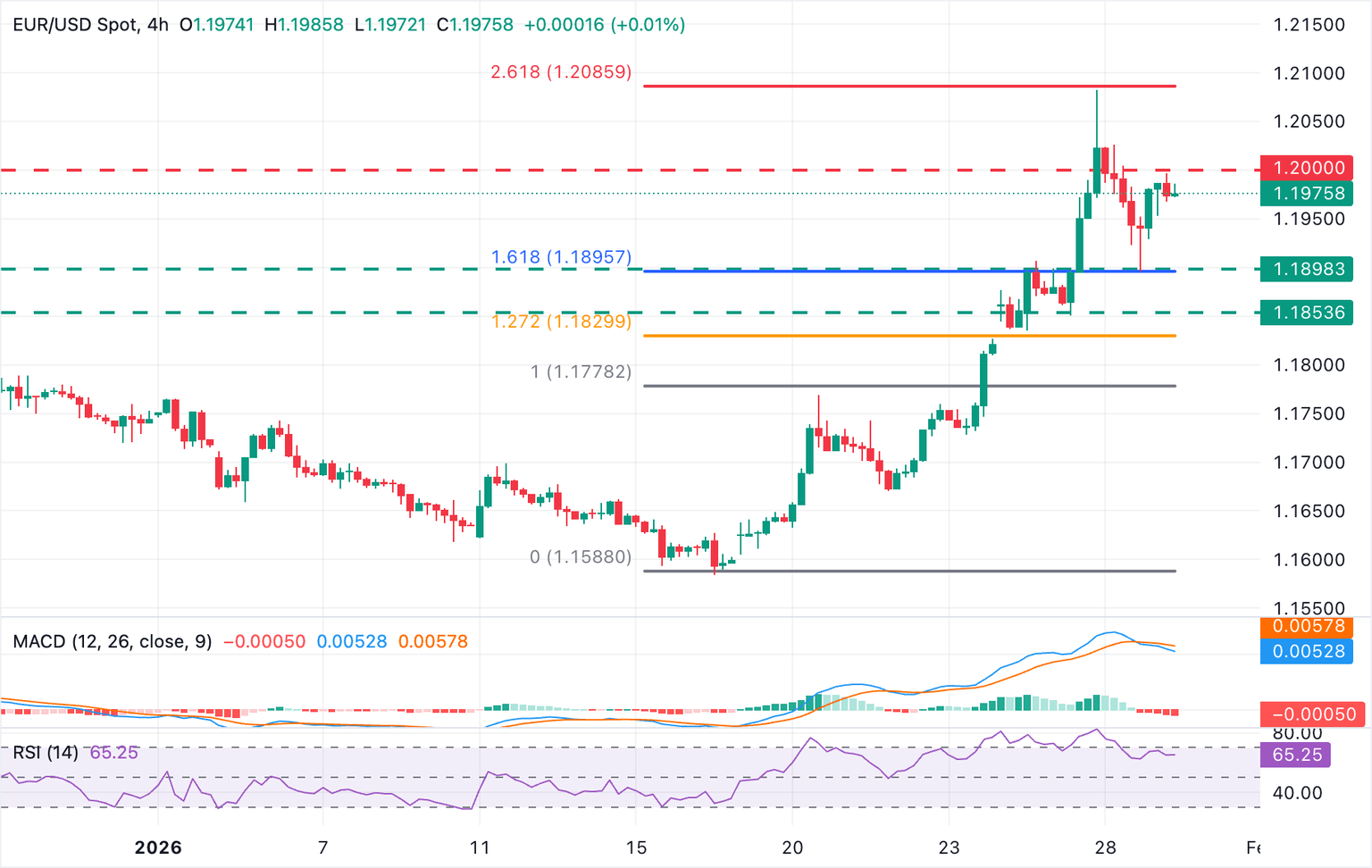
EUR/USD is in a consolidation phase after the reversal from the 261.8% Fibonacci extension of the January 16-20 uptrend, at 1.2085, was contained at the 1.1900 area.
Technical indicators are mixed. The Relative Strength Index (RSI) stands at 65 on the 4-hour chart, highlighting a positive trend, although the Moving Average Convergence Divergence (MACD) has crossed below the signal line, with the histogram turning negative, which points to a fading upside momentum.
Support levels are at Wednesday’s low in the area of 1.1900, and the January 27 low, at 1.1850. On the upside, the 1.2000 psychological level is holding bulls at the present time, ahead of the 1.2082 long-term high hit on Tuesday.
(The technical analysis of this story was written with the help of an AI tool.)
Euro FAQs
The Euro is the currency for the 20 European Union countries that belong to the Eurozone. It is the second most heavily traded currency in the world behind the US Dollar. In 2022, it accounted for 31% of all foreign exchange transactions, with an average daily turnover of over $2.2 trillion a day.
EUR/USD is the most heavily traded currency pair in the world, accounting for an estimated 30% off all transactions, followed by EUR/JPY (4%), EUR/GBP (3%) and EUR/AUD (2%).
The European Central Bank (ECB) in Frankfurt, Germany, is the reserve bank for the Eurozone. The ECB sets interest rates and manages monetary policy.
The ECB’s primary mandate is to maintain price stability, which means either controlling inflation or stimulating growth. Its primary tool is the raising or lowering of interest rates. Relatively high interest rates – or the expectation of higher rates – will usually benefit the Euro and vice versa.
The ECB Governing Council makes monetary policy decisions at meetings held eight times a year. Decisions are made by heads of the Eurozone national banks and six permanent members, including the President of the ECB, Christine Lagarde.
Eurozone inflation data, measured by the Harmonized Index of Consumer Prices (HICP), is an important econometric for the Euro. If inflation rises more than expected, especially if above the ECB’s 2% target, it obliges the ECB to raise interest rates to bring it back under control.
Relatively high interest rates compared to its counterparts will usually benefit the Euro, as it makes the region more attractive as a place for global investors to park their money.
Data releases gauge the health of the economy and can impact on the Euro. Indicators such as GDP, Manufacturing and Services PMIs, employment, and consumer sentiment surveys can all influence the direction of the single currency.
A strong economy is good for the Euro. Not only does it attract more foreign investment but it may encourage the ECB to put up interest rates, which will directly strengthen the Euro. Otherwise, if economic data is weak, the Euro is likely to fall.
Economic data for the four largest economies in the euro area (Germany, France, Italy and Spain) are especially significant, as they account for 75% of the Eurozone’s economy.
Another significant data release for the Euro is the Trade Balance. This indicator measures the difference between what a country earns from its exports and what it spends on imports over a given period.
If a country produces highly sought after exports then its currency will gain in value purely from the extra demand created from foreign buyers seeking to purchase these goods. Therefore, a positive net Trade Balance strengthens a currency and vice versa for a negative balance.
AUD/JPY Price Forecast: Keeps bullish vibe near 108.50 amid Japan’s fiscal and political challenges
The AUD/JPY cross extends the rally to near 108.50 during the early European session on Thursday. Concerns over fiscal health and political uncertainty in Japan weigh on the Japanese Yen (JPY) against the Australian Dollar (AUD). Japan’s Prime Minister Sanae Takaichi unveiled plans to pause the country’s consumption tax if her Liberal Democratic Party wins the February 8 election.
Meanwhile, speculation about a possible intervention by Japanese authorities might help limit the JPY’s losses. Takaichi warned over the weekend that officials stand ready to take necessary steps against speculative and highly abnormal market moves.
Technical Analysis:
In the daily chart, AUD/JPY holds above the 100-day EMA, keeping the broader uptrend intact. Price sits marginally above the upper Bollinger Band at 108.39, indicating a stretched advance as the bands widen. RSI at 68.31 is close to the overbought threshold and confirms firm bullish momentum. A daily close above the band could extend the move, while rejection would open a corrective slide toward the middle band.
Bollinger Bands remain in expansion, keeping volatility elevated as the trend extends. The 100-day EMA at 102.46 remains a deeper trend floor. RSI below 70 leaves limited room before overbought conditions; a downtick from here would flag consolidation rather than a reversal. The initial support is seen at the middle band of 106.35, followed by the lower Bollinger Band at 104.35. Staying above the rising middle band would keep the bullish bias intact.
(The technical analysis of this story was written with the help of an AI tool.)
Japanese Yen FAQs
The Japanese Yen (JPY) is one of the world’s most traded currencies. Its value is broadly determined by the performance of the Japanese economy, but more specifically by the Bank of Japan’s policy, the differential between Japanese and US bond yields, or risk sentiment among traders, among other factors.
One of the Bank of Japan’s mandates is currency control, so its moves are key for the Yen. The BoJ has directly intervened in currency markets sometimes, generally to lower the value of the Yen, although it refrains from doing it often due to political concerns of its main trading partners. The BoJ ultra-loose monetary policy between 2013 and 2024 caused the Yen to depreciate against its main currency peers due to an increasing policy divergence between the Bank of Japan and other main central banks. More recently, the gradually unwinding of this ultra-loose policy has given some support to the Yen.
Over the last decade, the BoJ’s stance of sticking to ultra-loose monetary policy has led to a widening policy divergence with other central banks, particularly with the US Federal Reserve. This supported a widening of the differential between the 10-year US and Japanese bonds, which favored the US Dollar against the Japanese Yen. The BoJ decision in 2024 to gradually abandon the ultra-loose policy, coupled with interest-rate cuts in other major central banks, is narrowing this differential.
The Japanese Yen is often seen as a safe-haven investment. This means that in times of market stress, investors are more likely to put their money in the Japanese currency due to its supposed reliability and stability. Turbulent times are likely to strengthen the Yen’s value against other currencies seen as more risky to invest in.
AUD/USD rises to near 0.7050 as RBA rate hike bets increase

AUD/USD extends its gains for the third successive session, trading around 0.7040 during the Asian hours on Thursday. The pair appreciated after hotter-than-expected Australian inflation data, released on Wednesday, lifted the odds of a Reserve Bank of Australia (RBA) rate hike as early as next week.
Markets now price in over a 70% chance of a 25 basis points (bps) hike by the RBA from the 3.6% cash rate, up from 60% before the release, with rates fully priced at 3.85% by May and around 4.10% by September.
Australia’s CPI rose by 3.8% year-over-year (YoY) in December, following a 3.4% increase prior. The market consensus was for 3.6% growth in the reported period. Australia’s RBA Trimmed Mean inflation increased to 0.2% month-over-month (MoM) and 3.3% year-over-year (YoY). The monthly CPI rose 1.0% in December, up from 0% previously and above the 0.7% forecast.
Australia’s export prices rose 3.2% quarter-on-quarter (QoQ) in Q4 2025, rebounding from a 0.9% fall in Q3 and marking the first increase in three quarters, as well as the strongest gain in a year. Meanwhile, Import prices climbed 0.9%, beating expectations for a 0.2% decline and reversing a 0.4% drop in Q3.
The upside of the AUD/USD pair could be restrained as the US Dollar (USD) strengthens after US Treasury Secretary Scott Bessent reiterated the US commitment to a strong USD policy. The US Federal Reserve (Fed) kept interest rates unchanged at its January meeting on Wednesday, pointing to still-elevated inflation and resilient economic growth.
Fed Chair Jerome Powell noted during the post-meeting press conference that job gains have moderated and the unemployment rate has shown signs of stabilization, adding that the Fed is “well positioned” to assess incoming data on a meeting-by-meeting basis and remains off a preset path for future rate decisions.
Australian Dollar FAQs
One of the most significant factors for the Australian Dollar (AUD) is the level of interest rates set by the Reserve Bank of Australia (RBA). Because Australia is a resource-rich country another key driver is the price of its biggest export, Iron Ore. The health of the Chinese economy, its largest trading partner, is a factor, as well as inflation in Australia, its growth rate and Trade Balance. Market sentiment – whether investors are taking on more risky assets (risk-on) or seeking safe-havens (risk-off) – is also a factor, with risk-on positive for AUD.
The Reserve Bank of Australia (RBA) influences the Australian Dollar (AUD) by setting the level of interest rates that Australian banks can lend to each other. This influences the level of interest rates in the economy as a whole. The main goal of the RBA is to maintain a stable inflation rate of 2-3% by adjusting interest rates up or down. Relatively high interest rates compared to other major central banks support the AUD, and the opposite for relatively low. The RBA can also use quantitative easing and tightening to influence credit conditions, with the former AUD-negative and the latter AUD-positive.
China is Australia’s largest trading partner so the health of the Chinese economy is a major influence on the value of the Australian Dollar (AUD). When the Chinese economy is doing well it purchases more raw materials, goods and services from Australia, lifting demand for the AUD, and pushing up its value. The opposite is the case when the Chinese economy is not growing as fast as expected. Positive or negative surprises in Chinese growth data, therefore, often have a direct impact on the Australian Dollar and its pairs.
Iron Ore is Australia’s largest export, accounting for $118 billion a year according to data from 2021, with China as its primary destination. The price of Iron Ore, therefore, can be a driver of the Australian Dollar. Generally, if the price of Iron Ore rises, AUD also goes up, as aggregate demand for the currency increases. The opposite is the case if the price of Iron Ore falls. Higher Iron Ore prices also tend to result in a greater likelihood of a positive Trade Balance for Australia, which is also positive of the AUD.
The Trade Balance, which is the difference between what a country earns from its exports versus what it pays for its imports, is another factor that can influence the value of the Australian Dollar. If Australia produces highly sought after exports, then its currency will gain in value purely from the surplus demand created from foreign buyers seeking to purchase its exports versus what it spends to purchase imports. Therefore, a positive net Trade Balance strengthens the AUD, with the opposite effect if the Trade Balance is negative.
Federal Reserve pauses, sees economy on firm footing

At its January meeting, the Federal Reserve kept the Fed Funds Target Range (FFTR) unchanged at 3.50%–3.75%, a decision that was fully in line with market expectations.
FOMC statement highlights
The Committee acknowledged that inflation remains somewhat elevated, while noting that it no longer judges downside risks to employment as rising. The unemployment rate has shown signs of stabilisation, although job gains remain low, and uncertainty around the economic outlook remains elevated.
The Fed upgraded its assessment of economic activity, saying growth has been expanding at a “solid” pace, while reiterating that it remains attentive to risks on both sides of its dual mandate. The statement also reaffirmed the longer-run goals and monetary policy strategy.
The decision passed by a 10–2 vote, with Governors Miran and Waller dissenting in favour of a 25 basis points rate cut.
Powell press conference
Chair Powell said the US economy is on firm footing and that the current stance of policy is appropriate, continuing to promote progress towards both employment and inflation objectives. He noted that housing activity remains weak, while government shutdown effects should be reversed this quarter.
Powell suggested the labour market may be stabilising, though job growth has slowed, reflecting both a decline in labour force growth and softening labour demand. Measures such as Conference Board job availability point to some cooling, and Powell acknowledged that the labour market has softened, even as the economy has again surprised with its strength.
On inflation, Powell reiterated that it remains somewhat elevated relative to the Fed’s goal, with core PCE inflation in December estimated at around 3%. He stressed that most of the inflation overshoot has come from goods prices linked to tariffs, rather than demand, and described core PCE excluding tariff effects as running just above 2%, calling this a healthy development. Disinflation in services is continuing, while tariff-related goods inflation is expected to peak around the middle of the year and then ease, with much of the overshoot seen as one-time.
On policy, Powell said the policy rate is within the range of plausible estimates of neutral, likely towards the higher end, and argued it is hard to characterise policy as significantly restrictive based on incoming data. He stressed that policy is not on a preset course, with decisions taken meeting by meeting, and that the Committee is well positioned to determine the extent and timing of further adjustments.
Powell said no one’s base case is a rate hike, adding that a weakening labour market would argue for cuts, while continued labour strength would not. He noted that risks to both sides of the mandate have diminished somewhat, though it is hard to say they are fully in balance.
Finally, Powell said short-term inflation expectations have fully retraced, which he described as “very comforting”, while longer-term expectations continue to reflect confidence in a return to 2% inflation, reiterating that the Fed will always act if the economy moves away from its goals.
Overall, Powell’s tone was broadly neutral, leaning mildly dovish, as he downplayed restrictiveness, highlighted improving inflation dynamics, and kept the door open to future cuts without committing to them.
Interest rates FAQs
US Treasury Bessent: Rates up to the Fed, Chair race still wide open

US Treasury Secretary Scott Bessent said rate decisions remain firmly in the Fed’s domain and expressed hope that policymakers would keep an open mind.
Key Quotes
Miran’s term could continue.
It is up to the Fed on rates.
I hope they will have an open mind.
Have not narrowed or expanded chairman candidates.
I spoke with Trump on the Fed chair on Tuesday.
Fed FAQs
Monetary policy in the US is shaped by the Federal Reserve (Fed). The Fed has two mandates: to achieve price stability and foster full employment. Its primary tool to achieve these goals is by adjusting interest rates.
When prices are rising too quickly and inflation is above the Fed’s 2% target, it raises interest rates, increasing borrowing costs throughout the economy. This results in a stronger US Dollar (USD) as it makes the US a more attractive place for international investors to park their money.
When inflation falls below 2% or the Unemployment Rate is too high, the Fed may lower interest rates to encourage borrowing, which weighs on the Greenback.
The Federal Reserve (Fed) holds eight policy meetings a year, where the Federal Open Market Committee (FOMC) assesses economic conditions and makes monetary policy decisions.
The FOMC is attended by twelve Fed officials – the seven members of the Board of Governors, the president of the Federal Reserve Bank of New York, and four of the remaining eleven regional Reserve Bank presidents, who serve one-year terms on a rotating basis.
In extreme situations, the Federal Reserve may resort to a policy named Quantitative Easing (QE). QE is the process by which the Fed substantially increases the flow of credit in a stuck financial system.
It is a non-standard policy measure used during crises or when inflation is extremely low. It was the Fed’s weapon of choice during the Great Financial Crisis in 2008. It involves the Fed printing more Dollars and using them to buy high grade bonds from financial institutions. QE usually weakens the US Dollar.
Quantitative tightening (QT) is the reverse process of QE, whereby the Federal Reserve stops buying bonds from financial institutions and does not reinvest the principal from the bonds it holds maturing, to purchase new bonds. It is usually positive for the value of the US Dollar.
Ripple Price Forecast: XRP $2.00 breakout in focus, supported by unwavering institutional interest
Ripple (XRP) is trading at $1.92 at the time of writing on Wednesday, and consolidating above support at $1.90. Bulls have exhibited relative strength since Monday, driving XRP upward from the weekly open at $1.84.
Investors are navigating a delicate balance between institutional optimism and macro headwinds, especially with a market consensus that the Federal Reserve (Fed) will keep interest rates unchanged in Wednesday’s monetary policy decision.
XRP steadies as institutional and retail interest revives optimism
Interest in spot XRP Exchange Traded Funds (ETFs) has remained largely stable since their launch, despite price volatility. The ETFs, licensed to operate in the United States (US), recorded approximately $9 million in inflows on Tuesday, bringing cumulative net inflows to $1.25 billion, with the total assets under management (AUM) hovering at $1.38 billion.
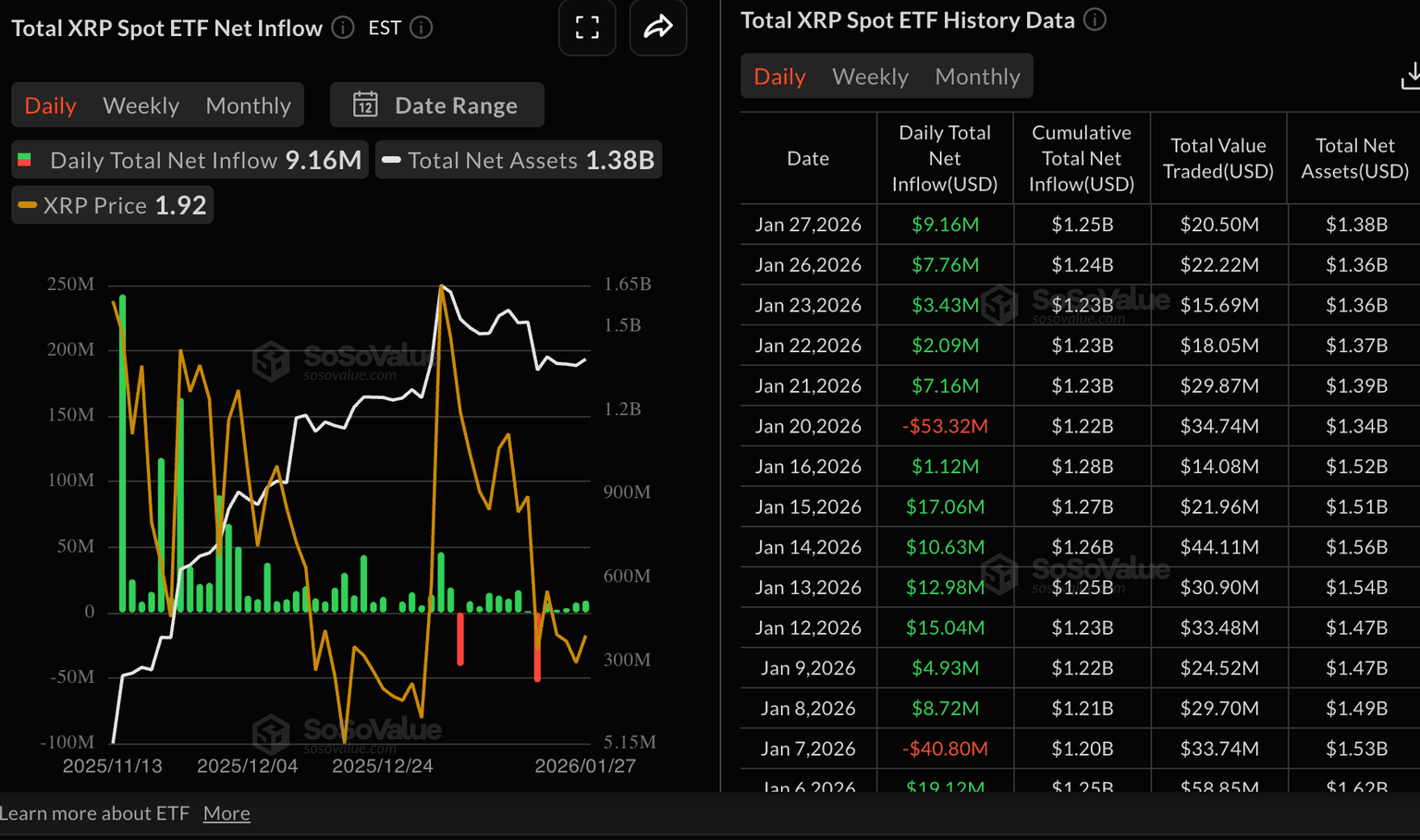
The unwavering institutional demand for XRP spot ETFs stands in stark contrast to broader crypto market weakness, as Bitcoin (BTC) and Ethereum (ETH) ETFs faced significant outflows of approximately $147 million and $64 million, respectively, during the same period.
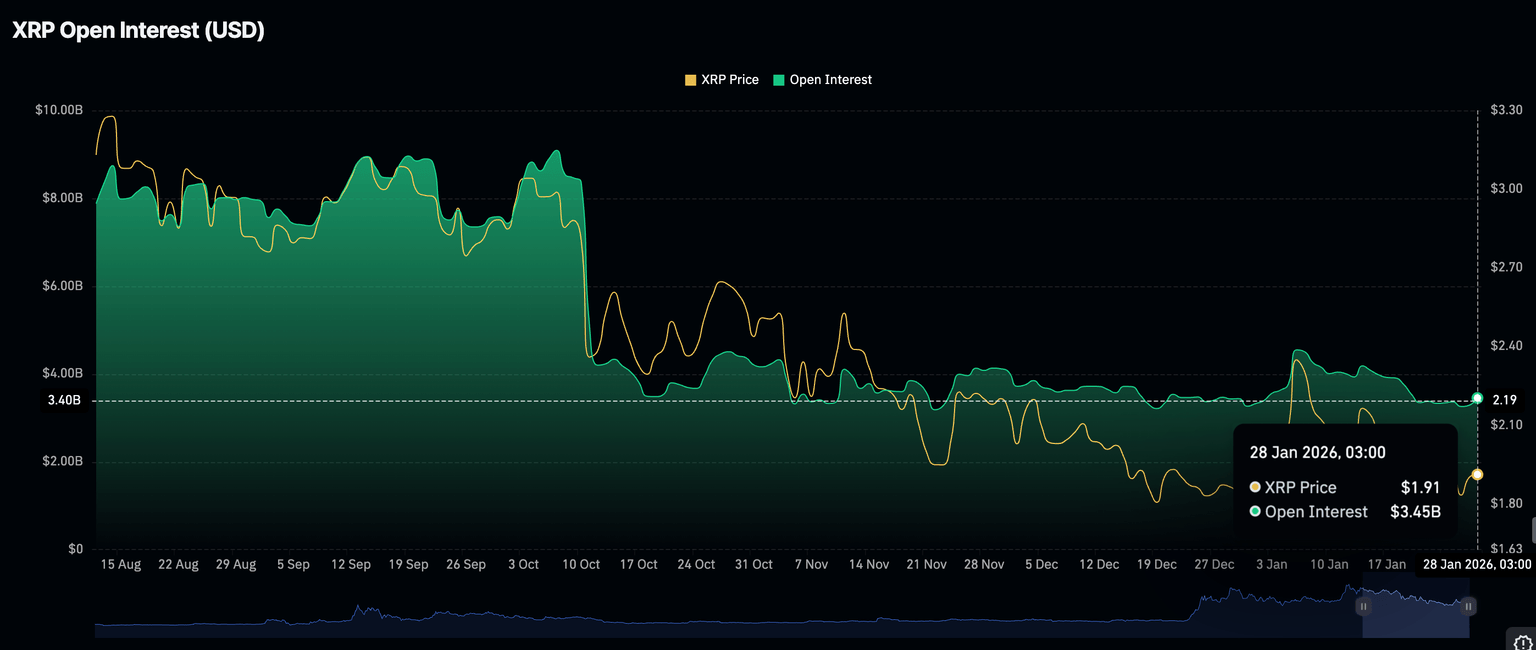
The derivatives market supports investor optimism for a breakout, as XRP futures Open Interest (OI) increases to $3.45 billion on Wednesday from $3.29 billion the previous day. The uptick in OI reflects renewed retail confidence in XRP’s near-term prospects. However, for XRP to steady its uptrend, traders should continue opening new positions. OI tracks the notional value of outstanding futures contracts.
Technical outlook: XRP bulls seek control
XRP showcases stability above support at $1.90, underpinned by strengthening technical indicators. For instance, the Relative Strength Index (RSI) has ascended to 45 on the daily chart, signalling fading bearish momentum. An increase in the RSI above the midline would steady bullish momentum and boost the chances of XRP rising above the $2.00 hurdle.
A decisive break above the 50-day Exponential Moving Average (EMA) at $2.02 could open the door for a move toward higher resistance levels. The 100-day EMA highlights the supply at $2.15 and the 200-day EMA at $2.28.
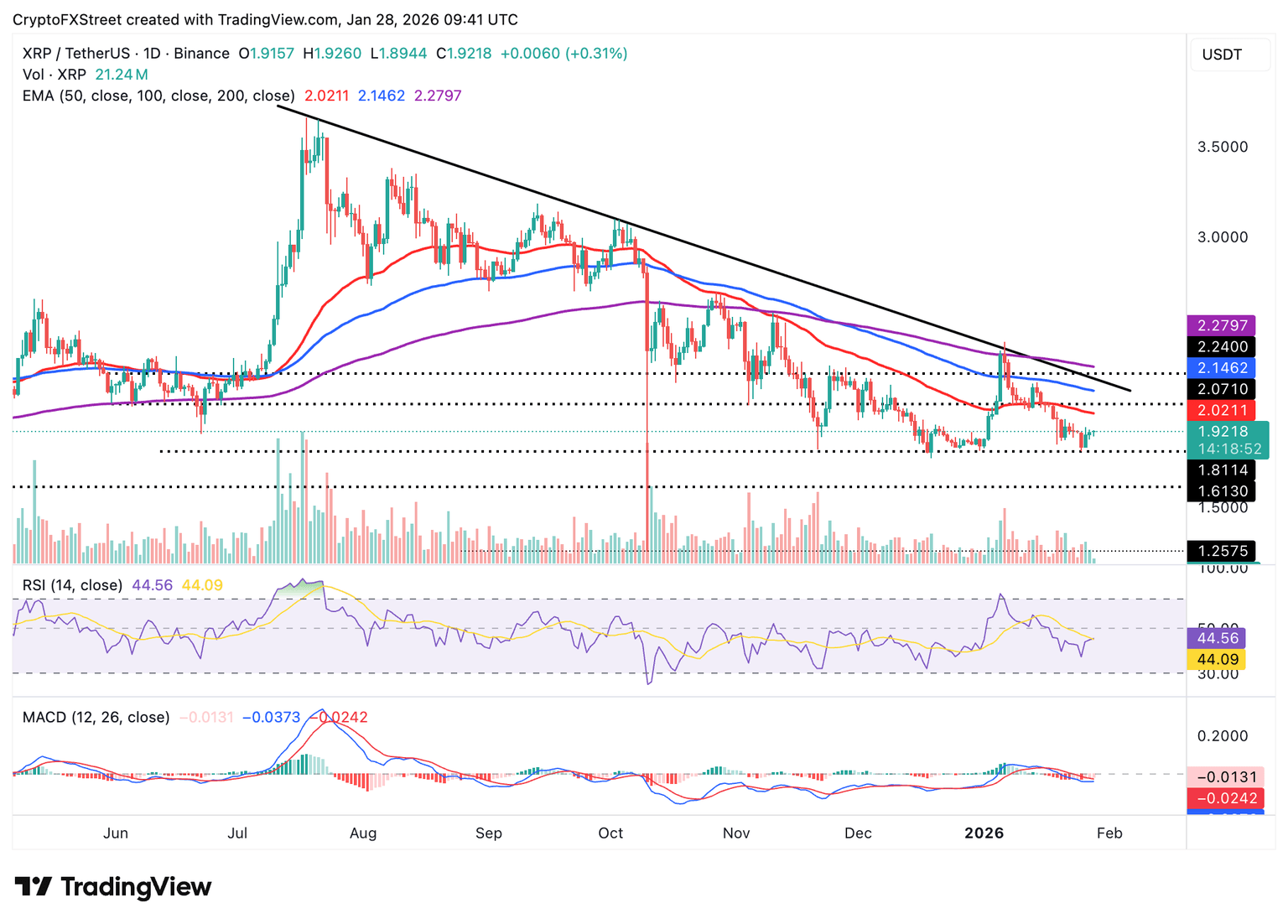
Still, the token faces mounting overhead pressure, as the Moving Average Convergence Divergence (MACD) remains in the negative region and below its signal line. Failure to hold current support risks extending losses toward the January lows of $1.81.
Crypto ETF FAQs
An Exchange-Traded Fund (ETF) is an investment vehicle or an index that tracks the price of an underlying asset. ETFs can not only track a single asset, but a group of assets and sectors. For example, a Bitcoin ETF tracks Bitcoin’s price. ETF is a tool used by investors to gain exposure to a certain asset.
Yes. The first Bitcoin futures ETF in the US was approved by the US Securities & Exchange Commission in October 2021. A total of seven Bitcoin futures ETFs have been approved, with more than 20 still waiting for the regulator’s permission. The SEC says that the cryptocurrency industry is new and subject to manipulation, which is why it has been delaying crypto-related futures ETFs for the last few years.
Yes. The SEC approved in January 2024 the listing and trading of several Bitcoin spot Exchange-Traded Funds, opening the door to institutional capital and mainstream investors to trade the main crypto currency. The decision was hailed by the industry as a game changer.
The main advantage of crypto ETFs is the possibility of gaining exposure to a cryptocurrency without ownership, reducing the risk and cost of holding the asset. Other pros are a lower learning curve and higher security for investors since ETFs take charge of securing the underlying asset holdings. As for the main drawbacks, the main one is that as an investor you can’t have direct ownership of the asset, or, as they say in crypto, “not your keys, not your coins.” Other disadvantages are higher costs associated with holding crypto since ETFs charge fees for active management. Finally, even though investing in ETFs reduces the risk of holding an asset, price swings in the underlying cryptocurrency are likely to be reflected in the investment vehicle too.
AUD/USD: Potential for further gains – UOB Group

The UOB Group report by Quek Ser Leang and Lee Sue Ann highlights that the Australian Dollar is likely to continue its upward trajectory, with potential resistance at 0.7050. The report notes that while further strength is anticipated, overbought conditions may limit the extent of the rally. Support levels are identified at 0.6965 and 0.6940.
Australian Dollar strength expected
“Upward momentum remains strong, but it is uncertain how much further this rally can extend; the next resistance is at 0.7050.”
“While further AUD strength is not ruled out, deeply overbought conditions suggest that any advance is unlikely to break clearly above 0.7050.”
(This article was created with the help of an Artificial Intelligence tool and reviewed by an editor.)