Bitcoin, Ethereum, and Ripple are approaching key technical levels at the time of writing on Monday as the broader crypto market stabilizes. Market participants are closely watching whether BTC, ETH, and XRP can sustain breakouts and achieve decisive daily closes above nearby resistance levels, which could signal the start of a short-term recovery.
Gold climbs to record high near $4,400 on safe-haven flows
Gold price (XAU/USD) rises to an all-time high near $4,300 during the Asian trading hours on Monday. The precious metal gains momentum on the expectation of US Federal Reserve (Fed) interest rate cuts after signs of softer US inflation and cooler jobs reports. Lower interest rates could reduce the opportunity cost of holding Gold, supporting the non-yielding precious metal.
Additionally, persistent safe-haven demand amid the Israel-Iran conflict and the rise in US-Venezuela tensions might contribute to the yellow metal’s upside. It’s worth noting that traders seek assets that can preserve value during periods of uncertainty, which supports the Gold price.
Financial markets are likely to trade in a subdued mood, and traders might book profits ahead of the long holiday period. This, in turn, might cap the upside for the precious metal. The US Chicago Fed National Activity Index report for September will be published later on Monday. On Tuesday, the preliminary reading of the US Gross Domestic Product (GDP) for the third quarter (Q3) will be in the spotlight.
Daily Digest Market Movers: Gold jumps amid Fed rate cut expectations, safe-haven flows
- The US is still in pursuit of a third oil tanker near Venezuela, officials told Reuters on Sunday, as US President Donald Trump intensifies an oil blockade on Nicolás Maduro’s government.
- Israel’s Prime Minister Benjamin Netanyahu said over the weekend that officials are preparing to brief US President Donald Trump about options for attacking Iran again, according to Reuters.
- The final reading from the University of Michigan on Friday showed that the Consumer Sentiment Index was downwardly revised to 52.9 in December from a preliminary reading of 53.3. Economists had expected the index to be upwardly revised to 53.4.
- Cleveland Fed President Beth Hammack said on Sunday that monetary policy is in a good place to pause, and she will assess the effects of 75 basis points (bps) of rate cuts on the economy during the first quarter, per Bloomberg.
- Financial markets are pricing in only a 21.0% chance the Fed will cut interest rates at its next meeting in January, after it reduced them by a quarter-point at each of its last three meetings, according to the CME FedWatch tool.
Gold stays bullish and prepares to challenge its record high
Gold trades in positive territory on the day. According to the four-hour chart, the yellow metal maintains the bullish outlook as the price is well-supported above the key 100-period Exponential Moving Average. Furthermore, the Bollinger Bands widen and the 14-day Relative Strength Index (RSI) is located above the midline, keeping the bulls in check.
The immediate resistance level for XAU/USD emerges at an all-time high of $4,381. A clean break above this level could set Gold up toward the $4,400 psychological mark.
On the flip side, sustained trading below the December 20 low of $4,337 could invite fresh selling pressure and drag the price down to the lower limit of the Bollinger Band of $4,307, followed by the 100-day EMA of $4,253.

Gold FAQs
Gold has played a key role in human’s history as it has been widely used as a store of value and medium of exchange. Currently, apart from its shine and usage for jewelry, the precious metal is widely seen as a safe-haven asset, meaning that it is considered a good investment during turbulent times. Gold is also widely seen as a hedge against inflation and against depreciating currencies as it doesn’t rely on any specific issuer or government.
Central banks are the biggest Gold holders. In their aim to support their currencies in turbulent times, central banks tend to diversify their reserves and buy Gold to improve the perceived strength of the economy and the currency. High Gold reserves can be a source of trust for a country’s solvency. Central banks added 1,136 tonnes of Gold worth around $70 billion to their reserves in 2022, according to data from the World Gold Council. This is the highest yearly purchase since records began. Central banks from emerging economies such as China, India and Turkey are quickly increasing their Gold reserves.
Gold has an inverse correlation with the US Dollar and US Treasuries, which are both major reserve and safe-haven assets. When the Dollar depreciates, Gold tends to rise, enabling investors and central banks to diversify their assets in turbulent times. Gold is also inversely correlated with risk assets. A rally in the stock market tends to weaken Gold price, while sell-offs in riskier markets tend to favor the precious metal.
The price can move due to a wide range of factors. Geopolitical instability or fears of a deep recession can quickly make Gold price escalate due to its safe-haven status. As a yield-less asset, Gold tends to rise with lower interest rates, while higher cost of money usually weighs down on the yellow metal. Still, most moves depend on how the US Dollar (USD) behaves as the asset is priced in dollars (XAU/USD). A strong Dollar tends to keep the price of Gold controlled, whereas a weaker Dollar is likely to push Gold prices up.
Japan’s Top FX Diplomat Mimura: Recently seeing one-sided, rapid moves

Atsushi Mimura, Japan’s Vice Finance Minister for International Affairs and top foreign exchange official, said on Monday that he is concerned about foreign exchange move and will take appropriate action against excessive actions.
Key quotes
Recently seeing one-sided, rapid moves.
Will take appropriate action against excessive moves.
Concerned about the forex move.
Market reaction
At the time of writing, the USD/JPY pair is trading around 157.65, down 0.08% on the day.
Japanese Yen FAQs
The Japanese Yen (JPY) is one of the world’s most traded currencies. Its value is broadly determined by the performance of the Japanese economy, but more specifically by the Bank of Japan’s policy, the differential between Japanese and US bond yields, or risk sentiment among traders, among other factors.
One of the Bank of Japan’s mandates is currency control, so its moves are key for the Yen. The BoJ has directly intervened in currency markets sometimes, generally to lower the value of the Yen, although it refrains from doing it often due to political concerns of its main trading partners. The BoJ ultra-loose monetary policy between 2013 and 2024 caused the Yen to depreciate against its main currency peers due to an increasing policy divergence between the Bank of Japan and other main central banks. More recently, the gradually unwinding of this ultra-loose policy has given some support to the Yen.
Over the last decade, the BoJ’s stance of sticking to ultra-loose monetary policy has led to a widening policy divergence with other central banks, particularly with the US Federal Reserve. This supported a widening of the differential between the 10-year US and Japanese bonds, which favored the US Dollar against the Japanese Yen. The BoJ decision in 2024 to gradually abandon the ultra-loose policy, coupled with interest-rate cuts in other major central banks, is narrowing this differential.
The Japanese Yen is often seen as a safe-haven investment. This means that in times of market stress, investors are more likely to put their money in the Japanese currency due to its supposed reliability and stability. Turbulent times are likely to strengthen the Yen’s value against other currencies seen as more risky to invest in.
Australia CFTC AUD NC Net Positions down to $-629K from previous $-84.2K
Information on these pages contains forward-looking statements that involve risks and uncertainties. Markets and instruments profiled on this page are for informational purposes only and should not in any way come across as a recommendation to buy or sell in these assets. You should do your own thorough research before making any investment decisions. FXStreet does not in any way guarantee that this information is free from mistakes, errors, or material misstatements. It also does not guarantee that this information is of a timely nature. Investing in Open Markets involves a great deal of risk, including the loss of all or a portion of your investment, as well as emotional distress. All risks, losses and costs associated with investing, including total loss of principal, are your responsibility. The views and opinions expressed in this article are those of the authors and do not necessarily reflect the official policy or position of FXStreet nor its advertisers. The author will not be held responsible for information that is found at the end of links posted on this page.
If not otherwise explicitly mentioned in the body of the article, at the time of writing, the author has no position in any stock mentioned in this article and no business relationship with any company mentioned. The author has not received compensation for writing this article, other than from FXStreet.
FXStreet and the author do not provide personalized recommendations. The author makes no representations as to the accuracy, completeness, or suitability of this information. FXStreet and the author will not be liable for any errors, omissions or any losses, injuries or damages arising from this information and its display or use. Errors and omissions excepted.
The author and FXStreet are not registered investment advisors and nothing in this article is intended to be investment advice.
United States CFTC Oil NC Net Positions climbed from previous 55K to 584K
Information on these pages contains forward-looking statements that involve risks and uncertainties. Markets and instruments profiled on this page are for informational purposes only and should not in any way come across as a recommendation to buy or sell in these assets. You should do your own thorough research before making any investment decisions. FXStreet does not in any way guarantee that this information is free from mistakes, errors, or material misstatements. It also does not guarantee that this information is of a timely nature. Investing in Open Markets involves a great deal of risk, including the loss of all or a portion of your investment, as well as emotional distress. All risks, losses and costs associated with investing, including total loss of principal, are your responsibility. The views and opinions expressed in this article are those of the authors and do not necessarily reflect the official policy or position of FXStreet nor its advertisers. The author will not be held responsible for information that is found at the end of links posted on this page.
If not otherwise explicitly mentioned in the body of the article, at the time of writing, the author has no position in any stock mentioned in this article and no business relationship with any company mentioned. The author has not received compensation for writing this article, other than from FXStreet.
FXStreet and the author do not provide personalized recommendations. The author makes no representations as to the accuracy, completeness, or suitability of this information. FXStreet and the author will not be liable for any errors, omissions or any losses, injuries or damages arising from this information and its display or use. Errors and omissions excepted.
The author and FXStreet are not registered investment advisors and nothing in this article is intended to be investment advice.
United Kingdom CFTC GBP NC Net Positions declined to £-755K from previous £-93.2K
Information on these pages contains forward-looking statements that involve risks and uncertainties. Markets and instruments profiled on this page are for informational purposes only and should not in any way come across as a recommendation to buy or sell in these assets. You should do your own thorough research before making any investment decisions. FXStreet does not in any way guarantee that this information is free from mistakes, errors, or material misstatements. It also does not guarantee that this information is of a timely nature. Investing in Open Markets involves a great deal of risk, including the loss of all or a portion of your investment, as well as emotional distress. All risks, losses and costs associated with investing, including total loss of principal, are your responsibility. The views and opinions expressed in this article are those of the authors and do not necessarily reflect the official policy or position of FXStreet nor its advertisers. The author will not be held responsible for information that is found at the end of links posted on this page.
If not otherwise explicitly mentioned in the body of the article, at the time of writing, the author has no position in any stock mentioned in this article and no business relationship with any company mentioned. The author has not received compensation for writing this article, other than from FXStreet.
FXStreet and the author do not provide personalized recommendations. The author makes no representations as to the accuracy, completeness, or suitability of this information. FXStreet and the author will not be liable for any errors, omissions or any losses, injuries or damages arising from this information and its display or use. Errors and omissions excepted.
The author and FXStreet are not registered investment advisors and nothing in this article is intended to be investment advice.
United States CFTC Gold NC Net Positions rose from previous $204.6K to $2239K
Information on these pages contains forward-looking statements that involve risks and uncertainties. Markets and instruments profiled on this page are for informational purposes only and should not in any way come across as a recommendation to buy or sell in these assets. You should do your own thorough research before making any investment decisions. FXStreet does not in any way guarantee that this information is free from mistakes, errors, or material misstatements. It also does not guarantee that this information is of a timely nature. Investing in Open Markets involves a great deal of risk, including the loss of all or a portion of your investment, as well as emotional distress. All risks, losses and costs associated with investing, including total loss of principal, are your responsibility. The views and opinions expressed in this article are those of the authors and do not necessarily reflect the official policy or position of FXStreet nor its advertisers. The author will not be held responsible for information that is found at the end of links posted on this page.
If not otherwise explicitly mentioned in the body of the article, at the time of writing, the author has no position in any stock mentioned in this article and no business relationship with any company mentioned. The author has not received compensation for writing this article, other than from FXStreet.
FXStreet and the author do not provide personalized recommendations. The author makes no representations as to the accuracy, completeness, or suitability of this information. FXStreet and the author will not be liable for any errors, omissions or any losses, injuries or damages arising from this information and its display or use. Errors and omissions excepted.
The author and FXStreet are not registered investment advisors and nothing in this article is intended to be investment advice.
Eurozone CFTC EUR NC Net Positions up to €1388K from previous €94.1K
Information on these pages contains forward-looking statements that involve risks and uncertainties. Markets and instruments profiled on this page are for informational purposes only and should not in any way come across as a recommendation to buy or sell in these assets. You should do your own thorough research before making any investment decisions. FXStreet does not in any way guarantee that this information is free from mistakes, errors, or material misstatements. It also does not guarantee that this information is of a timely nature. Investing in Open Markets involves a great deal of risk, including the loss of all or a portion of your investment, as well as emotional distress. All risks, losses and costs associated with investing, including total loss of principal, are your responsibility. The views and opinions expressed in this article are those of the authors and do not necessarily reflect the official policy or position of FXStreet nor its advertisers. The author will not be held responsible for information that is found at the end of links posted on this page.
If not otherwise explicitly mentioned in the body of the article, at the time of writing, the author has no position in any stock mentioned in this article and no business relationship with any company mentioned. The author has not received compensation for writing this article, other than from FXStreet.
FXStreet and the author do not provide personalized recommendations. The author makes no representations as to the accuracy, completeness, or suitability of this information. FXStreet and the author will not be liable for any errors, omissions or any losses, injuries or damages arising from this information and its display or use. Errors and omissions excepted.
The author and FXStreet are not registered investment advisors and nothing in this article is intended to be investment advice.
Japan CFTC JPY NC Net Positions up to ¥174K from previous ¥26.5K
Information on these pages contains forward-looking statements that involve risks and uncertainties. Markets and instruments profiled on this page are for informational purposes only and should not in any way come across as a recommendation to buy or sell in these assets. You should do your own thorough research before making any investment decisions. FXStreet does not in any way guarantee that this information is free from mistakes, errors, or material misstatements. It also does not guarantee that this information is of a timely nature. Investing in Open Markets involves a great deal of risk, including the loss of all or a portion of your investment, as well as emotional distress. All risks, losses and costs associated with investing, including total loss of principal, are your responsibility. The views and opinions expressed in this article are those of the authors and do not necessarily reflect the official policy or position of FXStreet nor its advertisers. The author will not be held responsible for information that is found at the end of links posted on this page.
If not otherwise explicitly mentioned in the body of the article, at the time of writing, the author has no position in any stock mentioned in this article and no business relationship with any company mentioned. The author has not received compensation for writing this article, other than from FXStreet.
FXStreet and the author do not provide personalized recommendations. The author makes no representations as to the accuracy, completeness, or suitability of this information. FXStreet and the author will not be liable for any errors, omissions or any losses, injuries or damages arising from this information and its display or use. Errors and omissions excepted.
The author and FXStreet are not registered investment advisors and nothing in this article is intended to be investment advice.
Cardano Price Forecast: ADA suffers from $900 million loss realization as prices bounce near $0.34
ADA price today: $0.37
- ADA investors have booked over $900 million in losses in December.
- Investors who bought ADA in the past 365 days are holding average losses of nearly 40%.
- ADA is testing the resistance near $0.37 after bouncing off $0.34.
Loss realization among Cardano (ADA) holders increased sharply in December, marking one of its heaviest capitulation months since 2023. Since the beginning of the month, investors have realized over $900 million in losses as of Friday.
%20%5B04-1766200998267-1766200998268.21.38%2C%2020%20Dec%2C%202025%5D.png&w=1536&q=95)
The move comes as bearish sentiment following the October 10 crash saw ADA erase all its gains from over the past 14 months.
With prices plunging toward $0.35, all ADA investors are holding an average loss of 40%. Notably, investors who bought the token in the past 365 days are also experiencing losses of a similar size.
As a result, most investors began cutting losses in December.
%20%5B04-1766201047603-1766201047604.22.03%2C%2020%20Dec%2C%202025%5D.png&w=1536&q=95)
Large holders fueled selling activity amid open interest contraction
On the spot market, the intense selling pressure majorly flowed from wallets holding 1M-10M ADA, as their collective holdings dropped by 130M ADA since the beginning of the month.
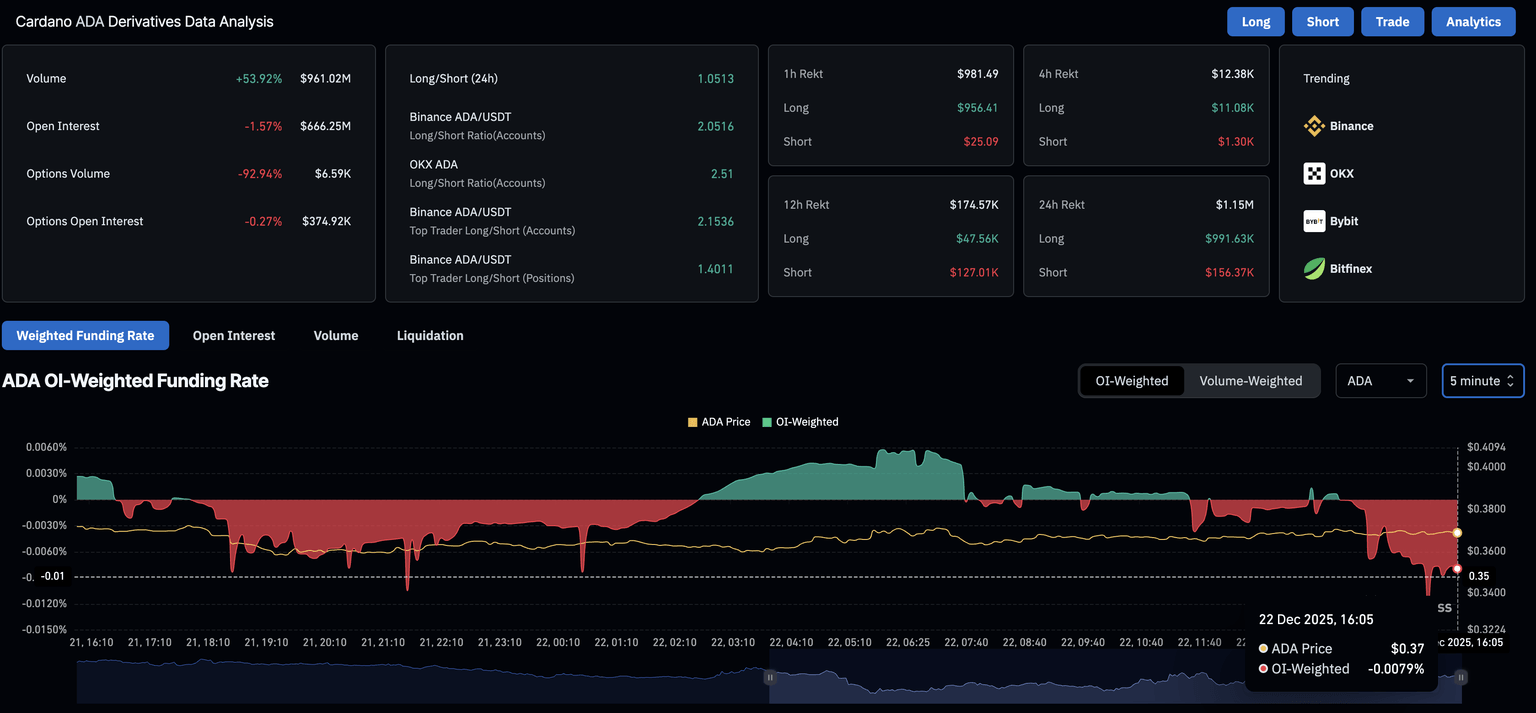
On the derivatives side, ADA’s futures open interest remains subdued at around $657 million as of Friday, with market participants staying on the sidelines since the October 10 crash.

ADA is trading at $0.37, up 4% at publication time on Saturday.
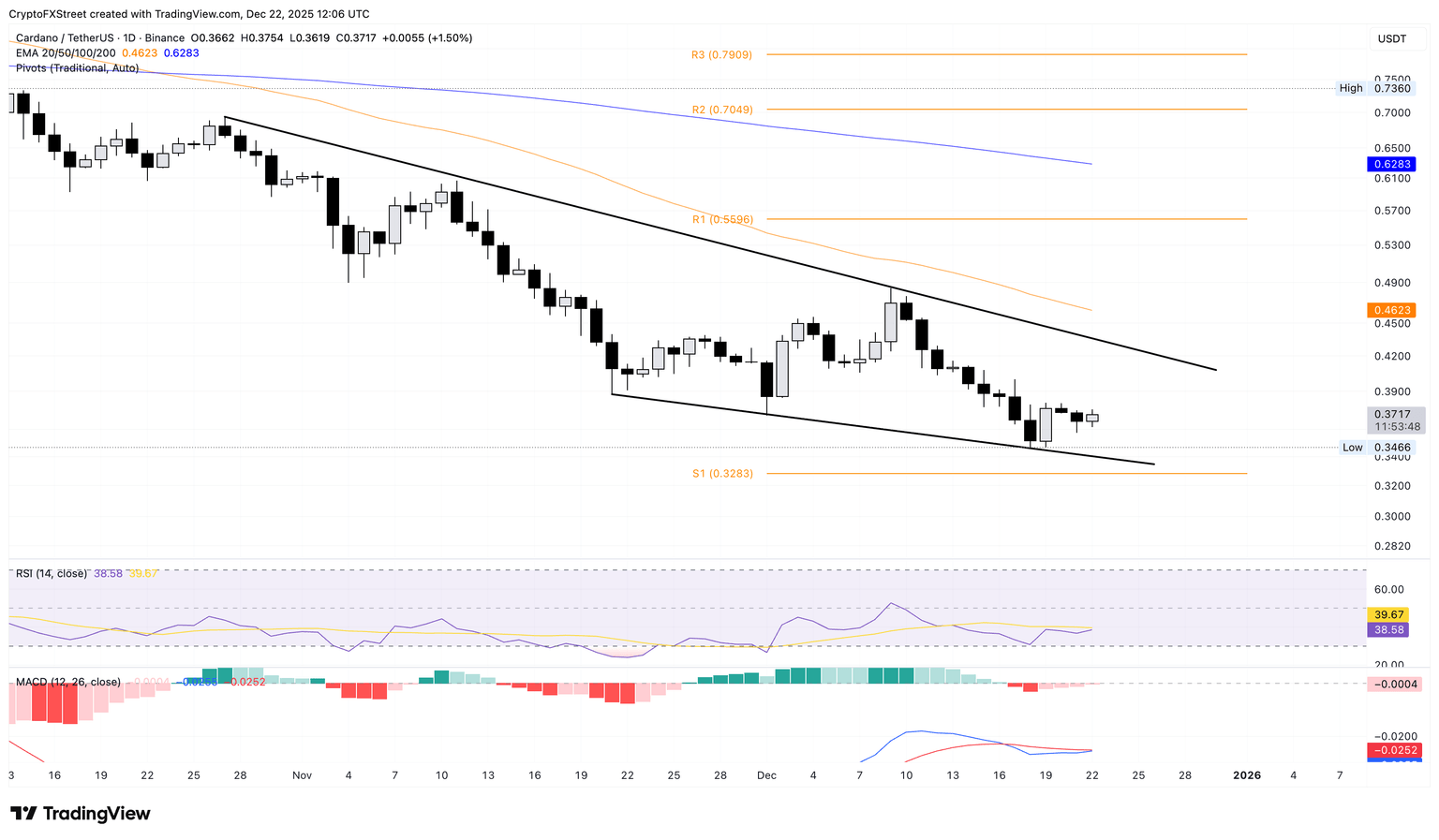
Cardano Price Forecast: ADA faces resistance at $0.37
ADA bounced off $0.34 and is testing the $0.37 resistance, near the upper boundary of the descending channel. The channel’s resistance is strengthened by the 20-day Exponential Moving Average (EMA), which has proven a key hurdle since October 10.

A rise above the descending channel could see ADA test the $0.51 level, but it has to clear the 50-day EMA on the way up. On the downside, ADA could find support at $0.34.
The Relative Strength Index (RSI) is below its neutral level and testing its moving average line. Meanwhile, the Stochastic Oscillator (Stoch) is attempting to recover from oversold conditions.