Since the start of the week, gold’s price has moved lower, but has yet to erase the gains made last week. In today’s report we intend to focus on the newest round of peace talks between Russia and Ukraine, whilst noting the release of the US Employment data later on day and end our report with an update in regards to the tensions brewing in Venezuela.
USD/JPY declines as Yen strengthens on BoJ hike bets and weak US jobs data

The Japanese Yen (JPY) strengthens against the US Dollar (USD) on Tuesday as the Greenback remains on the back foot following the release of the delayed October and November Nonfarm Payrolls (NFP) reports.
At the time of writing, USD/JPY is trading around 154.64, down about 0.40% on the day, while expectations of a Bank of Japan (BoJ) rate hike later this week continue to keep the Yen broadly supported.
Data from the US Bureau of Labor Statistics (BLS) showed that the US economy added 64,000 jobs in November, slightly above market expectations for a 50,000 increase. October payrolls fell by 105,000, sharply reversing September’s 108,000 increase, which was also revised down from 119,000.
The Unemployment Rate rose to 4.6% in November, above market expectations of 4.4% and marking its highest level since September 2021.
Average Hourly Earnings rose just 0.1% MoM in November, missing market expectations for a 0.3% increase, while annual wage growth slowed to 3.5% from 3.7%. In October, earnings increased 0.4% on the month, up from 0.2%, while yearly wage growth eased to 3.7% from 3.8%.
Overall, the employment data suggest that the US labour market is continuing to cool. While November’s payroll gain came in slightly better than expected, the broader picture remains soft, with slower job creation, rising unemployment and easing wage growth.
However, the data did little to shift expectations for the January FOMC meeting, where investors largely anticipate the Fed to hold rates steady. Market attention now turns to the November Consumer Price Index (CPI) data due on Thursday for further clues on the Fed’s monetary policy path into 2026, with markets currently pricing in two rate cuts.
In Japan, attention is now firmly on the Bank of Japan’s policy decision due on Friday, where the central bank is widely expected to raise its policy rate to 0.75%, which would mark the highest level in more than three decades. With the move largely priced in, market focus is likely to shift to Governor Kazuo Ueda’s guidance on the timing and extent of further rate hikes. On Wednesday, Japan’s economic calendar features the November trade data, including the Adjusted Merchandise Trade Balance, Exports and Imports.
Nonfarm Payrolls FAQs
Nonfarm Payrolls (NFP) are part of the US Bureau of Labor Statistics monthly jobs report. The Nonfarm Payrolls component specifically measures the change in the number of people employed in the US during the previous month, excluding the farming industry.
The Nonfarm Payrolls figure can influence the decisions of the Federal Reserve by providing a measure of how successfully the Fed is meeting its mandate of fostering full employment and 2% inflation.
A relatively high NFP figure means more people are in employment, earning more money and therefore probably spending more. A relatively low Nonfarm Payrolls’ result, on the either hand, could mean people are struggling to find work.
The Fed will typically raise interest rates to combat high inflation triggered by low unemployment, and lower them to stimulate a stagnant labor market.
Nonfarm Payrolls generally have a positive correlation with the US Dollar. This means when payrolls’ figures come out higher-than-expected the USD tends to rally and vice versa when they are lower.
NFPs influence the US Dollar by virtue of their impact on inflation, monetary policy expectations and interest rates. A higher NFP usually means the Federal Reserve will be more tight in its monetary policy, supporting the USD.
Nonfarm Payrolls are generally negatively-correlated with the price of Gold. This means a higher-than-expected payrolls’ figure will have a depressing effect on the Gold price and vice versa.
Higher NFP generally has a positive effect on the value of the USD, and like most major commodities Gold is priced in US Dollars. If the USD gains in value, therefore, it requires less Dollars to buy an ounce of Gold.
Also, higher interest rates (typically helped higher NFPs) also lessen the attractiveness of Gold as an investment compared to staying in cash, where the money will at least earn interest.
Nonfarm Payrolls is only one component within a bigger jobs report and it can be overshadowed by the other components.
At times, when NFP come out higher-than-forecast, but the Average Weekly Earnings is lower than expected, the market has ignored the potentially inflationary effect of the headline result and interpreted the fall in earnings as deflationary.
The Participation Rate and the Average Weekly Hours components can also influence the market reaction, but only in seldom events like the “Great Resignation” or the Global Financial Crisis.
Breaking: Nonfarm Payrolls increase by 64,000 in November vs. 50,000 expected
Nonfarm Payrolls (NFP) in the United States (US) rose by 64,000 in November, the US Bureau of Labor Statistics (BLS) reported on Tuesday. This reading came in better than the market expectation for an increase of 50,000. The report also showed that Nonfarm Payrolls declined by 105,000 in October.
The underlying details of the publication showed that the Unemployment Rate climbed to 4.6% in November, compared to the market expectation of 4.4%. In this period, the Labor Force Participation Rate edged higher to 62.5% from 62.4%.
Join our live coverage of the US NFP data and the market reaction.
Market reaction to Nonfarm Payrolls data
The US Dollar (USD) came under renewed selling pressure with the immediate reaction to the Nonfarm Payrolls data and the USD Index dropped to its lowest level since early October below 98.00. At the time of press, the USD Index was down 0.2% on the day at 98.05.
US Dollar Price Today
The table below shows the percentage change of US Dollar (USD) against listed major currencies today. US Dollar was the weakest against the British Pound.
| USD | EUR | GBP | JPY | CAD | AUD | NZD | CHF | |
|---|---|---|---|---|---|---|---|---|
| USD | -0.27% | -0.48% | -0.29% | -0.17% | -0.17% | -0.18% | -0.34% | |
| EUR | 0.27% | -0.21% | -0.11% | 0.09% | 0.10% | 0.09% | -0.08% | |
| GBP | 0.48% | 0.21% | 0.10% | 0.30% | 0.31% | 0.30% | 0.14% | |
| JPY | 0.29% | 0.11% | -0.10% | 0.19% | 0.20% | 0.18% | 0.03% | |
| CAD | 0.17% | -0.09% | -0.30% | -0.19% | 0.00% | -0.00% | -0.19% | |
| AUD | 0.17% | -0.10% | -0.31% | -0.20% | 0.00% | -0.02% | -0.17% | |
| NZD | 0.18% | -0.09% | -0.30% | -0.18% | 0.00% | 0.02% | -0.16% | |
| CHF | 0.34% | 0.08% | -0.14% | -0.03% | 0.19% | 0.17% | 0.16% |
The heat map shows percentage changes of major currencies against each other. The base currency is picked from the left column, while the quote currency is picked from the top row. For example, if you pick the US Dollar from the left column and move along the horizontal line to the Japanese Yen, the percentage change displayed in the box will represent USD (base)/JPY (quote).
This section below was published as a preview of the Nonfarm Payrolls data at 04:00 GMT.
- Nonfarm Payrolls are expected to rise by 50K in November after the September increase of 119K.
- The United States Bureau of Labor Statistics will publish the delayed jobs data on Tuesday at 13:30 GMT.
- The US Dollar is set to experience intense volatility on the employment data amid growing labor market concerns.
The United States (US) Bureau of Labor Statistics (BLS) will release the delayed Nonfarm Payrolls (NFP) data for October and November on Tuesday at 13:30 GMT.

Volatility around the US Dollar (USD) will likely ramp up on the employment reports for fresh insights on the US Federal Reserve’s (Fed) path forward on interest rates going into the turn of the year.
What to expect from the next Nonfarm Payrolls report?
Tuesday’s US employment report will be unusual, covering data for both October and November. October’s data won’t be complete as the BLS will only release indicators from the establishment survey due to collection issues caused by the government shutdown.
Economists expect Nonfarm Payrolls to rise by 50,000 in November. Markets also eagerly await the October figure after the 119,000-job gain seen in September.
The Unemployment Rate (UE) is likely to remain unchanged at 4.4% during the same period.
Meanwhile, Average Hourly Earnings (AHE), a closely watched measure of wage inflation, for October and November will also be published alongside the NFP releases. The AHE rose 3.8% year-over-year (YoY) in September.
Previewing the employment report, TD Securities analysts said: “We expect the November employment report to show a 70k rebound in job gains after contracting by 60k in October. Weakness in both months will likely be led by the government sector.”
“We also look for the UE rate to edge higher to 4.5% in November as the labor market gradually softens. Average Hourly Earnings likely rebounded to 0.3% month-over-month (MoM) after a subdued 0.1% in October,” they added.
How will the US September Nonfarm Payrolls affect EUR/USD?
The US Dollar is hanging close to two-month troughs against its major currency rivals in the aftermath of a less hawkish Fed outcome and ahead of the highly anticipated NFP publication.
The broad USD weakness has sent the EUR/USD pair back above the 1.1700 mark. Will the major see additional upside?
The Fed announced the expected 25 basis point (bps) interest rate cut to 3.5%-3.75% last Wednesday in a 9-3 vote.
Fed Chairman Jerome Powell stuck to his cautious tone at his post-monetary policy meeting press conference, disappointing those who had been positioned for a more hawkish one.
Powell noted: “First of all, gradual cooling in the labor market has continued,” adding that “unemployment is now up three-tenths from June through September.”
Markets continued to price in two more rate cuts next year, against the US central bank’s median expectation for a single quarter-percentage-point cut next year, smashing the Greenback across the board.
On the economic data front, the Labor Department reported last week that Initial Claims for state unemployment benefits jumped by 44,000, the biggest increase since mid-July of 2021, to a seasonally adjusted 236,000 for the week ended December 6.
Meanwhile, the Institute for Supply Management (ISM) Services PMI showed little improvement in November at 52.6 compared with 52.4 in October, while the Automatic Data Processing (ADP) reported that US private payrolls unexpectedly declined by 32K in November, following a revised 47K increase. Analysts estimated a job gain of 5K.
The employment placement firm Challenger, Gray & Christmas said earlier this month that “recent signs from unofficial data point to heavier job reductions to come, with announced layoffs through November topping 1.1 million.”
With growing labor market concerns, expressed by Powell as well, the NFP data will be closely scrutinized to help determine the number of Fed rate cuts expected in 2026.
A weaker-than-expected headline NFP release and an unexpected increase in the Unemployment Rate in November could aggravate concerns over the slowdown in the US jobs market, bolstering bets for another rate cut by the Fed at its next meeting in January. In such a case, the USD could see a fresh leg down, driving EUR/USD closer toward 1.1800.
Conversely, if the NFP beats estimates and the Unemployment Rate stays at 4.4% or even falls, EUR/USD could come under strong bearish pressure toward 1.1600. A positive surprise in the jobs data would push back against expectations of more than one Fed rate cut next year, providing the much-needed cushioning to the Greenback.
Dhwani Mehta, Asian Session Lead Analyst at FXStreet, offers a brief technical outlook for EUR/USD:
“The main currency pair consolidates near the two-month high of 1.1769, while holding well beyond all the major daily Simple Moving Averages (SMA). Meanwhile, the 14-day Relative Strength Index (RSI) flirts with the overbought territory on the daily chart, suggesting that there is more scope for upside. Further, the crossover of the 21-day and 50-day SMAs adds credence to the bullish potential in the pair.”
“If the upside regains traction, the next resistance is seen at the 1.1800 round level, above which the 1.1850 psychological barrier will be tested. The September 17 high of 1.1919 will be next on buyers’ radars. On the flip side, any corrective pullback could see initial support at the 100-day SMA of 1.1644. The next demand area is seen at around 1.1610, where the 21-day and 50-day SMAs hang around. Deeper declines could challenge the 1.1550 level.”
(This story was updated on December 16 at 10:11 GMT to reflect a last-minute consensus change in Nonfarm Payrolls for November to 50K.)
Nonfarm Payrolls FAQs
Nonfarm Payrolls (NFP) are part of the US Bureau of Labor Statistics monthly jobs report. The Nonfarm Payrolls component specifically measures the change in the number of people employed in the US during the previous month, excluding the farming industry.
The Nonfarm Payrolls figure can influence the decisions of the Federal Reserve by providing a measure of how successfully the Fed is meeting its mandate of fostering full employment and 2% inflation.
A relatively high NFP figure means more people are in employment, earning more money and therefore probably spending more. A relatively low Nonfarm Payrolls’ result, on the either hand, could mean people are struggling to find work.
The Fed will typically raise interest rates to combat high inflation triggered by low unemployment, and lower them to stimulate a stagnant labor market.
Nonfarm Payrolls generally have a positive correlation with the US Dollar. This means when payrolls’ figures come out higher-than-expected the USD tends to rally and vice versa when they are lower.
NFPs influence the US Dollar by virtue of their impact on inflation, monetary policy expectations and interest rates. A higher NFP usually means the Federal Reserve will be more tight in its monetary policy, supporting the USD.
Nonfarm Payrolls are generally negatively-correlated with the price of Gold. This means a higher-than-expected payrolls’ figure will have a depressing effect on the Gold price and vice versa.
Higher NFP generally has a positive effect on the value of the USD, and like most major commodities Gold is priced in US Dollars. If the USD gains in value, therefore, it requires less Dollars to buy an ounce of Gold.
Also, higher interest rates (typically helped higher NFPs) also lessen the attractiveness of Gold as an investment compared to staying in cash, where the money will at least earn interest.
Nonfarm Payrolls is only one component within a bigger jobs report and it can be overshadowed by the other components.
At times, when NFP come out higher-than-forecast, but the Average Weekly Earnings is lower than expected, the market has ignored the potentially inflationary effect of the headline result and interpreted the fall in earnings as deflationary.
The Participation Rate and the Average Weekly Hours components can also influence the market reaction, but only in seldom events like the “Great Resignation” or the Global Financial Crisis.
United Kingdom S&P Global Services PMI above forecasts (51.5) in December: Actual (52.1)
The long wait is over, and the Bureau of Labor Statistics in the US will release nonfarm payrolls reports for both November and October at 1330 GMT on Tuesday. The overall NFP figure for October is expected to be -10k, however, it is expected to be influenced by a massive 130k drop in federal department workers.
Nonfarm Payrolls expected to highlight US labor market weakened in November

The United States (US) Bureau of Labor Statistics (BLS) will release the delayed Nonfarm Payrolls (NFP) data for October and November on Tuesday at 13:30 GMT.
Volatility around the US Dollar (USD) will likely ramp up on the employment reports for fresh insights on the US Federal Reserve’s (Fed) path forward on interest rates going into the turn of the year.
What to expect from the next Nonfarm Payrolls report?
Tuesday’s US employment report will be unusual, covering data for both October and November. October’s data won’t be complete as the BLS will only release indicators from the establishment survey due to collection issues caused by the government shutdown.
Economists expect Nonfarm Payrolls to rise by 40,000 in November. Markets also eagerly await the October figure after the 119,000-job gain seen in September.
The Unemployment Rate (UE) is likely to remain unchanged at 4.4% during the same period.
Meanwhile, Average Hourly Earnings (AHE), a closely watched measure of wage inflation, for October and November will also be published alongside the NFP releases. The AHE rose 3.8% year-over-year (YoY) in September.
Previewing the employment report, TD Securities analysts said: “We expect the November employment report to show a 70k rebound in job gains after contracting by 60k in October. Weakness in both months will likely be led by the government sector.”
“We also look for the UE rate to edge higher to 4.5% in November as the labor market gradually softens. Average Hourly Earnings likely rebounded to 0.3% month-over-month (MoM) after a subdued 0.1% in October,” they added.
How will the US September Nonfarm Payrolls affect EUR/USD?
The US Dollar is hanging close to two-month troughs against its major currency rivals in the aftermath of a less hawkish Fed outcome and ahead of the highly anticipated NFP publication.
The broad USD weakness has sent the EUR/USD pair back above the 1.1700 mark. Will the major see additional upside?
The Fed announced the expected 25 basis point (bps) interest rate cut to 3.5%-3.75% last Wednesday in a 9-3 vote.
Fed Chairman Jerome Powell stuck to his cautious tone at his post-monetary policy meeting press conference, disappointing those who had been positioned for a more hawkish one.
Powell noted: “First of all, gradual cooling in the labor market has continued,” adding that “unemployment is now up three-tenths from June through September.”
Markets continued to price in two more rate cuts next year, against the US central bank’s median expectation for a single quarter-percentage-point cut next year, smashing the Greenback across the board.
On the economic data front, the Labor Department reported last week that Initial Claims for state unemployment benefits jumped by 44,000, the biggest increase since mid-July of 2021, to a seasonally adjusted 236,000 for the week ended December 6.
Meanwhile, the Institute for Supply Management (ISM) Services PMI showed little improvement in November at 52.6 compared with 52.4 in October, while the Automatic Data Processing (ADP) reported that US private payrolls unexpectedly declined by 32K in November, following a revised 47K increase. Analysts estimated a job gain of 5K.
The employment placement firm Challenger, Gray & Christmas said earlier this month that “recent signs from unofficial data point to heavier job reductions to come, with announced layoffs through November topping 1.1 million.”
With growing labor market concerns, expressed by Powell as well, the NFP data will be closely scrutinized to help determine the number of Fed rate cuts expected in 2026.
A weaker-than-expected headline NFP release and an unexpected increase in the Unemployment Rate in November could aggravate concerns over the slowdown in the US jobs market, bolstering bets for another rate cut by the Fed at its next meeting in January. In such a case, the USD could see a fresh leg down, driving EUR/USD closer toward 1.1800.
Conversely, if the NFP beats estimates and the Unemployment Rate stays at 4.4% or even falls, EUR/USD could come under strong bearish pressure toward 1.1600. A positive surprise in the jobs data would push back against expectations of more than one Fed rate cut next year, providing the much-needed cushioning to the Greenback.
Dhwani Mehta, Asian Session Lead Analyst at FXStreet, offers a brief technical outlook for EUR/USD:
“The main currency pair consolidates near the two-month high of 1.1769, while holding well beyond all the major daily Simple Moving Averages (SMA). Meanwhile, the 14-day Relative Strength Index (RSI) flirts with the overbought territory on the daily chart, suggesting that there is more scope for upside. Further, the crossover of the 21-day and 50-day SMAs adds credence to the bullish potential in the pair.”
“If the upside regains traction, the next resistance is seen at the 1.1800 round level, above which the 1.1850 psychological barrier will be tested. The September 17 high of 1.1919 will be next on buyers’ radars. On the flip side, any corrective pullback could see initial support at the 100-day SMA of 1.1644. The next demand area is seen at around 1.1610, where the 21-day and 50-day SMAs hang around. Deeper declines could challenge the 1.1550 level.”
Economic Indicator
Unemployment Rate
The Unemployment Rate, released by the US Bureau of Labor Statistics (BLS), is the percentage of the total civilian labor force that is not in paid employment but is actively seeking employment. The rate is usually higher in recessionary economies compared to economies that are growing. Generally, a decrease in the Unemployment Rate is seen as bullish for the US Dollar (USD), while an increase is seen as bearish. That said, the number by itself usually can’t determine the direction of the next market move, as this will also depend on the headline Nonfarm Payroll reading, and the other data in the BLS report.
Employment FAQs
Labor market conditions are a key element to assess the health of an economy and thus a key driver for currency valuation. High employment, or low unemployment, has positive implications for consumer spending and thus economic growth, boosting the value of the local currency. Moreover, a very tight labor market – a situation in which there is a shortage of workers to fill open positions – can also have implications on inflation levels and thus monetary policy as low labor supply and high demand leads to higher wages.
The pace at which salaries are growing in an economy is key for policymakers. High wage growth means that households have more money to spend, usually leading to price increases in consumer goods. In contrast to more volatile sources of inflation such as energy prices, wage growth is seen as a key component of underlying and persisting inflation as salary increases are unlikely to be undone. Central banks around the world pay close attention to wage growth data when deciding on monetary policy.
The weight that each central bank assigns to labor market conditions depends on its objectives. Some central banks explicitly have mandates related to the labor market beyond controlling inflation levels. The US Federal Reserve (Fed), for example, has the dual mandate of promoting maximum employment and stable prices. Meanwhile, the European Central Bank’s (ECB) sole mandate is to keep inflation under control. Still, and despite whatever mandates they have, labor market conditions are an important factor for policymakers given its significance as a gauge of the health of the economy and their direct relationship to inflation.
Gold Price Forecast: XAU/USD holds gains above $4,300 on prospect of further Fed rate cuts

Gold price (XAU/USD) extends its upside to around $4,305, the highest since October 21, during the early Asian trading hours on Tuesday. The precious metal edges higher on further US Federal Reserve (Fed) cut bets. The US Nonfarm Payrolls (NFP) report will take center stage later on Tuesday. Also, the US Retail Sales and Purchasing Managers Index (PMI) will be published.
The US Fed implemented its third cut of the year last week and signaled an additional rate reduction next year, supporting the yellow metal. Lower interest rates could reduce the opportunity cost of holding Gold, supporting the non-yielding precious metal.
According to the Summary of Economic Projections (SEP), or so-called “dot plot,” the median forecast points to only one 25 basis points (bps) rate cut by the end of 2026. However, financial markets are generally pricing in the probability of at least two rate reductions by the year-end.
The US federal shutdown has delayed the publication of a collection of US economic data, which will be released later on Tuesday. Traders await the US employment data for more clues about the US interest rate path. “If the data point to a meaningful slowdown, I believe this would reinforce bets on rate cuts and push gold to test higher levels,” said Rania Gule, senior market analyst at XS.com.
On the other hand, optimism surrounding Ukraine peace talks could undermine a traditional safe-haven asset like Gold. US officials said on Monday that an agreement with Ukrainian President Volodymyr Zelenskyy to end its war with Russia was nearly complete, although territorial disputes remain unresolved and a strong security guarantee from the US and European countries remains a sticking point.
Gold FAQs
Gold has played a key role in human’s history as it has been widely used as a store of value and medium of exchange. Currently, apart from its shine and usage for jewelry, the precious metal is widely seen as a safe-haven asset, meaning that it is considered a good investment during turbulent times. Gold is also widely seen as a hedge against inflation and against depreciating currencies as it doesn’t rely on any specific issuer or government.
Central banks are the biggest Gold holders. In their aim to support their currencies in turbulent times, central banks tend to diversify their reserves and buy Gold to improve the perceived strength of the economy and the currency. High Gold reserves can be a source of trust for a country’s solvency. Central banks added 1,136 tonnes of Gold worth around $70 billion to their reserves in 2022, according to data from the World Gold Council. This is the highest yearly purchase since records began. Central banks from emerging economies such as China, India and Turkey are quickly increasing their Gold reserves.
Gold has an inverse correlation with the US Dollar and US Treasuries, which are both major reserve and safe-haven assets. When the Dollar depreciates, Gold tends to rise, enabling investors and central banks to diversify their assets in turbulent times. Gold is also inversely correlated with risk assets. A rally in the stock market tends to weaken Gold price, while sell-offs in riskier markets tend to favor the precious metal.
The price can move due to a wide range of factors. Geopolitical instability or fears of a deep recession can quickly make Gold price escalate due to its safe-haven status. As a yield-less asset, Gold tends to rise with lower interest rates, while higher cost of money usually weighs down on the yellow metal. Still, most moves depend on how the US Dollar (USD) behaves as the asset is priced in dollars (XAU/USD). A strong Dollar tends to keep the price of Gold controlled, whereas a weaker Dollar is likely to push Gold prices up.
FX Today: Hasset leaves the spotlight, weaker USD

What to look out for on Tuesday, December 16th:
The US Dollar Index (DXY) declined sharply following the Fed’s policy announcements last Wednesday and closed a third consecutive week in negative territory. Late Monday, the USD Index trimmed part of its losses and trades near 98.40.
US Dollar Price Today
The table below shows the percentage change of US Dollar (USD) against listed major currencies today. US Dollar was the strongest against the New Zealand Dollar.
| USD | EUR | GBP | JPY | CAD | AUD | NZD | CHF | |
|---|---|---|---|---|---|---|---|---|
| USD | -0.02% | 0.01% | -0.33% | 0.10% | 0.22% | 0.28% | 0.11% | |
| EUR | 0.02% | 0.03% | -0.33% | 0.11% | 0.25% | 0.30% | 0.12% | |
| GBP | -0.01% | -0.03% | -0.33% | 0.08% | 0.20% | 0.26% | 0.09% | |
| JPY | 0.33% | 0.33% | 0.33% | 0.44% | 0.55% | 0.62% | 0.44% | |
| CAD | -0.10% | -0.11% | -0.08% | -0.44% | 0.12% | 0.17% | 0.00% | |
| AUD | -0.22% | -0.25% | -0.20% | -0.55% | -0.12% | 0.06% | -0.14% | |
| NZD | -0.28% | -0.30% | -0.26% | -0.62% | -0.17% | -0.06% | -0.17% | |
| CHF | -0.11% | -0.12% | -0.09% | -0.44% | -0.01% | 0.14% | 0.17% |
The heat map shows percentage changes of major currencies against each other. The base currency is picked from the left column, while the quote currency is picked from the top row. For example, if you pick the US Dollar from the left column and move along the horizontal line to the Japanese Yen, the percentage change displayed in the box will represent USD (base)/JPY (quote).
Kevin Hassett, President Donald Trump’s preferred candidate to replace Jerome Powell as Chair of the Federal Reserve (Fed), is facing opposition from senior Trump advisers, according to sources familiar with the situation. This pushback reportedly stems from concerns that Hassett is “too close” to the president. Meanwhile, another candidate, former Federal Reserve Governor Kevin Warsh, has begun to gain more attention and support.
Forecasting the week: A key week with US CPI, NFP, PMIs, and plenty of central bank activity. The US Bureau of Labor Statistics will publish the Nonfarm Payrolls (NFP) data for November and part of the October report on Tuesday.
USD/CAD holds steady above 1.3780 to close out the American session. The Canadian Consumer Price Index (CPI) annualized at 2.2%, the same number as last month’s report, and lower than the 2.4% expected.
EUR/USD The pair is still in a consolidation phase, nearing 1.1740, closing the American session on Monday. On Thursday, the European Central Bank (ECB) will announce its monetary policy decision.
USD/JPY Japanese firms cited easing uncertainty around US trade policy and resilient demand in high-tech sectors as key factors supporting business sentiment, according to comments from a senior Bank of Japan (BoJ) official on the Tankan survey. After posting marginal gains the previous week, the pair trades near 155.30, recovering some of the losses incurred during Asian/European trading hours.
Gold clings to a bullish stance near $4310, but cut some of its intraday gains after trading close to a two-month high at $4350.
GBP/USD is trading on a red note near the 1.3360 region on Monday. The Bank of England (BoE) will announce its interest rate decision on Thursday.
Fed FAQs
Monetary policy in the US is shaped by the Federal Reserve (Fed). The Fed has two mandates: to achieve price stability and foster full employment. Its primary tool to achieve these goals is by adjusting interest rates.
When prices are rising too quickly and inflation is above the Fed’s 2% target, it raises interest rates, increasing borrowing costs throughout the economy. This results in a stronger US Dollar (USD) as it makes the US a more attractive place for international investors to park their money.
When inflation falls below 2% or the Unemployment Rate is too high, the Fed may lower interest rates to encourage borrowing, which weighs on the Greenback.
The Federal Reserve (Fed) holds eight policy meetings a year, where the Federal Open Market Committee (FOMC) assesses economic conditions and makes monetary policy decisions.
The FOMC is attended by twelve Fed officials – the seven members of the Board of Governors, the president of the Federal Reserve Bank of New York, and four of the remaining eleven regional Reserve Bank presidents, who serve one-year terms on a rotating basis.
In extreme situations, the Federal Reserve may resort to a policy named Quantitative Easing (QE). QE is the process by which the Fed substantially increases the flow of credit in a stuck financial system.
It is a non-standard policy measure used during crises or when inflation is extremely low. It was the Fed’s weapon of choice during the Great Financial Crisis in 2008. It involves the Fed printing more Dollars and using them to buy high grade bonds from financial institutions. QE usually weakens the US Dollar.
Quantitative tightening (QT) is the reverse process of QE, whereby the Federal Reserve stops buying bonds from financial institutions and does not reinvest the principal from the bonds it holds maturing, to purchase new bonds. It is usually positive for the value of the US Dollar.
Mantle Price Forecast: MNT eyes 30% recovery after Ethereum staking software upgrade
Mantle (MNT) is trading above a short-term support at $1.28 at the time of writing on Monday, as the broader cryptocurrency market stabilizes in the wake of last week’s monetary policy-triggered volatility. If bulls tighten their grip further, MNT could extend its recovery by 30% to $1.63 in the short to medium-term.
Mantle staking upgrade achieves on-demand liquidity
Mantle has upgraded its Ethereum liquid staking software, the Buffer Pool, enabling 24-hour redemptions via a dual-liquidity pathway. According to the announcement, the mETH Protocol “supplies a portion of staked ETH into Aave to preserve yield and support fast, on-demand liquidity with no additional fees.”
The mechanism operates by routing smaller requests via the instant buffer pool, while larger ones are processed via the ‘Aave ETH Market’ reserve. Both mechanisms support 24-hour redemption requests with no downtime.
Mantle stated that mETH Protocol has grown into a liquid staking token (LST) purpose-built for institutional scaling, meeting high liquidity demands without compromising utility.
“As one of the largest ETH liquid staking tokens, mETH helps secure networks such as EigenDA and Symbiotic while powering yield strategies through integrations with over 40 leading dApps including Ethena and Compound,” Mantle said in a blog post.
On the other hand, retail demand remains significantly suppressed despite the software upgrade. CoinGlass data highlights a weak derivatives market, with futures Open Interest averaging $78 million, down from a record high of $490 million, recorded on October 9.
A weakening derivatives market suggests that investors are losing confidence in the token’s ability to recover or sustain an uptrend, with many staying on the sidelines.

Technical outlook: Mantle poised for breakout
Mantle is trading between key support at $1.23 and resistance at $1.28 at the time of writing on Monday, as bulls fight to maintain control of the trend. The 50-day Exponential Moving Average (EMA) reinforces the immediate support at $1.23 while the 100-day EMA highlights the hurdle at $1.28.
The Moving Average Convergence Divergence (MACD) indicator maintains a buy signal on November 26, and the green histogram bars expanding above the mean line support a short-term bullish outlook.

A daily close above the 100-day EMA hurdle may pave the way for a 30% increase to $1.63, matching the 0.618 Fibonacci retracement level.
Still, traders should be cautious because a correction below the support band at $1.21-$1.23 could trigger an extended decline toward November’s low of $0.86.
Bitcoin, altcoins, stablecoins FAQs
Bitcoin is the largest cryptocurrency by market capitalization, a virtual currency designed to serve as money. This form of payment cannot be controlled by any one person, group, or entity, which eliminates the need for third-party participation during financial transactions.
Altcoins are any cryptocurrency apart from Bitcoin, but some also regard Ethereum as a non-altcoin because it is from these two cryptocurrencies that forking happens. If this is true, then Litecoin is the first altcoin, forked from the Bitcoin protocol and, therefore, an “improved” version of it.
Stablecoins are cryptocurrencies designed to have a stable price, with their value backed by a reserve of the asset it represents. To achieve this, the value of any one stablecoin is pegged to a commodity or financial instrument, such as the US Dollar (USD), with its supply regulated by an algorithm or demand. The main goal of stablecoins is to provide an on/off-ramp for investors willing to trade and invest in cryptocurrencies. Stablecoins also allow investors to store value since cryptocurrencies, in general, are subject to volatility.
Bitcoin dominance is the ratio of Bitcoin’s market capitalization to the total market capitalization of all cryptocurrencies combined. It provides a clear picture of Bitcoin’s interest among investors. A high BTC dominance typically happens before and during a bull run, in which investors resort to investing in relatively stable and high market capitalization cryptocurrency like Bitcoin. A drop in BTC dominance usually means that investors are moving their capital and/or profits to altcoins in a quest for higher returns, which usually triggers an explosion of altcoin rallies.
Bitcoin Price Forecast: BTC struggles to regain $90K as bearish pressure persists
Bitcoin (BTC) steadies above $89,000 at the time of writing on Monday, after failing to break above a descending trendline last week. Meanwhile, modest inflows into US-listed spot Bitcoin Exchange Traded Funds (ETFs) suggest improving institutional interest. However, traders should remain cautious, as bearish technical outlook and warnings from veteran trader Peter Brandt keep downside risks firmly in focus.
Why BTC could fall toward $25,000?
Peter Brandt, a veteran commodity trader, posted on his X account on Monday that BTC could fall toward $25,240.
Brandt explained that Bitcoin bull cycles have experienced exponential decay, indicating that the explosive move in BTC is slowing over time and signaling the asset’s maturity. Historically, all previous bull cycles have gone through a parabolic move, as shown in the chart below.
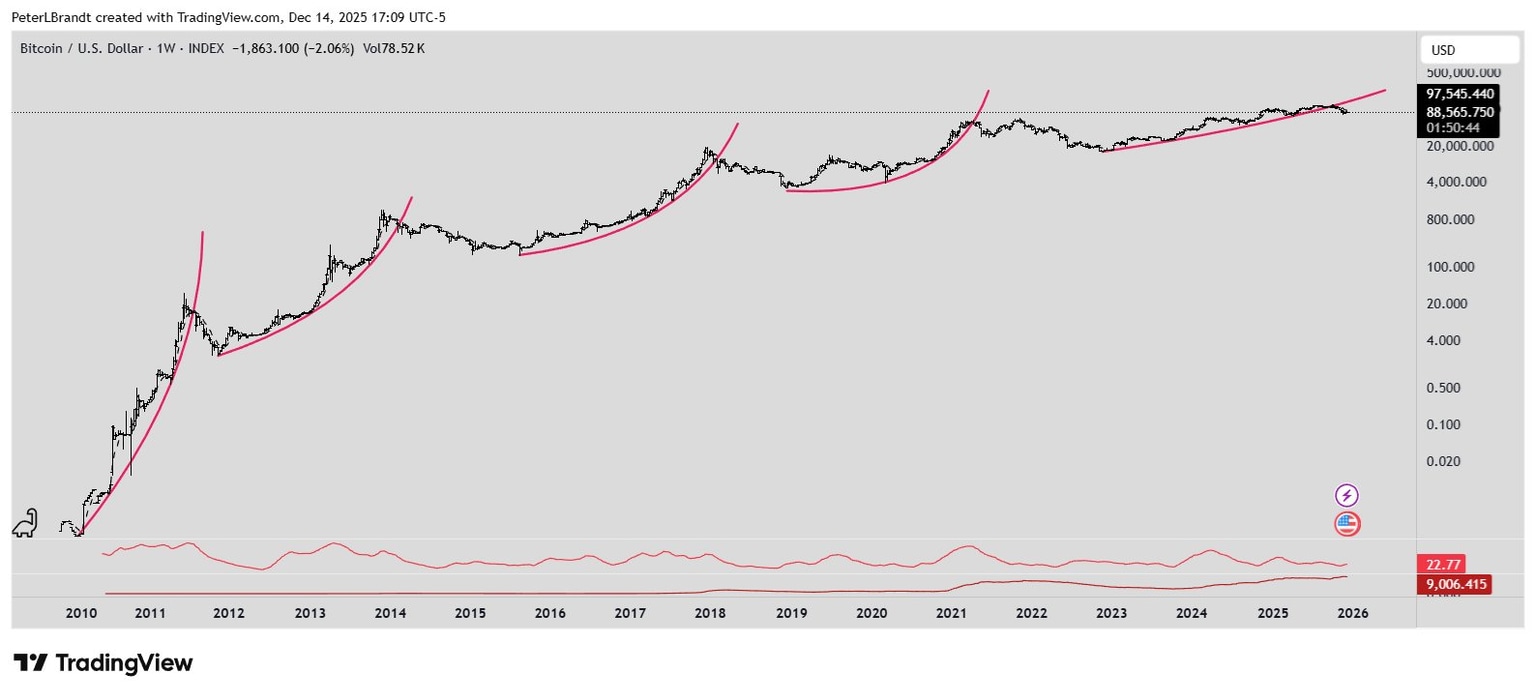
However, in each cycle, when BTC broke below the parabolic support line, it declined by at least 80%. As BTC’s current price hovers around $89,000, the parabolic advance has been violated and Brandt suggests it could lead to a correction to $25,240.
Some other signs of concern
In addition to the veteran traders’ bearish outlook, another sign to watch for is the Bank of Japan’s (BoJ) interest rate decision on Friday, in which the central bank is expected to raise borrowing costs by 25 basis points (bps).
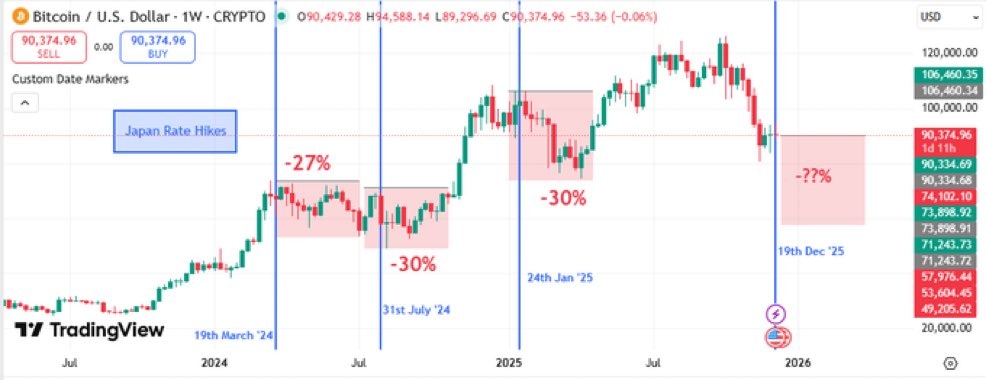
As shown in the chart below, Bitcoin has historically declined following BoJ rate hikes, falling 27% after the March 2024 decision, 30% after the July 2024 hike, and 30% after January 2025, showing a consistent pattern of sharp pullbacks after BoJ policy tightening.
If history repeats after Friday’s rate decision, Bitcoin could mirror past reactions, potentially undergoing a roughly 30% correction that would drag the price toward $63,000.
Mild improvement in institutional demand
Institutional demand for Bitcoin shows mild signs of improvement. According to SoSoValue data, US-listed spot Bitcoin ETFs recorded a weekly inflow of $286.60 million, following a mild outflow of $87.77 million in the previous week, suggesting that institutional investor interest improved slightly. However, these weekly inflows remain small relative to those observed in mid-September. For BTC to continue its recovery, the ETF inflows should intensify.

Bitcoin Price Forecast: BTC struggles below $90,000
Bitcoin price was rejected from a descending trendline (drawn by connecting multiple highs since early October) last week. This trendline coincided with the 61.8% Fibonacci retracement level at $94,253 (drawn from the April low of $74,508 to the all-time high of $126,199 set in October), making it a key resistance zone. As of Monday, BTC hovers above $89,000.
If BTC continues its pullback, it could extend the decline toward the next key support at $85,569, which aligns with the 78.6% Fibonacci retracement level.
The Relative Strength Index (RSI) on the daily chart is at 44, below its neutral level of 50, indicating slight bearish momentum. Moreover, the Moving Average Convergence Divergence (MACD) lines are converging, and a flip to a bearish crossover would further support the bearish outlook.

Looking up, if BTC breaks above the descending trendline and closes above the $94,253 resistance level, it could extend the rally toward the $100,000 psychological level.
Bitcoin, altcoins, stablecoins FAQs
Bitcoin is the largest cryptocurrency by market capitalization, a virtual currency designed to serve as money. This form of payment cannot be controlled by any one person, group, or entity, which eliminates the need for third-party participation during financial transactions.
Altcoins are any cryptocurrency apart from Bitcoin, but some also regard Ethereum as a non-altcoin because it is from these two cryptocurrencies that forking happens. If this is true, then Litecoin is the first altcoin, forked from the Bitcoin protocol and, therefore, an “improved” version of it.
Stablecoins are cryptocurrencies designed to have a stable price, with their value backed by a reserve of the asset it represents. To achieve this, the value of any one stablecoin is pegged to a commodity or financial instrument, such as the US Dollar (USD), with its supply regulated by an algorithm or demand. The main goal of stablecoins is to provide an on/off-ramp for investors willing to trade and invest in cryptocurrencies. Stablecoins also allow investors to store value since cryptocurrencies, in general, are subject to volatility.
Bitcoin dominance is the ratio of Bitcoin’s market capitalization to the total market capitalization of all cryptocurrencies combined. It provides a clear picture of Bitcoin’s interest among investors. A high BTC dominance typically happens before and during a bull run, in which investors resort to investing in relatively stable and high market capitalization cryptocurrency like Bitcoin. A drop in BTC dominance usually means that investors are moving their capital and/or profits to altcoins in a quest for higher returns, which usually triggers an explosion of altcoin rallies.
Bittensor price forecast: TAO faces bearish pressure ahead of halving event
Bittensor (TAO) edges higher by over 2% at press time on Monday, recovering from a 5% loss on Sunday. Bittensor’s recovery is underpinned by its halving event scheduled for Monday, which would reduce daily supply emissions by 50% to 3,600 TAO tokens. Still, the derivatives market shows lukewarm sentiment, with futures Open Interest declining and the funding rate turning negative.
The technical outlook for TAO remains bearish as it breaks below a short-term support trendline on the 4-hour chart, targeting the S1 Pivot Point at $286.
Bittensor halving struggles to ignite demand
Bittensor will record its first halving event on Monday, reducing the emission rate of TAO by 50% to 0.5 TAO per block. This will halve the daily emission to 3,600 TAO from the current rate of 7,200 TAO.
Reduced emissions make TAO more valuable, if demand remains stable or increases. At the same time, the Alpha rewards, which are TAO tokens distributed at the subnet level to miners, validators, and subnet owners, will remain unaffected.
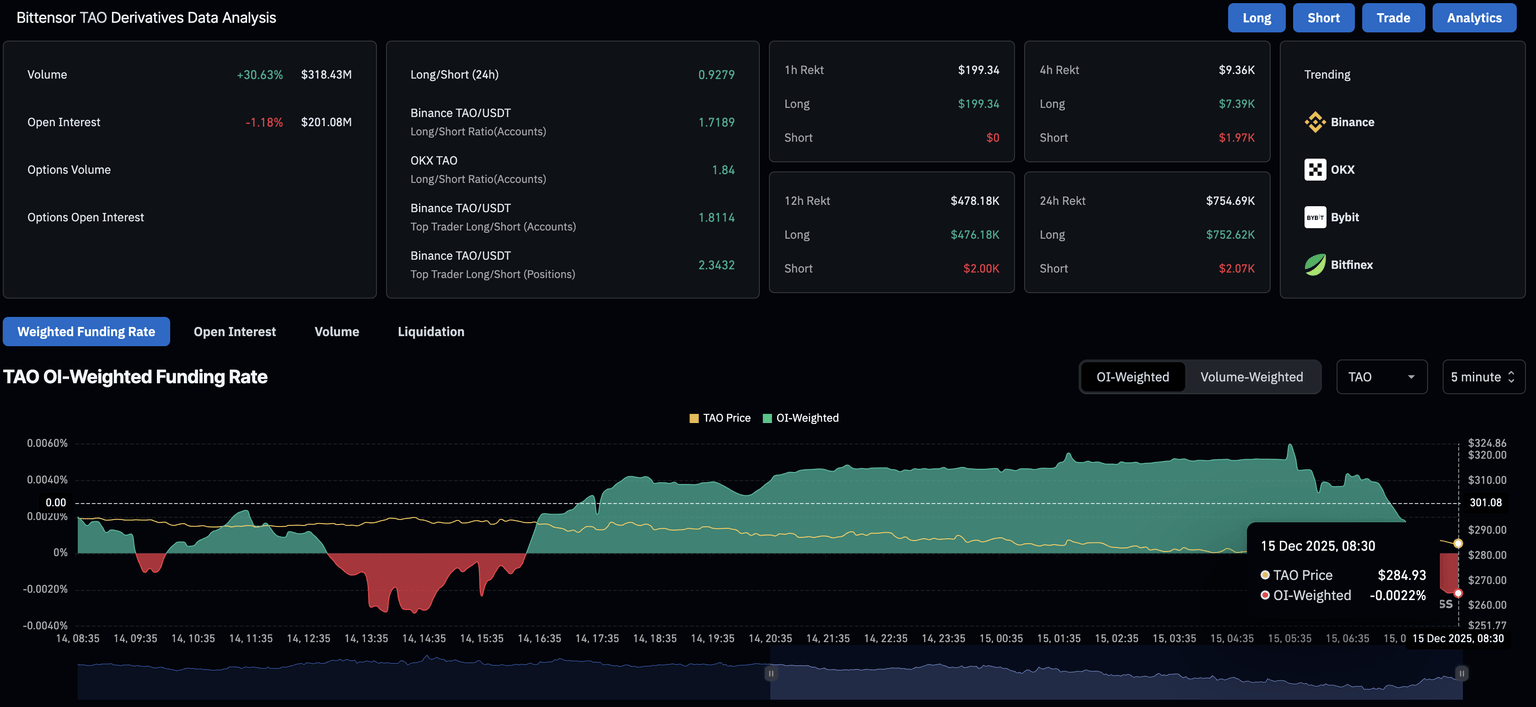
However, on the derivatives side, retail interest remains dull, as TAO futures Open Interest (OI) dropped 1.18% over the last 24 hours to $201.08 million. This indicates a reduced number of active positions, as traders limit their risk exposure.
Still, the OI-weighted funding rate has dropped to -0.0022% from 0.0060% earlier on Monday, signaling a sharp increase in bearish confidence.
Bittensor’s triangle pattern fallout risks further decline to $265
Bittensor breaks below a symmetrical triangle pattern on the 4-hour price chart formed by connecting two converging trendlines. The intraday recovery in the decentralized AI network token marks a retest of the broken support trendline connecting the December 1 and 7 lows, near the 50-period Exponential Moving Average (EMA) at $291.
A potential post-retest reversal could extend the decline to the S1 Pivot Point at $265, followed by the S2 Pivot Point at $250.
The momentum indicators on the daily chart suggest a bearish bias amid rising selling pressure. The Relative Strength Index (RSI) at 42 remains below the halfway line, extending a prevailing downward trend. At the same time, the Moving Average Convergence Divergence (MACD) and the signal line keep a steady decline into the negative territory, indicating a bearish momentum buildup.
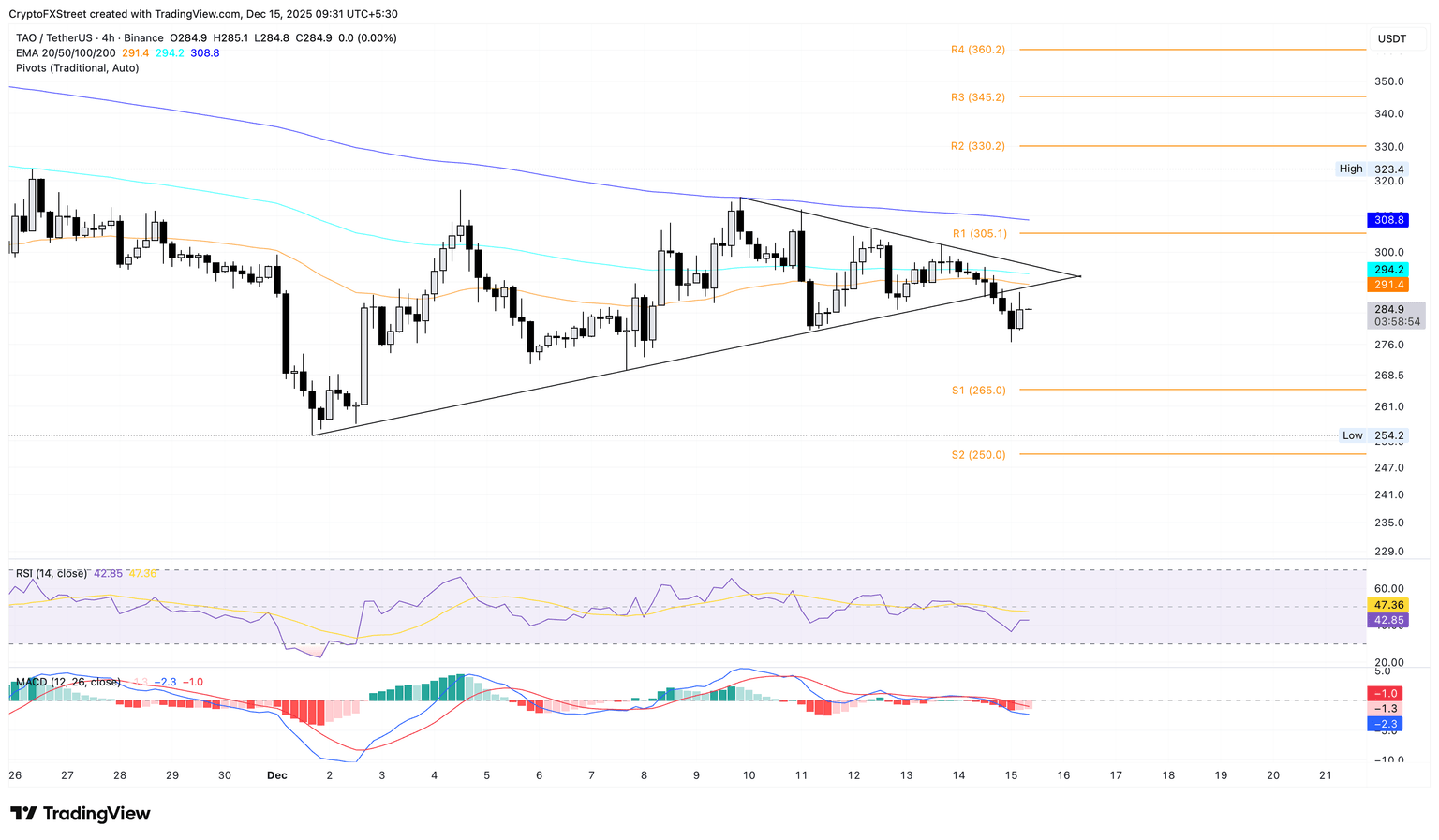
Looking up, a potential rebound above the 50-period EMA at $291 could extend the recovery to the R1 Pivot Point at $305.