Gold builds on the previous day’s recovery from levels just below the $4,000 psychological mark, or a one-and-a-half-week low, and gains positive traction for the second straight day. The momentum lifts the bullion to the top end of its weekly range, with bulls now awaiting a sustained move beyond the $4,100 round figure before positioning for further gains as the focus remains on FOMC minutes.
EUR/JPY softens to near 180.00 on intervention fears

The EUR/JPY cross loses ground to near 180.00 during the early European session on Wednesday. The Japanese Yen (JPY) strengthens against the Euro (EUR) amid speculations that Japanese authorities would step into the market to stem further weakness in the domestic currency.
Japan’s Finance Minister Katayama is “alarmed” over the foreign exchange moves. Katayama emphasized that it is important for exchange rates to move in a stable manner consistent with fundamentals, adding that the government is watching markets closely as it finalizes its fiscal stance. Intervention fears might support the JPY against the EUR in the near term.
The Bank of Japan (BoJ) Governor Kazuo Ueda told Prime Minister Sanae Takaichi that the central bank is in the process of slowly dialing back its easing support for the economy, signaling his unshaken intention to carefully raise interest rates. Ueda added that the BOJ will make appropriate policy decisions based on data.
While Ueda hinted at the chance of raising interest rates, Japanese Prime Minister Takaichi has voiced displeasure over the idea and urged the Japanese central bank to cooperate with government efforts to reflate the economy. Takaichi urged the BoJ to maintain low interest rates, emphasizing that monetary policy should support both robust economic growth and stable price increases. Uncertainty surrounding BoJ rate hikes could weigh on the Japanese Yen (JPY) and act as a tailwind for the cross.
On the Euro’s front, the European Central Bank (ECB) has kept its key interest rates unchanged since June 2025, with traders expecting this pause to last into the next year. The cautious stance of the ECB could provide some support to the EUR. According to a Reuters report from September 2025, analysts anticipate that the ECB’s rate-cutting cycle will end amid a stable economic outlook.
Japanese Yen FAQs
The Japanese Yen (JPY) is one of the world’s most traded currencies. Its value is broadly determined by the performance of the Japanese economy, but more specifically by the Bank of Japan’s policy, the differential between Japanese and US bond yields, or risk sentiment among traders, among other factors.
One of the Bank of Japan’s mandates is currency control, so its moves are key for the Yen. The BoJ has directly intervened in currency markets sometimes, generally to lower the value of the Yen, although it refrains from doing it often due to political concerns of its main trading partners. The BoJ ultra-loose monetary policy between 2013 and 2024 caused the Yen to depreciate against its main currency peers due to an increasing policy divergence between the Bank of Japan and other main central banks. More recently, the gradually unwinding of this ultra-loose policy has given some support to the Yen.
Over the last decade, the BoJ’s stance of sticking to ultra-loose monetary policy has led to a widening policy divergence with other central banks, particularly with the US Federal Reserve. This supported a widening of the differential between the 10-year US and Japanese bonds, which favored the US Dollar against the Japanese Yen. The BoJ decision in 2024 to gradually abandon the ultra-loose policy, coupled with interest-rate cuts in other major central banks, is narrowing this differential.
The Japanese Yen is often seen as a safe-haven investment. This means that in times of market stress, investors are more likely to put their money in the Japanese currency due to its supposed reliability and stability. Turbulent times are likely to strengthen the Yen’s value against other currencies seen as more risky to invest in.
Australia Westpac Leading Index (MoM): 0.1% (October) vs -0.03%
Gold price attracts some buyers to around $4,070, snapping the three-day losing streak during the early Asian session on Wednesday. The precious metal rises amid the risk-off sentiment as traders brace for the long-awaited return of US economic data. The FOMC Minutes will be the highlights later on Wednesday, ahead of the US September Nonfarm Payrolls report.
Bitcoin sell-off tied to fading December rate cut odds: Wintermute
Bitcoin (BTC), along with other top cryptos, continued its downtrend over the past week as risk-off sentiment intensified across the digital asset market.
The top crypto’s sell-off last week was mainly driven by a sharp drop in market expectations of a December rate cut by the Federal Reserve (Fed). The probability of a rate cut declined from ~70% to ~42% in about a week, further plunging the already weak sentiment in risk assets, according to digital asset market maker Wintermute in a Monday report.
While risk assets generally experienced a pullback, crypto suffered the largest decline, with a 14% drop, maintaining its strong sentiment-driven nature relative to other asset classes. The move also underscores crypto’s negative skew versus equities in 2025.
Unlike the norm in a market-wide downtrend, Bitcoin and Ethereum (ETH) underperformed the average price movement of altcoins. However, all token categories experienced notable weekly drawdowns, including resilient sectors such as L1s, L2s, and DeFi.
“The move was indiscriminate and reflects a full risk-off shift rather than sector rotation,” the report states.
Whales’ distribution and early derisking intensified the sell-off amid traders’ expectations that 2026 could be bearish, based on the four-year cycle pattern, leading to a self-fulfilling prophecy.
A US-led sell-off, market remains constructive
Most of the pressure occurred during US trading sessions as US investors delved into the views of the 12 Federal Open Market Committee (FOMC) members.
“After Powell walked back the idea of a December cut, US traders began drilling into the individual views of the 12 FOMC members, which naturally happens in the US first. As a result, US desks started shading December cut odds lower,” Wintermute wrote.
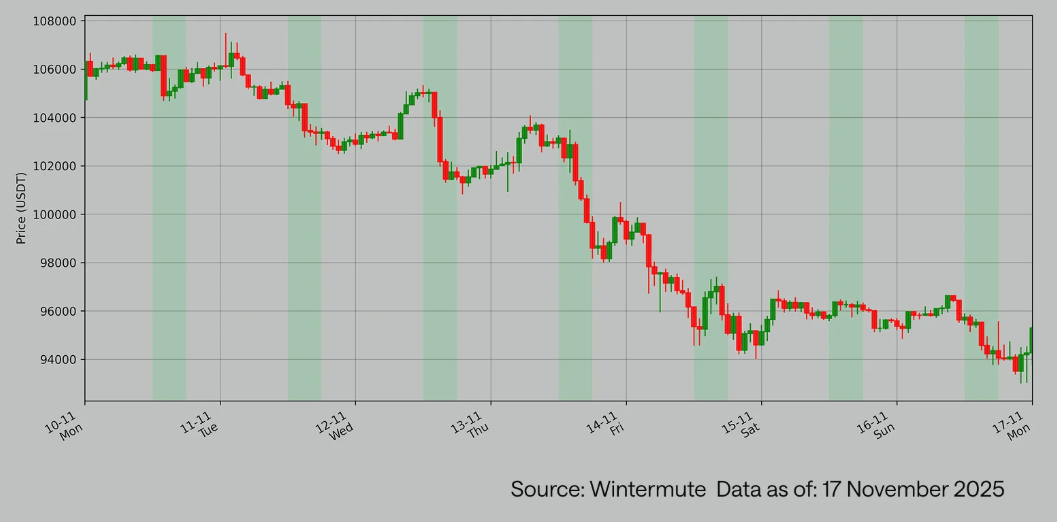
However, the market remains fundamentally constructive, as the broader macro picture points to continued global rate easing. The report highlights that the market is primarily macro-driven, suggesting that “the next catalyst is more likely to come from policy and rate cut expectations rather than crypto native flows.”
Still, major cryptos need to regain momentum for a broader market recovery, Wintermute concluded.
Other analysts have predicted a potential recovery in the coming months, spearheaded by progress in crypto regulations, particularly the CLARITY Act, which is gradually advancing in the Senate.
On the other hand, Thomas Lee, Chairman of Ethereum treasury firm BitMine, suggested in a Monday statement that the decline across cryptocurrencies could be due to a hole in a key market maker’s balance sheet.
Wintermute is one of the most popular digital asset market makers.
Bitcoin and Ethereum are up 1% and 4%, respectively, over the past 24 hours at the time of publication.
BoE’s Pill: Policymakers should be cautious

Bank of England (BoE) Chief Economist Huw Pill spoke at an interview with Reuters in the Bank of England in London on Tuesday. He said that underlying inflation dynamics in the UK are lower than headline inflation suggests and that policymakers should be cautious about over-interpreting.latest changes in key data
Key takeaways
Underlying inflation dynamics in the UK are lower than headline inflation suggests.
Policymakers should be cautious about over-interpreting latest changes in key data.
We haven’t seen the moderation in key nominal data that we would have expected in the past. Recent private-sector surveys have presented a less bearish picture of the economy than official figures.
I expect the QE portfolio held for monetary policy purposes to be wound down to a very low level.”
Pound Sterling FAQs
The Pound Sterling (GBP) is the oldest currency in the world (886 AD) and the official currency of the United Kingdom. It is the fourth most traded unit for foreign exchange (FX) in the world, accounting for 12% of all transactions, averaging $630 billion a day, according to 2022 data.
Its key trading pairs are GBP/USD, also known as ‘Cable’, which accounts for 11% of FX, GBP/JPY, or the ‘Dragon’ as it is known by traders (3%), and EUR/GBP (2%). The Pound Sterling is issued by the Bank of England (BoE).
The single most important factor influencing the value of the Pound Sterling is monetary policy decided by the Bank of England. The BoE bases its decisions on whether it has achieved its primary goal of “price stability” – a steady inflation rate of around 2%. Its primary tool for achieving this is the adjustment of interest rates.
When inflation is too high, the BoE will try to rein it in by raising interest rates, making it more expensive for people and businesses to access credit. This is generally positive for GBP, as higher interest rates make the UK a more attractive place for global investors to park their money.
When inflation falls too low it is a sign economic growth is slowing. In this scenario, the BoE will consider lowering interest rates to cheapen credit so businesses will borrow more to invest in growth-generating projects.
Data releases gauge the health of the economy and can impact the value of the Pound Sterling. Indicators such as GDP, Manufacturing and Services PMIs, and employment can all influence the direction of the GBP.
A strong economy is good for Sterling. Not only does it attract more foreign investment but it may encourage the BoE to put up interest rates, which will directly strengthen GBP. Otherwise, if economic data is weak, the Pound Sterling is likely to fall.
Another significant data release for the Pound Sterling is the Trade Balance. This indicator measures the difference between what a country earns from its exports and what it spends on imports over a given period.
If a country produces highly sought-after exports, its currency will benefit purely from the extra demand created from foreign buyers seeking to purchase these goods. Therefore, a positive net Trade Balance strengthens a currency and vice versa for a negative balance.
Australian Dollar pares losses as US Dollar declines on market caution
The Australian Dollar (AUD) recovers its intraday losses but remains in the negative territory against the US Dollar (USD) on Tuesday after registering losses in the previous session. The AUD/USD pair remained subdued after the Reserve Bank of Australia (RBA) published the Minutes of its November monetary policy meeting.
The RBA Meeting Minutes showed that board members signalled a more balanced policy stance, adding that it could keep the cash rate unchanged for longer if incoming data proves stronger than expected.
However, the AUD receives support as stronger domestic employment data reinforced expectations for a cautious stance from the Reserve Bank of Australia (RBA). As of the latest update on November 14, the ASX 30-Day Interbank Cash Rate Futures for December 2025 traded at 96.41, reflecting a 6% probability of a rate cut to 3.35% from 3.60% at the upcoming RBA Board meeting.
US Dollar moves little despite diminishing Fed rate cut likelihood
- The US Dollar Index (DXY), which measures the value of the US Dollar against six major currencies, is edging lower and trading around 99.50 at the time of writing. Traders brace for a backlog of US data following the government’s reopening.
- The CME FedWatch Tool suggests that financial markets are now pricing in a 43% chance that the Fed will cut its benchmark overnight borrowing rate by 25 basis points (bps) at its December meeting, down from 62% probability that markets priced a week ago.
- Federal Reserve Vice Chair Philip Jefferson noted Monday that risks to the labor market now outweigh upside risks to inflation, while stressing that the Fed should proceed “slowly” with any additional rate reductions.
- Fed Governor Christopher Waller said that the US central bank should cut the interest rates when policymakers meet in December. Waller added that he’s grown concerned over the labor market and the sharp slowdown in hiring.
- Kansas City Fed President Jeffrey Schmid said on Friday that monetary policy should “lean against demand growth,” adding that current Fed policy is “modestly restrictive,” which he believes is appropriate.
- National Economic Council Director Kevin Hassett cautioned that some October data may “never materialize,” as several agencies were unable to gather information during the shutdown. Initial private-sector reports suggest a cooling labor market and wavering consumer confidence, with persistent concerns about inflation.
- Automatic Data Processing (ADP) released the US Employment Change on Tuesday, showing an average weekly job loss of 11,250 in the four weeks to October 25. Weaker-than-expected private US labor data increased the likelihood of the Federal Reserve (Fed) policy easing. Challenger, Gray & Christmas announced that US employers slashed 153,074 jobs in October, up from the 55,597 cuts announced in October 2024.
- Reuters reported on Sunday that US Treasury Secretary Scott Bessent said a rare earths agreement between the United States (US) and China will “hopefully” be finalized by Thanksgiving. He added that he is confident China will uphold its commitments following the recent meeting in Korea between the two leaders, President Trump and President Xi Jinping.
- RBA Deputy Governor Andrew Hauser said last week, “Our best estimate is that monetary policy remains restrictive, though the committee continues to debate this.” Hauser added that if the policy is no longer mildly restrictive, it would have significant implications for future decisions.
- The Australian Bureau of Statistics (ABS) released the Unemployment Rate on Thursday, which declined to 4.3% in October from 4.5% in September, against the market expectations of 4.4%. Meanwhile, the Employment Change arrived at 42.2K in the same month from 12.8K (revised from 14.9K) prior, sharply exceeding the market forecast of 20K.
- Australia’s Full-Time Employment rose by 55.3K in October, from a rise of 6.5K in the previous reading (revised from 8.7K). Participation Rate steadied at 67%, while the Part-Time Employment decreased by 13.1K in October, versus an increase of 6.3K prior.
Australian Dollar moves below 0.6500 near lower rectangle boundary
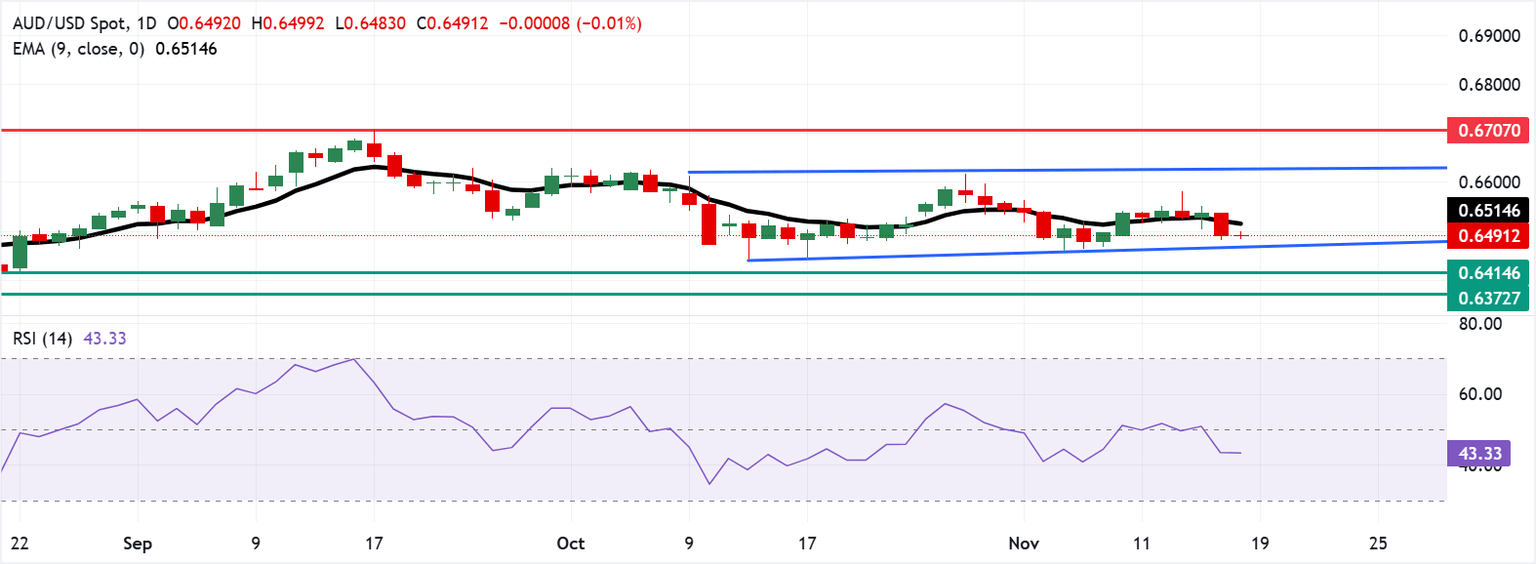
The AUD/USD pair is trading around 0.6490 on Tuesday. The analysis of the daily chart shows the pair consolidating within a rectangular range, reflecting sideways movement. The price moves below the nine-day Exponential Moving Average (EMA), suggesting that momentum is weakening.
On the downside, the primary support lies at the lower boundary of the rectangle around 0.6470, followed by the five-month low of 0.6414, which was recorded on August 21.
The AUD/USD pair may test the primary barrier at the nine-day EMA of 0.6514. A break above this level would improve the short-term price momentum and lead the pair to reach the rectangle’s upper boundary near 0.6630.
Australian Dollar Price Today
The table below shows the percentage change of Australian Dollar (AUD) against listed major currencies today. Australian Dollar was the weakest against the Swiss Franc.
| USD | EUR | GBP | JPY | CAD | AUD | NZD | CHF | |
|---|---|---|---|---|---|---|---|---|
| USD | -0.10% | -0.06% | -0.12% | -0.00% | 0.16% | 0.03% | -0.27% | |
| EUR | 0.10% | 0.03% | -0.02% | 0.09% | 0.25% | 0.12% | -0.17% | |
| GBP | 0.06% | -0.03% | -0.06% | 0.06% | 0.21% | 0.10% | -0.20% | |
| JPY | 0.12% | 0.02% | 0.06% | 0.11% | 0.27% | 0.14% | -0.15% | |
| CAD | 0.00% | -0.09% | -0.06% | -0.11% | 0.16% | 0.04% | -0.26% | |
| AUD | -0.16% | -0.25% | -0.21% | -0.27% | -0.16% | -0.12% | -0.42% | |
| NZD | -0.03% | -0.12% | -0.10% | -0.14% | -0.04% | 0.12% | -0.29% | |
| CHF | 0.27% | 0.17% | 0.20% | 0.15% | 0.26% | 0.42% | 0.29% |
The heat map shows percentage changes of major currencies against each other. The base currency is picked from the left column, while the quote currency is picked from the top row. For example, if you pick the Australian Dollar from the left column and move along the horizontal line to the US Dollar, the percentage change displayed in the box will represent AUD (base)/USD (quote).
Australian Dollar FAQs
One of the most significant factors for the Australian Dollar (AUD) is the level of interest rates set by the Reserve Bank of Australia (RBA). Because Australia is a resource-rich country another key driver is the price of its biggest export, Iron Ore. The health of the Chinese economy, its largest trading partner, is a factor, as well as inflation in Australia, its growth rate and Trade Balance. Market sentiment – whether investors are taking on more risky assets (risk-on) or seeking safe-havens (risk-off) – is also a factor, with risk-on positive for AUD.
The Reserve Bank of Australia (RBA) influences the Australian Dollar (AUD) by setting the level of interest rates that Australian banks can lend to each other. This influences the level of interest rates in the economy as a whole. The main goal of the RBA is to maintain a stable inflation rate of 2-3% by adjusting interest rates up or down. Relatively high interest rates compared to other major central banks support the AUD, and the opposite for relatively low. The RBA can also use quantitative easing and tightening to influence credit conditions, with the former AUD-negative and the latter AUD-positive.
China is Australia’s largest trading partner so the health of the Chinese economy is a major influence on the value of the Australian Dollar (AUD). When the Chinese economy is doing well it purchases more raw materials, goods and services from Australia, lifting demand for the AUD, and pushing up its value. The opposite is the case when the Chinese economy is not growing as fast as expected. Positive or negative surprises in Chinese growth data, therefore, often have a direct impact on the Australian Dollar and its pairs.
Iron Ore is Australia’s largest export, accounting for $118 billion a year according to data from 2021, with China as its primary destination. The price of Iron Ore, therefore, can be a driver of the Australian Dollar. Generally, if the price of Iron Ore rises, AUD also goes up, as aggregate demand for the currency increases. The opposite is the case if the price of Iron Ore falls. Higher Iron Ore prices also tend to result in a greater likelihood of a positive Trade Balance for Australia, which is also positive of the AUD.
The Trade Balance, which is the difference between what a country earns from its exports versus what it pays for its imports, is another factor that can influence the value of the Australian Dollar. If Australia produces highly sought after exports, then its currency will gain in value purely from the surplus demand created from foreign buyers seeking to purchase its exports versus what it spends to purchase imports. Therefore, a positive net Trade Balance strengthens the AUD, with the opposite effect if the Trade Balance is negative.
PBOC sets USD/CNY reference rate at 7.0856 vs. 7.0816 previous

The People’s Bank of China (PBOC) sets the USD/CNY central rate for the trading session ahead on Tuesday at 7.0856 compared to the previous day’s fix of 7.0816 and 7.1096 Reuters estimate.
PBOC FAQs
The primary monetary policy objectives of the People’s Bank of China (PBoC) are to safeguard price stability, including exchange rate stability, and promote economic growth. China’s central bank also aims to implement financial reforms, such as opening and developing the financial market.
The PBoC is owned by the state of the People’s Republic of China (PRC), so it is not considered an autonomous institution. The Chinese Communist Party (CCP) Committee Secretary, nominated by the Chairman of the State Council, has a key influence on the PBoC’s management and direction, not the governor. However, Mr. Pan Gongsheng currently holds both of these posts.
Unlike the Western economies, the PBoC uses a broader set of monetary policy instruments to achieve its objectives. The primary tools include a seven-day Reverse Repo Rate (RRR), Medium-term Lending Facility (MLF), foreign exchange interventions and Reserve Requirement Ratio (RRR). However, The Loan Prime Rate (LPR) is China’s benchmark interest rate. Changes to the LPR directly influence the rates that need to be paid in the market for loans and mortgages and the interest paid on savings. By changing the LPR, China’s central bank can also influence the exchange rates of the Chinese Renminbi.
Yes, China has 19 private banks – a small fraction of the financial system. The largest private banks are digital lenders WeBank and MYbank, which are backed by tech giants Tencent and Ant Group, per The Straits Times. In 2014, China allowed domestic lenders fully capitalized by private funds to operate in the state-dominated financial sector.
Dow Jones Industrial Average drops below 47,000 on AI concerns and Fed uncertainty
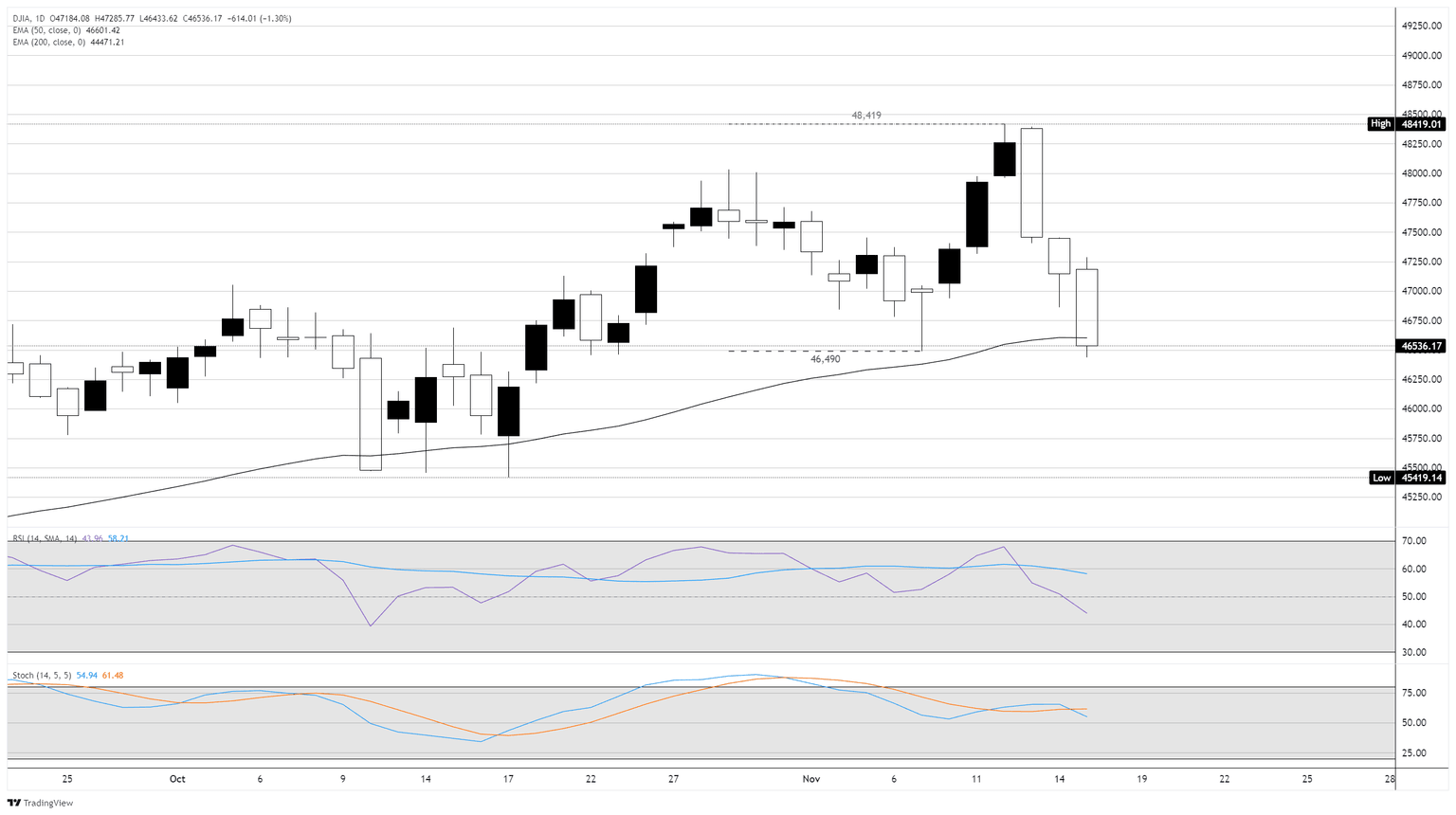
The Dow Jones Industrial Average (DJIA) hit another weak patch on Monday, backsliding 750 points at its lowest and slipping back below the 47,000 handle to start the new trading week with many of the same questions from last week going unanswered. The AI segment continues to see new challenges amid concerns about endpoint revenues, and investors are hoping that a kickstart to official data sources following the reopening of the federal government will help push the Federal Reserve (Fed) to deliver a third straight interest rate cut in December.
Alphabet shares supported by Berkshire investment
Shares in Google parent holding company Alphabet (GOOG) rose over 3% on the day after it was revealed that Warren Buffett’s Berkshire Hathaway (BRK) poured $4.3 billion into a stake in the Google search and YouTube giant at the end of September. Hyper-traditionalist investor Warren Buffett recently announced his retirement by the end of the year to Berkshire shareholders, leading to speculation that a play into Google properties is being spearheaded by more tech-friendly names in the Berkshire flagship.
Berkshire Hathaway continues to unwind its massive holdings of Apple (AAPL) stock, shedding another 15% of its total shares held as of the end of the third quarter. However, the Oracle of Omaha’s investment company’s holdings in Apple still sit at a lofty $60.7 billion.
Too-hot AI rally now faces tough questions about profitability
The AI trade continues to come under renewed pressure, with LLM computing services darling Nvidia (NVDA) falling another 1.8% on Monday. The chipmaker is slated to reveal its latest quarterly earnings after the closing bell on Wednesday, and investors are becoming concerned that the constantly-growing demand for AI-driven compute power still remains woefully outsized compared to revenues and return on investment on the actual deployment side.
US government back open… for now
The US government successfully passed a short-term funding resolution to restart federal operations last week, and investors are immediately pivoting into a wait-and-see stance as backdated labor and inflation data come down the chute. The Trump administration has preemptively warned that October’s labor and inflation data may be “lost forever”, but traders are hoping that September’s Nonfarm Payrolls (NFP) jobs report, while stale, will provide enough ammunition to pave the way to a third straight interest rate cut on December 10.
Fed Chair Jerome Powell signaled at the Fed’s last interest rate decision that a lack of official government data will force the Fed to stand pat until it receives further information on the US economy, battering broad-market expectations for a third straight rate cut in December.
Dow Jones daily chart
Nvidia FAQs
Nvidia is the leading fabless designer of graphics processing units or GPUs. These sophisticated devices allow computers to better process graphics for display interfaces by accelerating computer memory and RAM. This is especially true in the world of video games, where Nvidia graphics cards became a mainstay of the industry. Additionally, Nvidia is well-known as the creator of its CUDA API that allows developers to create software for a number of industries using its parallel computing platform. Nvidia chips are leading products in the data center, supercomputing and artificial intelligence industries. The company is also viewed as one of the inventors of the system-on-a-chip design.
Current CEO Jensen Huang founded Nvidia with Chris Malachowsky and Curtis Priem in 1993. All three founders were semiconductor engineers, who had previously worked at AMD, Sun Microsystems, IBM and Hewlett-Packard. The team set out to build more proficient GPUs than currently existed in the market and largely succeeded by late 1990s. The company was founded with $40,000 but secured $20 million in funding from Sequoia Capital venture fund early on. Nvidia went public in 1999 under the ticker NVDA. Nvidia became a leading designer of chips to the data center, PC, automotive and mobile markets through its close relationship with Taiwan Semiconductor.
In 2022, Nvidia released its ninth-generation data center GPU called the H100. This GPU is specifically designed with the needs of artificial intelligence applications in mind. For instance, OpenAI’s ChatGPT and GPT-4 large language models (LLMs) rely on the H100’s high efficiency in parallel processing to execute a high number of commands quickly. The chip is said to speed up networks by six times Nvidia’s previous A100 chip and is based on the new Hopper architecture. The H100 chip contains 80 billion transistors. Nvidia’s market cap reached $1 trillion in May 2023 largely on the promise of its H100 chip becoming the “picks and shovels” of the coming AI revolution. In June 2024, Nvidia’s market capitalization crossed the $3 trillion mark.
Long-time CEO Jense Huang has a cult following in Silicon Valley and on Wall Street due to his strict loyalty and determination to build Nvidia into one of the world’s leading companies. Nvidia neary fell apart on several occasions, but each time Huang bet everything on a new technology that turned out to be the ticket to the company’s success. Huang is seen as a visionary in Silicon Valley, and his company is at the forefront of most major breakthroughs in computer processing. Huang is known for his enthusiastic keynote addresses at annual Nvidia GTC conferences, as well as his love of black leather jackets and Denny’s, the fast food chain where the company was founded.
EUR/GBP retreats from highs as Sterling firms on profit-taking, BoE comments

The Euro weakens against the British Pound on Monday, with EUR/GBP extending its pullback after climbing to fresh year-to-date highs near 0.8865 on Friday, as traders react to contrasting signals from the European Central Bank (ECB) and the Bank of England (BoE).
At the time of writing, the cross is trading around 0.8806, with no fresh economic releases on either side. Sterling is firmer on the day, helped by light profit-taking on the recent Euro rally amid lingering uncertainty ahead of the UK’s November 26 budget.
Sterling also found a mild lift from hawkish-leaning remarks by BoE policymaker Catherine Mann earlier in the day. Mann warned that the UK is operating in “a more shock-ridden environment,” saying recent shocks continue to give “an upward bias to inflation.”
She noted that firms are “continuing to factor in inflation into pricing,” adding that underlying inflation dynamics show “upside risk.” While she acknowledged that wage normalization is underway, Mann said central banks will still “have to lean against upward bias.”
On the Euro side, ECB commentary offered little support to the Euro. Vice-President Luis de Guindos said he expects inflation “to converge towards the target,” and noted that wage dynamics are “going in the right direction,” while highlighting that the Eurozone’s fiscal challenge remains “a key vulnerability.”
In separate remarks, ECB’s Sleijpen said inflation risks for the Euro Area are “balanced,” reiterating that current data show the economy is “in a good place” and that monetary policy is also “in a good place.”
Beyond central-bank remarks, the European Commission’s latest projections pointed to a mixed growth path for the bloc. The EU now expects Eurozone Gross Domestic Product (GDP) to rise 1.3% in 2025, an upgrade from the previous 0.9% estimate, but lowered its 2026 forecast to 1.2% from 1.4%, with growth seen at 1.4% in 2027. Germany’s 2026 outlook was nudged slightly higher to 1.2% from 1.1%, while the Eurozone budget deficit is projected at 3.2% in 2025 and widening to 3.4% by 2027.
Looking ahead, attention turns to the upcoming inflation releases, with the UK Consumer Price Index (CPI) and the Eurozone Harmonised Index of Consumer Prices (HICP) due on Wednesday.
Pound Sterling Price Today
The table below shows the percentage change of British Pound (GBP) against listed major currencies today. British Pound was the strongest against the Australian Dollar.
| USD | EUR | GBP | JPY | CAD | AUD | NZD | CHF | |
|---|---|---|---|---|---|---|---|---|
| USD | 0.19% | -0.01% | 0.36% | 0.06% | 0.53% | 0.22% | 0.15% | |
| EUR | -0.19% | -0.21% | 0.18% | -0.13% | 0.34% | 0.03% | -0.03% | |
| GBP | 0.00% | 0.21% | 0.37% | 0.07% | 0.54% | 0.23% | 0.17% | |
| JPY | -0.36% | -0.18% | -0.37% | -0.30% | 0.18% | -0.14% | -0.20% | |
| CAD | -0.06% | 0.13% | -0.07% | 0.30% | 0.47% | 0.15% | 0.10% | |
| AUD | -0.53% | -0.34% | -0.54% | -0.18% | -0.47% | -0.31% | -0.38% | |
| NZD | -0.22% | -0.03% | -0.23% | 0.14% | -0.15% | 0.31% | -0.06% | |
| CHF | -0.15% | 0.03% | -0.17% | 0.20% | -0.10% | 0.38% | 0.06% |
The heat map shows percentage changes of major currencies against each other. The base currency is picked from the left column, while the quote currency is picked from the top row. For example, if you pick the British Pound from the left column and move along the horizontal line to the US Dollar, the percentage change displayed in the box will represent GBP (base)/USD (quote).
USD/CHF climbs amid US Dollar strength, SNB rate hold anticipation

USD/CHF remains supported on Monday, trading around 0.7950 at the time of writing, up 0.17% on the day. The pair is lifted by renewed strength in the US Dollar (USD) as expectations for an imminent policy easing by the Federal Reserve (Fed) continue to fade. Investors are now awaiting the release of a series of US economic reports delayed by the reopening of the federal government, a key element for clarifying the Fed’s policy outlook.
The Nonfarm Payrolls (NFP) report for September is scheduled for release on November 20, but uncertainty persists regarding the publication of other indicators, as several agencies were unable to collect data during the shutdown. Last week, the Director of the US National Economic Council, Kevin Hassett, warned that some October figures may “never be produced.”
According to the CME FedWatch tool, markets now assign only a 46% chance to a 25-basis-point rate cut in December, compared with 67% one week earlier. Several Federal Reserve officials have recently emphasized that inflation remains the dominant risk. Kansas City Fed President Jeffery Schmid said current policy is “modestly restrictive” and appropriate, while St. Louis Fed President Alberto Musalem noted that rates are now closer to neutral but called for caution to avoid easing too early.
On the Swiss side, the upside in USD/CHF could be limited by increased support for the Swiss Franc (CHF). Investors now expect the Swiss National Bank (SNB) to keep its policy rate at 0% in December, amid forecasts of slightly rising inflation. The SNB’s Vice President, Antoine Martin, recently said inflation is “expected to increase slightly,” reinforcing expectations of a rate hold.
The Franc also benefits from confirmation by the Swiss government of a new tariff agreement with the Trump administration. The United States agreed to reduce duties on Swiss exports to 15%, down from 39%, a development that offers meaningful relief to the Swiss economy.
Swiss Franc Price Today
The table below shows the percentage change of Swiss Franc (CHF) against listed major currencies today. Swiss Franc was the strongest against the Australian Dollar.
| USD | EUR | GBP | JPY | CAD | AUD | NZD | CHF | |
|---|---|---|---|---|---|---|---|---|
| USD | 0.16% | -0.14% | 0.15% | -0.01% | 0.21% | 0.11% | 0.17% | |
| EUR | -0.16% | -0.31% | 0.02% | -0.13% | 0.05% | -0.05% | 0.01% | |
| GBP | 0.14% | 0.31% | 0.31% | 0.15% | 0.35% | 0.25% | 0.32% | |
| JPY | -0.15% | -0.02% | -0.31% | -0.17% | 0.05% | -0.05% | 0.01% | |
| CAD | 0.00% | 0.13% | -0.15% | 0.17% | 0.22% | 0.12% | 0.18% | |
| AUD | -0.21% | -0.05% | -0.35% | -0.05% | -0.22% | -0.10% | -0.04% | |
| NZD | -0.11% | 0.05% | -0.25% | 0.05% | -0.12% | 0.10% | 0.06% | |
| CHF | -0.17% | -0.01% | -0.32% | -0.01% | -0.18% | 0.04% | -0.06% |
The heat map shows percentage changes of major currencies against each other. The base currency is picked from the left column, while the quote currency is picked from the top row. For example, if you pick the Swiss Franc from the left column and move along the horizontal line to the US Dollar, the percentage change displayed in the box will represent CHF (base)/USD (quote).