Gold trades with a negative bias below the $4,700 mark for the second consecutive day, and slides back closer to last week’s swing low during the Asian session. The uncertainty over the second round of US-Iran peace talks assists the US Dollar in attracting some buyers, which is seen weighing on the commodity. However, expectations for a less hawkish US Federal Reserve could limit losses for the non-yielding bullion ahead of the key central bank event risk.
Bank of Japan holds interest rate at 0.75%, upgrades inflation forecasts
The Bank of Japan (BoJ) board members decided to leave the short-term interest rate unadjusted at 0.75%, following the conclusion of its two-day monetary policy review meeting on Tuesday.
The decision aligned with the market expectations.
Summary of the BoJ’s Monetary Policy Statement
BoJ makes policy decision by 6-3 vote.
BoJ board members Nakagawa, Takata and Tamura dissented to rate decision.
Nakagawa, Takata and Tamura proposed raising short-term interest rate target to 1.0% from 0.75%.
Proposal by Nakagawa, Takata and Tamura turned down by majority vote.
BoJ’s Nakagawa said while situation in Middle East remained unclear, given economic developments, risks to prices were skewed to the upside under accommodative financial conditions.
BoJ’s Takata said price stability target had been more or less achieved and that risks to prices in Japan were already skewed to the upside due to the second-round effects of price rises stemming from overseas developments.
Will continue to raise interest rates in accordance with developments in economy, prices, financial markets.
Will scrutinise timing, pace of policy adjustment with close eye on economic, price impact from Middle East development.
Will conduct monetary policy as appropriate from perspective of sustainably, stably achieving 2% inflation target.
Japan’s economic growth likely to decelerate in fiscal 2026.
Corporate profits, households’ real income to be pushed down by factors such as deterioration in terms of trade reflecting rise in crude oil prices.
Economy to be underpinned by government’s various measures such as fuel oil subsidies, other factors.
BoJ’s quarterly Outlook Report
Real interest rates are at significantly low levels.
Underlying inflation likely to be at level generally consistent with 2% target in second half of fiscal 2026 and fiscal 2027.
Risks to economic outlook skewed to downside.
Risks to inflation skewed to upside.
Japan’s economic growth is likely to decelerate in fiscal 2026.
The rise in crude oil prices reflecting the impact of the situation in the Middle East is expected to push down corporate profits and households’ real income.
Economy is expected to continue growing moderately, albeit at a decelerated rate.
Japan’s economic growth rate is likely to rise moderately from fiscal 2027 onward, since it is projected that the adverse effects of high crude oil prices will wane.
Projected year-on-year rate of increase in the CPI for fiscal 2026 is significantly higher, reflecting the rise in crude oil prices.
There are various risks to the outlook.
Necessary to pay particular attention to the impact of the future course of the situation in the Middle East on financial and FX markets.
Necessary to pay due attention to keep the risk of inflation significantly deviating upward from materializing.
Possible that the rise in crude oil prices is passed on to the price of various goods and services more easily than before.
Board’s core CPI fiscal 2026 median forecast at +2.8% vs +1.9% in January.
Board’s core CPI fiscal 2027 median forecast at +2.3% vs +2.0% in January.
Board’s core CPI fiscal 2028 median forecast at +2.0%.
Board’s real GDP fiscal 2026 median forecast at +0.5% vs +1.0% in January.
Board’s real GDP fiscal 2027 median forecast at +0.7% vs +0.8% in January.
Board’s real GDP fiscal 2028 median forecast at +0.8%.
BoJ Report on Risks
Possible that the rise in crude oil prices is passed on to the price of various goods and services more easily than before.
Attention will also need to be paid to the possibility that food prices could rise by more than expected through higher market prices for raw materials.
There is risk that large-scale disruptions in supply chains will occur, exerting a significant impact on the production activity of Japanese firms.
Regarding AI, strong business fixed investment could push up the global economy, but if profits do not expand in line with such investment, adjustment pressure could arise, accompanied by changes in asset prices.
Exchange rate developments are, compared to the past, more likely to affect prices.
Trade policies announced so far have partly led to a change in the trend of globalization.
Medium- to long-term inflation expectations have risen moderately.
Market reaction to the BoJ policy announcements
USD/JPY meets fresh supply and eases back toward 159.00 in an immediate reaction to the Bank of Japan’s (BoJ) no-rate-change decision, still down 0.08% on the day.
Japanese Yen Price Today
The table below shows the percentage change of Japanese Yen (JPY) against listed major currencies today. Japanese Yen was the strongest against the New Zealand Dollar.
| USD | EUR | GBP | JPY | CAD | AUD | NZD | CHF | |
|---|---|---|---|---|---|---|---|---|
| USD | 0.06% | 0.04% | -0.08% | 0.06% | 0.08% | 0.16% | 0.12% | |
| EUR | -0.06% | -0.04% | -0.19% | -0.02% | -0.01% | 0.04% | 0.06% | |
| GBP | -0.04% | 0.04% | -0.13% | 0.00% | 0.04% | 0.10% | 0.09% | |
| JPY | 0.08% | 0.19% | 0.13% | 0.18% | 0.19% | 0.24% | 0.22% | |
| CAD | -0.06% | 0.02% | 0.00% | -0.18% | 0.01% | 0.06% | 0.06% | |
| AUD | -0.08% | 0.01% | -0.04% | -0.19% | -0.01% | 0.07% | 0.08% | |
| NZD | -0.16% | -0.04% | -0.10% | -0.24% | -0.06% | -0.07% | -0.01% | |
| CHF | -0.12% | -0.06% | -0.09% | -0.22% | -0.06% | -0.08% | 0.01% |
The heat map shows percentage changes of major currencies against each other. The base currency is picked from the left column, while the quote currency is picked from the top row. For example, if you pick the Japanese Yen from the left column and move along the horizontal line to the US Dollar, the percentage change displayed in the box will represent JPY (base)/USD (quote).
This section below was published on April 27 at 23:00 GMT as a preview of the Bank of Japan Interest Rate Decision.
- The Bank of Japan is expected to keep rates on hold, but a hike is not off the table.
- Uncertainty spurring from the Middle East war will take its toll on the decision.
- Macro fundamentals back the case for additional rate hikes in Japan.
The Bank of Japan (BoJ) will announce its monetary policy decision on Tuesday, at around 3:00 GMT. The BoJ is widely expected to deliver a hawkish hold, keeping the benchmark interest rate unchanged at 0.75% while also hinting at a willingness to hike rates. The latest change in interest rates took place in December, when BoJ officials hiked by 25 basis points (bps)
Japanese policymakers are between a rock and a hard place: The Middle East war is a global source of uncertainty, while the local macro puts pressure on policymakers to act promptly.
Hotter-than-expected inflation and a tightening labor market hint at faster interest rate hikes, which run counter to the BoJ officials’ views.
In the meantime, the Middle East war continues. Hopes for a quick resolution fade as time goes by, with the war about to turn two months old.
What to expect from the BoJ interest rate decision?
According to the latest available data, the Consumer Price Index (CPI) rose 1.5% YoY in March, up from 1.3% in February and above the 1.4% anticipated by market players. Core annual inflation, which excludes volatile food and energy prices, rose to 1.8%, up from the expected 1.5%. Meanwhile, the Unemployment Rate stood at 2.6% in February.
If the BoJ could base monetary policy solely on these data, policymakers should pull the trigger in this meeting. However, the ongoing crisis in the Middle East paints a different picture. Rising Oil prices and persistent supply disruptions are expected to have a profound and prolonged impact on inflation worldwide. Japan is no exception. That opens the door for a surprise interest rate hike, although we are talking about Japan, and surprises are not usually in their script.
Policymakers are well aware of the situation. In a press conference in Washington following the 20-G meeting, BoJ Governor Kazuo Ueda noted that higher Oil prices “pose both upside risks to prices and downside risks to the economy, making policy responses difficult.”
Ueda added: “Developments in the Middle East will be a crucial factor (for the BoJ’s policy decision), but the outlook remains quite uncertain.” Finally, he repeated the central bank’s commitment to price stability: “We will take the most appropriate response to achieve our 2% price target in a sustainable and stable way.”
Governor Ueda will offer a press conference following the rate announcement, as usual. And while market participants anticipate a hawkish lean, the focus will be on how hawkish Japanese policymakers are willing to be in such an uncertain environment.
How could the Bank of Japan’s monetary policy decision affect USD/JPY?
Heading into the announcement, market participants expect the BoJ to hold its fire but deliver at least 50 bps rate hikes through 2026. The monetary policy Board is likely to keep rates on hold in its April meeting, not because it is the right decision, but to prevent a market shock. Policymakers are likely to anticipate additional rates coming, which will not be a big surprise.
There are two quite hawkish scenarios. The first would be the BoJ actually triggering a rate hike. The second would be to directly pre-announce a rate hike at the next monetary policy meeting. Furthermore, if officials hint at worries about growth, something that so far they have avoided, the case for additional rate hikes will increase, and hence, boost demand for the Japanese Yen (JPY). The odds for any of those happening are quite limited.
A dovish announcement is off the table, given the ongoing Middle East war.
Valeria Bednarik, Chief Analyst at FXStreet, notes: “The USD/JPY pair trades in quite a limited range just below 160.00 since early April, driven by sentiment related to the Persian Gulf crisis. Speculative interest is looking at the US Dollar (USD) as the preferred safe-haven, with optimism boosting demand for the Greenback, and pessimism leading to USD sell-offs. The BoJ announcement, unless a surprise, is likely to have a limited impact on the pair.”

Bednarik adds: “From a technical point of view, the USD/JPY pair is neutral. In the daily chart, the pair develops around a flat 20-day Simple Moving Average (SMA), which has been unable to find a way since early April. The 100- and 200-day SMAs keep heading higher, far below the current level, in line with the former dominant bullish trend. At the same time, the pair develops not far below its 2026 peak in the 160.40 region. Finally, technical indicators head marginally lower within neutral levels, far from providing a clear directional clue. The pair could fall with a hawkish announcement, with a break below 159.00 opening the door for a test of the 158.40 region. Below the latter, the slide could continue towards 157.90. As previously noted, 160.00 provides resistance in the case of sudden JPY weakness, with additional gains aiming to retest the year high.”
Central banks FAQs
Central Banks have a key mandate which is making sure that there is price stability in a country or region. Economies are constantly facing inflation or deflation when prices for certain goods and services are fluctuating. Constant rising prices for the same goods means inflation, constant lowered prices for the same goods means deflation. It is the task of the central bank to keep the demand in line by tweaking its policy rate. For the biggest central banks like the US Federal Reserve (Fed), the European Central Bank (ECB) or the Bank of England (BoE), the mandate is to keep inflation close to 2%.
A central bank has one important tool at its disposal to get inflation higher or lower, and that is by tweaking its benchmark policy rate, commonly known as interest rate. On pre-communicated moments, the central bank will issue a statement with its policy rate and provide additional reasoning on why it is either remaining or changing (cutting or hiking) it. Local banks will adjust their savings and lending rates accordingly, which in turn will make it either harder or easier for people to earn on their savings or for companies to take out loans and make investments in their businesses. When the central bank hikes interest rates substantially, this is called monetary tightening. When it is cutting its benchmark rate, it is called monetary easing.
A central bank is often politically independent. Members of the central bank policy board are passing through a series of panels and hearings before being appointed to a policy board seat. Each member in that board often has a certain conviction on how the central bank should control inflation and the subsequent monetary policy. Members that want a very loose monetary policy, with low rates and cheap lending, to boost the economy substantially while being content to see inflation slightly above 2%, are called ‘doves’. Members that rather want to see higher rates to reward savings and want to keep a lit on inflation at all time are called ‘hawks’ and will not rest until inflation is at or just below 2%.
Normally, there is a chairman or president who leads each meeting, needs to create a consensus between the hawks or doves and has his or her final say when it would come down to a vote split to avoid a 50-50 tie on whether the current policy should be adjusted. The chairman will deliver speeches which often can be followed live, where the current monetary stance and outlook is being communicated. A central bank will try to push forward its monetary policy without triggering violent swings in rates, equities, or its currency. All members of the central bank will channel their stance toward the markets in advance of a policy meeting event. A few days before a policy meeting takes place until the new policy has been communicated, members are forbidden to talk publicly. This is called the blackout period.
Bank of Japan expected to hold rates amid Iran war-driven inflation fears
The Bank of Japan (BoJ) will announce its monetary policy decision on Tuesday, at around 3:00 GMT. The BoJ is widely expected to deliver a hawkish hold, keeping the benchmark interest rate unchanged at 0.75% while also hinting at a willingness to hike rates. The latest change in interest rates took place in December, when BoJ officials hiked by 25 basis points (bps)
Japanese policymakers are between a rock and a hard place: The Middle East war is a global source of uncertainty, while the local macro puts pressure on policymakers to act promptly.
Hotter-than-expected inflation and a tightening labor market hint at faster interest rate hikes, which run counter to the BoJ officials’ views.
In the meantime, the Middle East war continues. Hopes for a quick resolution fade as time goes by, with the war about to turn two months old.
What to expect from the BoJ interest rate decision?
According to the latest available data, the Consumer Price Index (CPI) rose 1.5% YoY in March, up from 1.3% in February and above the 1.4% anticipated by market players. Core annual inflation, which excludes volatile food and energy prices, rose to 1.8%, up from the expected 1.5%. Meanwhile, the Unemployment Rate stood at 2.6% in February.
If the BoJ could base monetary policy solely on these data, policymakers should pull the trigger in this meeting. However, the ongoing crisis in the Middle East paints a different picture. Rising Oil prices and persistent supply disruptions are expected to have a profound and prolonged impact on inflation worldwide. Japan is no exception. That opens the door for a surprise interest rate hike, although we are talking about Japan, and surprises are not usually in their script.
Policymakers are well aware of the situation. In a press conference in Washington following the 20-G meeting, BoJ Governor Kazuo Ueda noted that higher Oil prices “pose both upside risks to prices and downside risks to the economy, making policy responses difficult.”
Ueda added: “Developments in the Middle East will be a crucial factor (for the BoJ’s policy decision), but the outlook remains quite uncertain.” Finally, he repeated the central bank’s commitment to price stability: “We will take the most appropriate response to achieve our 2% price target in a sustainable and stable way.”
Governor Ueda will offer a press conference following the rate announcement, as usual. And while market participants anticipate a hawkish lean, the focus will be on how hawkish Japanese policymakers are willing to be in such an uncertain environment.
How could the Bank of Japan’s monetary policy decision affect USD/JPY?
Heading into the announcement, market participants expect the BoJ to hold its fire but deliver at least 50 bps rate hikes through 2026. The monetary policy Board is likely to keep rates on hold in its April meeting, not because it is the right decision, but to prevent a market shock. Policymakers are likely to anticipate additional rates coming, which will not be a big surprise.
There are two quite hawkish scenarios. The first would be the BoJ actually triggering a rate hike. The second would be to directly pre-announce a rate hike at the next monetary policy meeting. Furthermore, if officials hint at worries about growth, something that so far they have avoided, the case for additional rate hikes will increase, and hence, boost demand for the Japanese Yen (JPY). The odds for any of those happening are quite limited.
A dovish announcement is off the table, given the ongoing Middle East war.
Valeria Bednarik, Chief Analyst at FXStreet, notes: “The USD/JPY pair trades in quite a limited range just below 160.00 since early April, driven by sentiment related to the Persian Gulf crisis. Speculative interest is looking at the US Dollar (USD) as the preferred safe-haven, with optimism boosting demand for the Greenback, and pessimism leading to USD sell-offs. The BoJ announcement, unless a surprise, is likely to have a limited impact on the pair.”

Bednarik adds: “From a technical point of view, the USD/JPY pair is neutral. In the daily chart, the pair develops around a flat 20-day Simple Moving Average (SMA), which has been unable to find a way since early April. The 100- and 200-day SMAs keep heading higher, far below the current level, in line with the former dominant bullish trend. At the same time, the pair develops not far below its 2026 peak in the 160.40 region. Finally, technical indicators head marginally lower within neutral levels, far from providing a clear directional clue. The pair could fall with a hawkish announcement, with a break below 159.00 opening the door for a test of the 158.40 region. Below the latter, the slide could continue towards 157.90. As previously noted, 160.00 provides resistance in the case of sudden JPY weakness, with additional gains aiming to retest the year high.”
Economic Indicator
BoJ Interest Rate Decision
The Bank of Japan (BoJ) announces its interest rate decision after each of the Bank’s eight scheduled annual meetings. Generally, if the BoJ is hawkish about the inflationary outlook of the economy and raises interest rates it is bullish for the Japanese Yen (JPY). Likewise, if the BoJ has a dovish view on the Japanese economy and keeps interest rates unchanged, or cuts them, it is usually bearish for JPY.
Next release: Tue Apr 28, 2026 03:00
Frequency: Irregular
Consensus: 0.75%
Previous: 0.75%
Source: Bank of Japan
Japanese Yen FAQs
The Japanese Yen (JPY) is one of the world’s most traded currencies. Its value is broadly determined by the performance of the Japanese economy, but more specifically by the Bank of Japan’s policy, the differential between Japanese and US bond yields, or risk sentiment among traders, among other factors.
One of the Bank of Japan’s mandates is currency control, so its moves are key for the Yen. The BoJ has directly intervened in currency markets sometimes, generally to lower the value of the Yen, although it refrains from doing it often due to political concerns of its main trading partners. The BoJ ultra-loose monetary policy between 2013 and 2024 caused the Yen to depreciate against its main currency peers due to an increasing policy divergence between the Bank of Japan and other main central banks. More recently, the gradually unwinding of this ultra-loose policy has given some support to the Yen.
Over the last decade, the BoJ’s stance of sticking to ultra-loose monetary policy has led to a widening policy divergence with other central banks, particularly with the US Federal Reserve. This supported a widening of the differential between the 10-year US and Japanese bonds, which favored the US Dollar against the Japanese Yen. The BoJ decision in 2024 to gradually abandon the ultra-loose policy, coupled with interest-rate cuts in other major central banks, is narrowing this differential.
The Japanese Yen is often seen as a safe-haven investment. This means that in times of market stress, investors are more likely to put their money in the Japanese currency due to its supposed reliability and stability. Turbulent times are likely to strengthen the Yen’s value against other currencies seen as more risky to invest in.
Fed: Policy on hold as Iran shock lingers – TD Securities

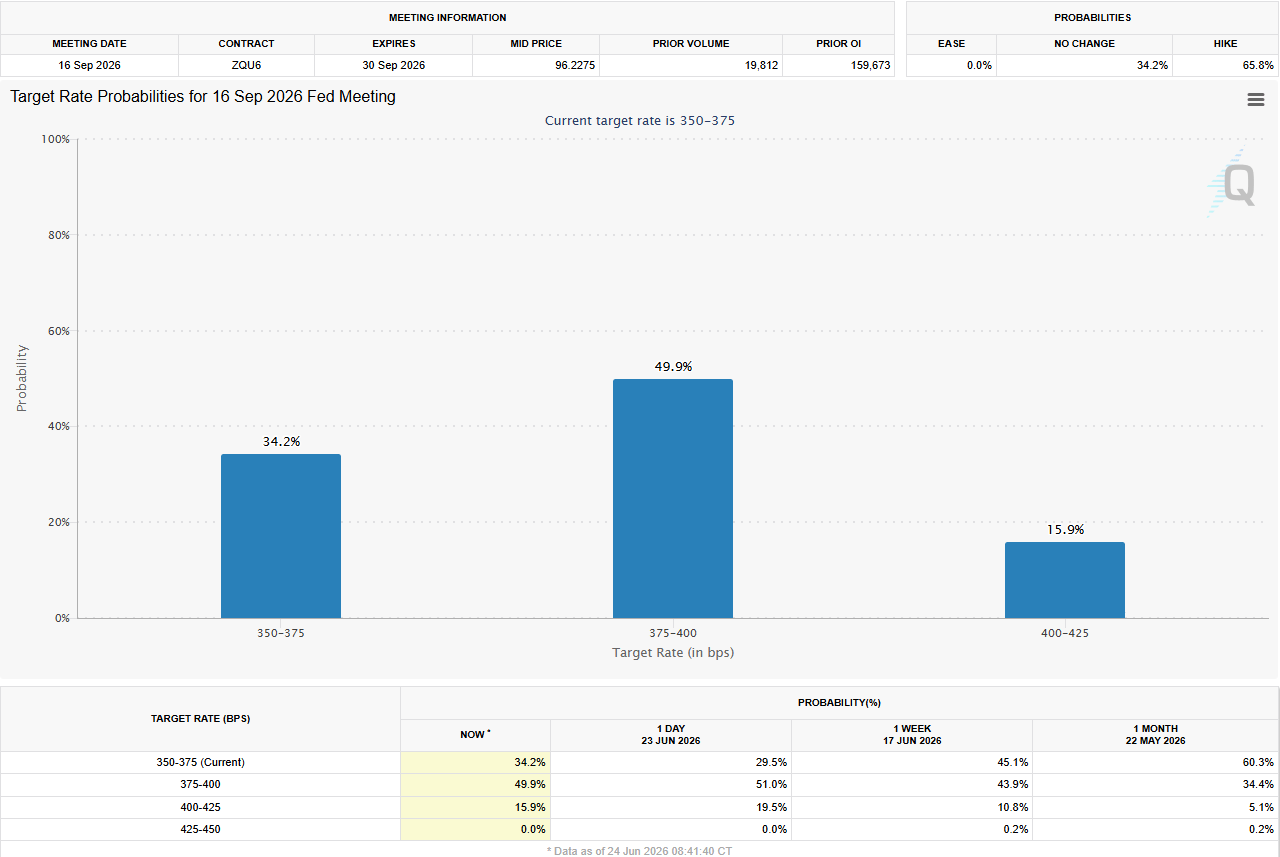
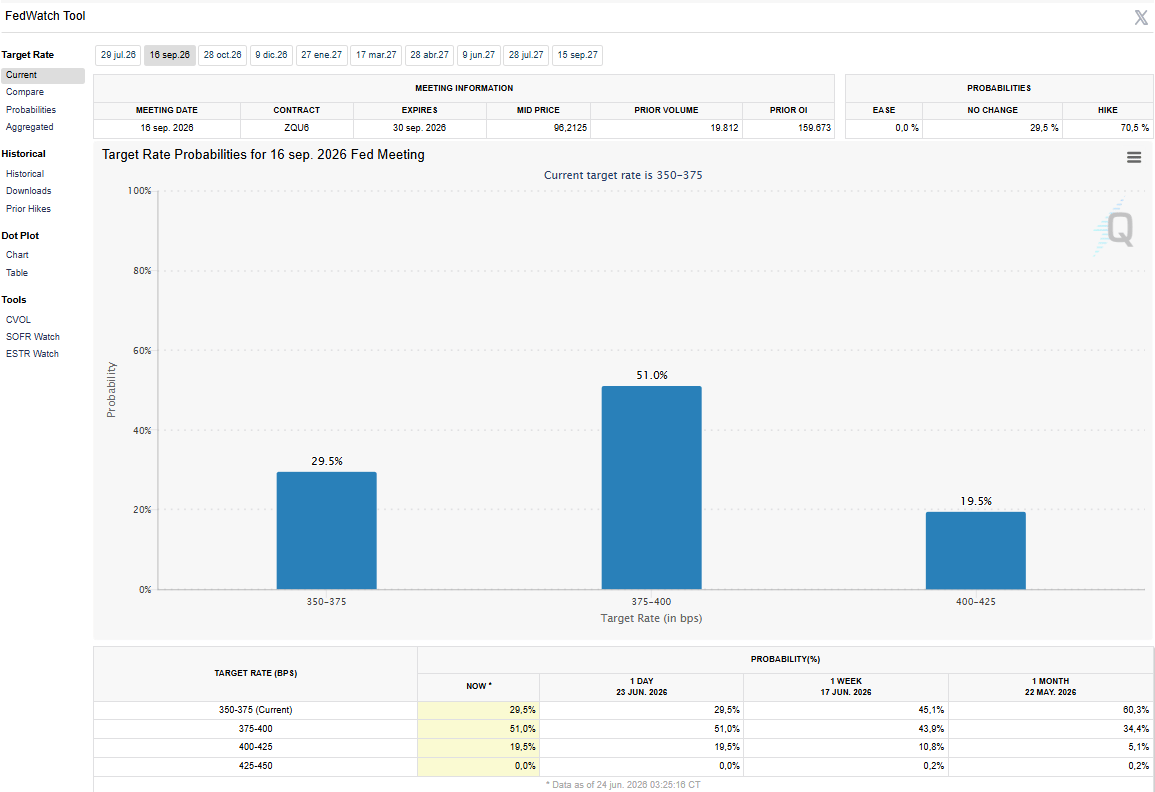
TD Securities strategists Oscar Munoz and Eli Nir expect the Federal Reserve (Fed) to keep the Fed funds rate at 3.50–3.75% at the April Federal Open Market Committee (FOMC), with Chair Powell maintaining a neutral stance on future policy. They see the Fed remaining on hold until September 2026 as it assesses Iran-related risks, before delivering a gradual 75 bps of easing through March 2027.
Powell’s last meeting and path ahead
“The policy rate will remain at 3.50-3.75% at the April FOMC. The labor market remains in balance while headline inflation has picked up due to the oil shock. Given the still-heightened level of uncertainty, we expect the Committee will reiterate a message of patience.”
“With the DoJ [Department of Justice] dropping its investigation into Powell, it appears that this week could be Powell’s last FOMC meeting as chair. As we discussed in our note last week, whether or not Powell stays on as governor once Warsh is confirmed will be up to him. Powell may provide guidance on this in his press conference, but he could also choose to make a statement at a later time.”
“Warsh’s Senate hearing offered little clarity on near-term policy. We believe it will prove difficult for him to achieve cuts immediately given the heightened uncertainty from the Iran conflict. He reiterated criticism of the Fed’s inflation performance, balance-sheet size, and forward guidance.”
“We expect the Fed to remain on hold until September as they assess the developments in Iran and its impact on the economy. By then, inflation progress will have likely resumed, allowing for the Fed to continue its gradual move towards neutral. We look for 50bps total of easing this year in September and December with an additional 25bps cut in March 2027, ending with a Fed funds rate at 3.00%.”
“We continue to expect that if the economic impacts from Iran moderate, the Fed can resume easing in September on inflation progress. Underlying inflation will likely improve after tariff and oil impacts fade, and we see little inflation risk from the labor market as will be evident in Q1 ECI this week.”
(This article was created with the help of an Artificial Intelligence tool and reviewed by an editor.)
XRP lags recovery despite capital inflows
Ripple (XRP) is trading under increasing sell-side pressure as of writing on Monday. A near-term support at $1.41 suggests that dip-buying remains steady despite overhanging resistance at $1.53 and $1.78.
Risk appetite has continued to improve amid renewed optimism for the United States (US)-Iran peace. Despite the US President Donald Trump canceling the peace talks scheduled for last Sunday in Pakistan, Iran has reportedly sent a new proposal to the White House.
The proposal seeks to delay the topic of Iran’s nuclear program while focusing on objectives such as opening the Strait of Hormuz and ending the war. It remains unclear whether the White House will act on the proposal, as Trump has insisted that the US has the upper hand in the negotiations.
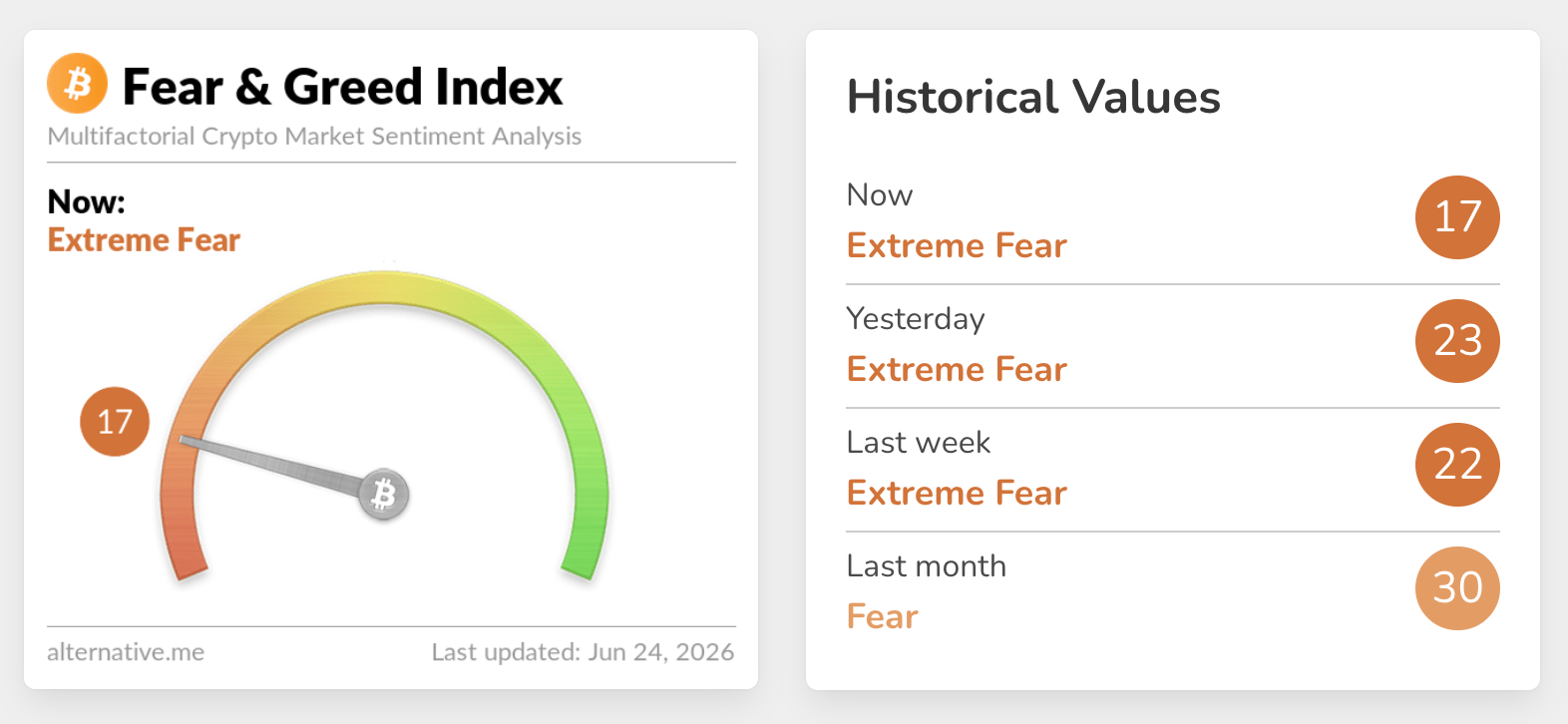
Broader market sentiment continues to improve with the crypto Fear & Greed Index holding at 47 in the fear territory on Monday, up from 33 the previous day. The index held in the extreme fear territory last month, underscoring the gradual but steady turnaround in investor risk appetite.

XRP recovery outlook lags on renewed institutional demand
Interest in XRP digital investment products recorded $25 million in inflows last week, bringing total assets under management to nearly $2.58 billion. The influx follows outflows of $56.2 million in the previous week and underscores an improving appetite for risk assets.

“The market now turns to the FOMC decision on 28–29 April, which is likely contributing to caution at the margin,” a CoinShares report states.
The Federal Reserve (Fed) is expected to leave interest rates unchanged in the 3.50%–$3.75% range on Wednesday. Of importance would be Fed Chair Jerome Powell’s new conference after the meeting, where investors will seek clues on the central bank’s policy direction, especially with the US-Iran conflict still pressuring global markets.

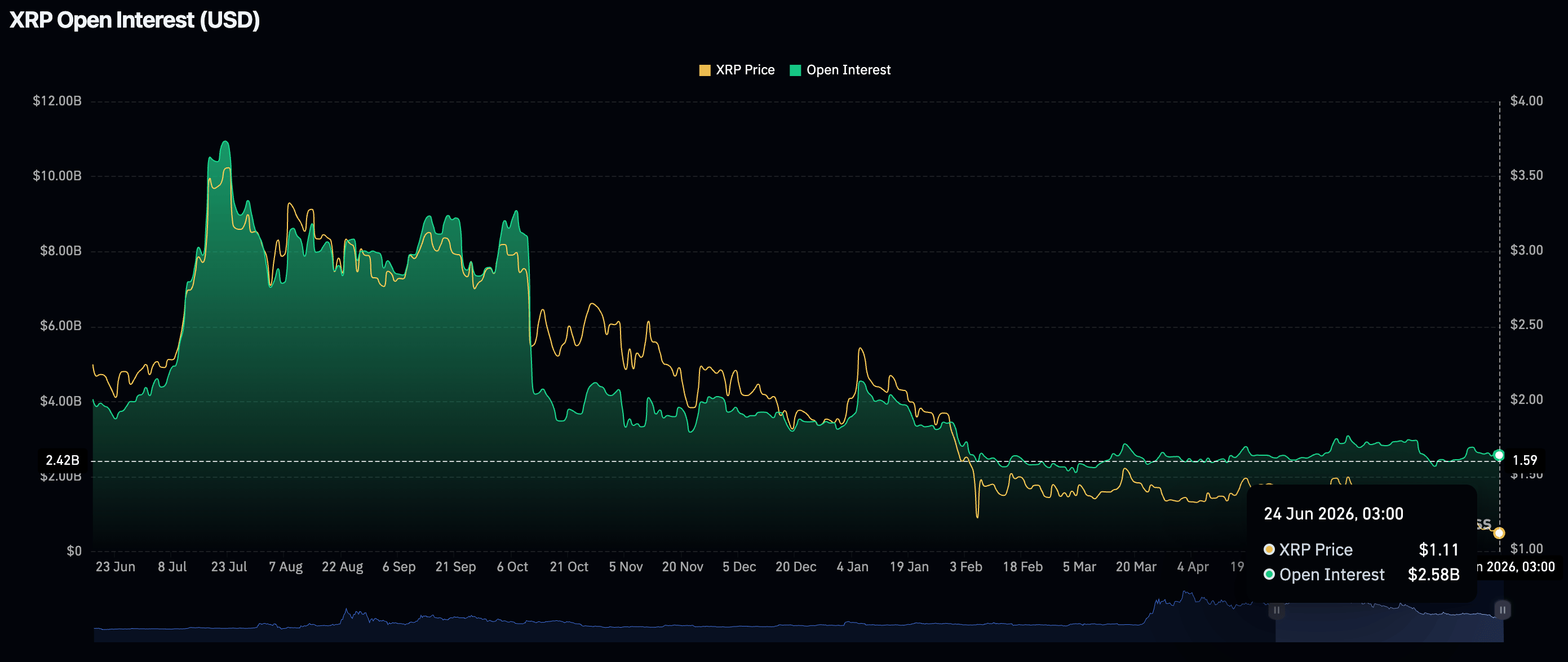
Meanwhile, retail demand for XRP perpetual futures contracts remains subdued, with Open Interest (OI) averaging $2.55 billion on Monday. Although the OI marks a slight increase from $2.50 billion the previous day, it pales in comparison to the record $10.94 billion in July. In other words, investors lack conviction in XRP’s ability to sustain an uptrend.

Technical outlook: XRP tests key support
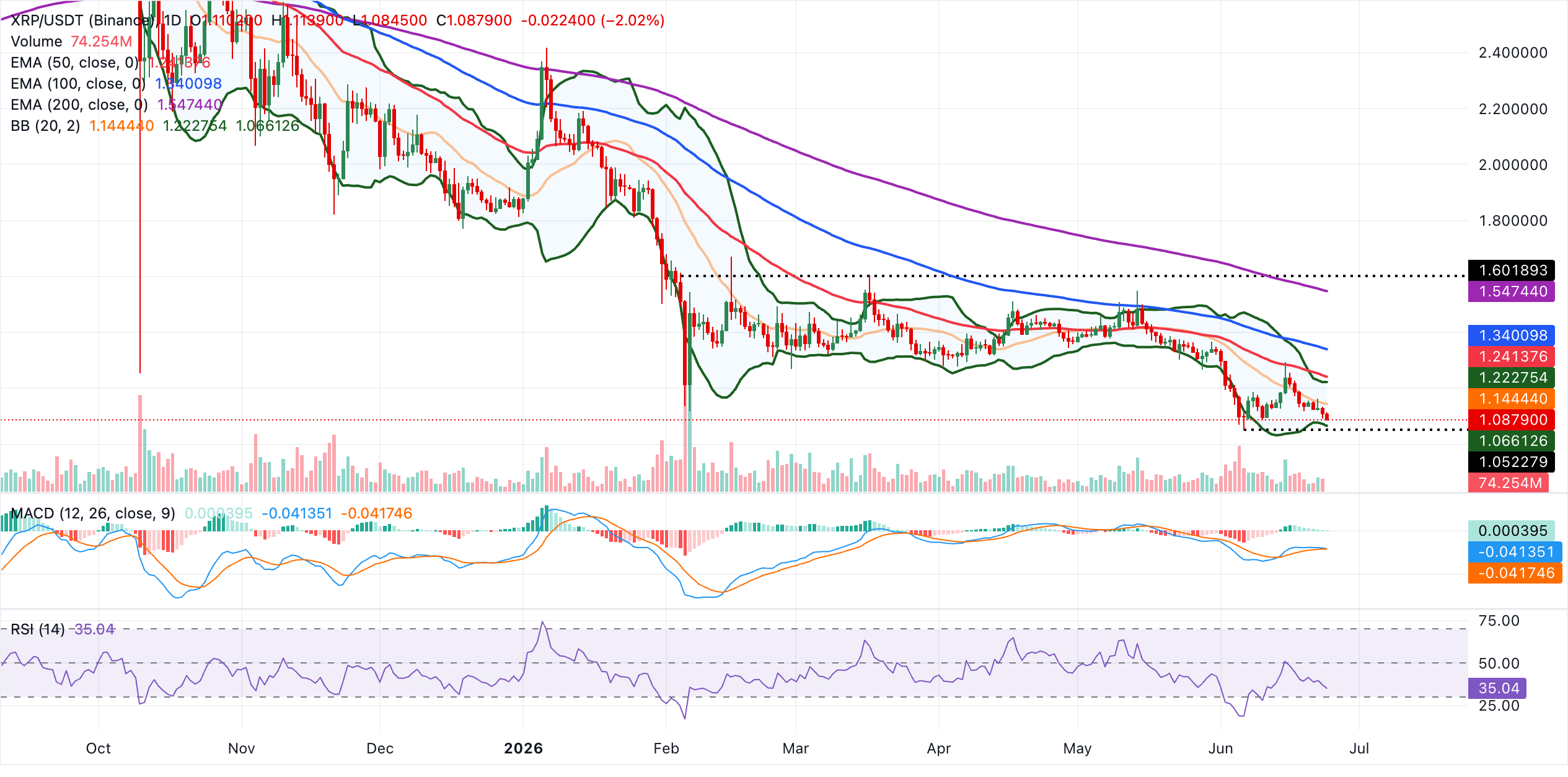
XRP is holding just above the 50-day Exponential Moving Average (EMA) near $1.42 while remaining capped beneath the descending trendline break level at $1.43 and, more importantly, the 100-day and 200-day EMAs at $1.53 and $1.78. This configuration keeps the broader tone capped despite a still mildly constructive backdrop, as the RSI holds near a neutral 52 on the daily chart. Moreover, the MACD histogram stays marginally positive on the same chart but has been losing momentum in recent sessions.

On the downside, immediate support is aligned with the 50-day EMA at $1.42. A daily close back below this pivot would expose the SuperTrend indicator line as the next notable floor near $1.31. On the topside, initial resistance is seen at the descending trendline break area around $1.43, and only a sustained move above that barrier would open the way toward the 100-day EMA at $1.53.
(The technical analysis of this story was written with the help of an AI tool.)
Ripple FAQs
EUR/JPY edges higher as markets brace for BoJ, ECB decisions amid Middle East tensions

EUR/JPY trades around 186.95 on Monday at the time of writing, up modestly by 0.07%, as markets adopt a wait-and-see stance ahead of this week’s monetary policy decisions from the Bank of Japan (BoJ) and the European Central Bank (ECB).
Investors broadly expect the Bank of Japan (BoJ) to leave interest rates unchanged at 0.75% on Tuesday. However, attention will focus on the central bank’s communication and any signals pointing to a potential rate hike in June. According to Commerzbank, the absence of clear forward guidance in this direction could weigh on the Japanese Yen (JPY), despite ongoing geopolitical tensions and concerns about intervention from Japanese authorities.
In the Eurozone, the European Central Bank (ECB) is also expected to keep rates on hold on Thursday, maintaining its benchmark deposit rate at 2%. Policymakers are adopting a wait-and-see approach amid elevated economic uncertainty, particularly linked to the conflict in the Middle East. Governing Council member Martins Kazaks recently noted that the ECB still has the “luxury” of gathering data before adjusting its policy stance.
Recent data from Germany highlight this fragile backdrop. The GfK Consumer Confidence index dropped to -33.3 for May, its lowest level in more than three years, pointing to deteriorating household sentiment. However, the impact on the Euro (EUR) has remained limited.
Geopolitical developments in the Middle East remain the key market driver. Hopes for de-escalation briefly emerged following reports that Iran had submitted a new peace proposal to the United States (US), including reopening the Strait of Hormuz. However, negotiations remain stalled, with Oil tankers blocked for two months and Crude prices hovering near $100 per barrel, raising concerns about a potential global recession.
In this environment, safe-haven flows and energy-driven inflation expectations continue to influence the Japanese Yen, while the Euro remains constrained by weak growth and limited policy visibility. The near-term direction of EUR/JPY will largely depend on signals from central banks this week and any progress on the geopolitical front.
Euro Price Today
The table below shows the percentage change of Euro (EUR) against listed major currencies today. Euro was the strongest against the US Dollar.
| USD | EUR | GBP | JPY | CAD | AUD | NZD | CHF | |
|---|---|---|---|---|---|---|---|---|
| USD | -0.20% | -0.16% | -0.14% | -0.42% | -0.49% | -0.52% | -0.12% | |
| EUR | 0.20% | 0.06% | 0.07% | -0.21% | -0.26% | -0.29% | 0.09% | |
| GBP | 0.16% | -0.06% | 0.02% | -0.26% | -0.36% | -0.35% | 0.03% | |
| JPY | 0.14% | -0.07% | -0.02% | -0.26% | -0.35% | -0.39% | 0.06% | |
| CAD | 0.42% | 0.21% | 0.26% | 0.26% | -0.08% | -0.12% | 0.30% | |
| AUD | 0.49% | 0.26% | 0.36% | 0.35% | 0.08% | -0.02% | 0.38% | |
| NZD | 0.52% | 0.29% | 0.35% | 0.39% | 0.12% | 0.02% | 0.40% | |
| CHF | 0.12% | -0.09% | -0.03% | -0.06% | -0.30% | -0.38% | -0.40% |
The heat map shows percentage changes of major currencies against each other. The base currency is picked from the left column, while the quote currency is picked from the top row. For example, if you pick the Euro from the left column and move along the horizontal line to the US Dollar, the percentage change displayed in the box will represent EUR (base)/USD (quote).
Singapore Industrial Production (YoY) climbed from previous -0.1% to 10.1% in March
Bitcoin, Ethereum and Ripple begin the week on a constructive note, extending gains after surging over 6%, 4% and 2% last week. BTC holds above $79,000, ETH closes above the 100-day Exponential Moving Average at $2,353, while XRP continues to defend its breakout above the key $1.41 resistance zone.
Iran’s Araghchi holds talks with Oman on ending war and securing Hormuz

Iran’s Foreign Minister Abbas Araghchi held talks in Oman on Sunday and discussed security in the Strait of Hormuz and broader Gulf waters and diplomatic efforts to end the Iran-US conflict, Reuters reported on Sunday.
Araghchi said that the US military presence in the Middle East was fuelling insecurity and division and called for a regional security framework free of outside interference.
Iran’s Foreign Minister further stated that regional countries must form collective security without US intervention.
Market reaction
At the time of writing, the West Texas Intermediate (WTI) is up 1.25% on the day at $94.30.
Brent Crude Oil FAQs
Brent Crude Oil is a type of Crude Oil found in the North Sea that is used as a benchmark for international Oil prices. It is considered ‘light’ and ‘sweet’ because of its high gravity and low sulfur content, making it easier to refine into gasoline and other high-value products. Brent Crude Oil serves as a reference price for approximately two-thirds of the world’s internationally traded Oil supplies. Its popularity rests on its availability and stability: the North Sea region has well-established infrastructure for Oil production and transportation, ensuring a reliable and consistent supply.
Like all assets supply and demand are the key drivers of Brent Crude Oil price. As such, global growth can be a driver of increased demand and vice versa for weak global growth. Political instability, wars, and sanctions can disrupt supply and impact prices. The decisions of OPEC, a group of major Oil-producing countries, is another key driver of price. The value of the US Dollar influences the price of Brent Crude Oil, since Oil is predominantly traded in US Dollars, thus a weaker US Dollar can make Oil more affordable and vice versa.
The weekly Oil inventory reports published by the American Petroleum Institute (API) and the Energy Information Agency (EIA) impact the price of Brent Crude Oil. Changes in inventories reflect fluctuating supply and demand. If the data shows a drop in inventories it can indicate increased demand, pushing up Oil price. Higher inventories can reflect increased supply, pushing down prices. API’s report is published every Tuesday and EIA’s the day after. Their results are usually similar, falling within 1% of each other 75% of the time. The EIA data is considered more reliable, since it is a government agency.
OPEC (Organization of the Petroleum Exporting Countries) is a group of 12 Oil producing nations who collectively decide production quotas for member countries at twice-yearly meetings. Their decisions often impact Brent Crude Oil prices. When OPEC decides to lower quotas, it can tighten supply, pushing up Oil prices. When OPEC increases production, it has the opposite effect. OPEC+ refers to an expanded group that includes ten extra non-OPEC members, the most notable of which is Russia.

USD/SGD: Upside risks as Hormuz crisis persists – OCBC

OCBC strategists Sim Moh Siong and Christopher Wong flag slight upside risks for USD/SGD as the Hormuz standoff weighs on risk appetite and imported cost pressures. While Singapore Dollar (SGD) remains a regional defensive currency, they note fading bearish momentum and rising RSI on USD/SGD, alongside expectations that Singapore inflation will accelerate toward 2% as energy-related costs from the Middle East conflict pass through supply chains.
Defensive SGD faces inflation pressures
“Slight upward risk. USD/SGD inched higher overnight tracking the broad USD rebound.”
“Pair was last at 1.2780 levels. Bearish momentum on daily chart faded while RSI rose.”
“Risks somewhat skewed to the upside for now. Resistance here at 1.2790/1.28 levels (21, 100 DMAs, 38.2% fibo retracement of 2026 low to high), 1.2850 (200 DMA, 23.6% fibo).”
“Support at 1.2750/60 levels (50 DMA, 50% fibo), 1.2670 (76.4% fibo). On relative terms, SGD can continue to trade like a regional defensive play, holding up better against higher-beta FX.”
“Looking ahead our economists see the prolonged US-Iran war and the continued closure of the Strait of Hormuz to trigger energy and petrochemical-related costs for businesses which could add to the inflationary pass-through into 2Q26 and potentially beyond.”
(This article was created with the help of an Artificial Intelligence tool and reviewed by an editor.)
Chainlink expands tokenization infrastructure with AWS Marketplace integration
Chainlink (LINK) has launched its Data Standard on the Amazon Web Services (AWS) Marketplace, giving developers and financial institutions direct access to blockchain connectivity tools through AWS infrastructure.
The launch brings Chainlink Data Feeds, Chainlink Data Streams and Chainlink Proof of Reserve into the AWS Marketplace, allowing enterprises to access the services through existing AWS tools.
Chainlink’s AWS integration addresses ‘oracle problem’ for blockchains
The move aims to solve the challenge of linking traditional cloud environments with blockchain networks while meeting the security, compliance and reliability standards required by institutions. Chainlink highlighted the step as a necessary solution even as banks and asset managers explore blockchain-based services such as tokenization.
Chainlink added that blockchain networks face an “oracle problem,” limiting access to external data needed for tokenization. The company said its decentralized oracle network addresses this by connecting AWS resources with smart contracts for secure data exchange.
The three services, which are available via the AWS Marketplace, are also designed to support institutional-grade blockchain use cases. Chainlink Data Feeds provide decentralized pricing and market data aggregated from multiple sources to support valuation, settlement and risk management functions.
On the other hand, Chainlink Data Streams deliver cryptographically signed, real-time data to enable faster market responsiveness and more precise settlement. It supports advanced on-chain applications such as perpetual futures, options and high-performance trading markets.
Chainlink Proof of Reserve enables on-chain verification of the reserves backing stablecoins and tokenized assets, helping issuers improve transparency, reduce under-collateralization risks and automate secure minting processes.
Chainlink said combining its oracle infrastructure with AWS cloud services could support tokenization solutions designed to reduce settlement times, improve liquidity and enable new asset classes.
The launch comes as tokenization has become a growing focus for traditional financial firms seeking to bring real-world assets onto blockchain networks, with secure data connectivity increasingly viewed as foundational infrastructure for broader adoption.
Chainlink Price Forecast: LINK holds 20- and 50-day EMAs support ahead of key trendline
On the daily chart, LINK is maintaining a constructive near-term bias as price consolidates above the 20- and 50-day Exponential Moving Averages (EMAs), clustered around $9.20, while remaining capped beneath the 100-day EMA at $10.07.
The preservation of the upward-sloping trendline support, projected from prior lows and anchored near $9.12, reinforces underlying demand. At the same time, the Relative Strength Index (RSI) near 54 and a mid-range Stochastic reading around 59 suggests modest bullish momentum rather than overextended conditions.
On the topside, initial resistance is seen at the horizontal barrier around $9.70, ahead of the more significant 100-day EMA, where a daily close above would open the way for a stronger advance to $11.16. The target is determined by measuring the triangle’s height and projecting it upward from a breakout point.

On the downside, immediate support is provided by the 20- and 50-day EMAs, which sit just above $9.20, with the rising trendline near $9.12 offering an additional floor. A drop below this latter zone would weaken the current constructive setup and expose deeper supports at $8.55 and then $8.18.
(The technical analysis of this story was written with the help of an AI tool.)