AUD/USD depreciates after registering minor gains in the previous day, trading around 0.7120 during the Asian hours. The technical analysis of the daily chart shows the pair consolidating sideways within a rectangle pattern, as neither bulls nor bears gain control. The AUD/USD pair is holding a slight bearish tone however as it sits beneath both the nine-day and 50-day EMAs.
Colombia Consumer Price Index (MoM) registered at 0.47%, below expectations (0.51%) in May
AUD/USD depreciates after registering minor gains in the previous day, trading around 0.7120 during the Asian hours. The technical analysis of the daily chart shows the pair consolidating sideways within a rectangle pattern, as neither bulls nor bears gain control. The AUD/USD pair is holding a slight bearish tone however as it sits beneath both the nine-day and 50-day EMAs.
SEC moves forward on rules for tokenized securities trading, prioritizes “innovation without arbitrage”

The US Securities and Exchange Commission (SEC) is developing a regulatory framework for the listing and trading of tokenized securities. The agency seeks to integrate blockchain-based assets into traditional financial markets without creating regulatory advantages for any market participant.
Speaking at the Piper Sandler Global Exchange & Fintech Conference in New York on Thursday, SEC Division of Trading and Markets Director Jamie Selway said the initiative is being pursued under the principle of “innovation without arbitrage,” a priority established by SEC Chair Paul Atkins.
“Chairman Atkins has directed the Division to work on developing a framework to list and trade tokenized securities, with ‘innovation without arbitrage’ as our guiding principle,” Selway said.
SEC to develop rules for tokenized securities amid increased institutional interest
The framework is intended to support technological innovation while ensuring tokenized securities compete on equal footing with traditional financial products. Selway stated that market outcomes should be determined by competition and investor demand rather than regulatory differences between digital and conventional asset structures.
The effort builds on previous SEC guidance addressing digital asset custody, wallets and tokenized securities operations. The agency is now examining how existing regulations can be adapted to support tokenized securities throughout their lifecycle, including issuance, trading, clearing, settlement and custody.
Quoting remarks from Atkins in March, Selway said firms should not be forced to navigate overlapping regulatory frameworks when products incorporate features that fall under multiple agencies’ jurisdiction. He added that greater coordination between regulators could lower barriers to innovation while providing clearer rules for market participants.
Selway also highlighted ongoing coordination between the SEC and the Commodity Futures Trading Commission (CFTC) to reduce compliance burdens and regulatory uncertainty for firms operating across both markets.
He encouraged market participants to provide feedback on areas where regulatory alignment may be needed, including data reporting requirements, portfolio margining and product classifications.
The SEC’s latest efforts come as interest in tokenized assets continues to grow among traditional financial institutions.
Despite the potential benefits, Selway cautioned against excessive leverage and speculative activity in digital asset markets, emphasizing the need to maintain investor protections as new technologies are integrated into regulated markets.
The SEC is expected to continue discussions with exchanges, fintech firms and other industry stakeholders as it develops the framework, with additional guidance and proposals likely in the coming months.
Philippine Peso: BSP tightening path supports PHP – UOB

UOB economists Julia Goh and Loke Siew Ting note that Philippine inflation unexpectedly eased in May but remains above the Bangko Sentral ng Pilipinas (BSP) target, keeping risks tilted to the upside. They expect the BSP to deliver a 25bps hike to 4.75% on 18 June and another 25bps to 5.00% in 3Q26, then hold rates to anchor expectations and support the Philippine Peso (PHP).
BSP seen hiking to 5.00 percent
“Notwithstanding the slower-than-expected headline inflation outturn, risks to the near-term inflation outlook remain skewed to the upside.”
“Thus, we retain our full-year 2026 inflation forecast at 7.5% for now (BSP est: 6.3%; 2025: 1.7%).”
“That said, the softer headline print alongside subdued 1Q26 GDP growth is likely to temper the BSP’s policy response (of outsized rate hikes) at the 18 Jun Monetary Board meeting.”
“We continue to expect a gradual 25bps increase in the reverse repurchase (RRP) rate to 4.75%, followed by a further 25bps hike to 5.00% in 3Q26, with rates held thereafter to strike a balance between anchoring inflation expectations toward target by early 2027 and preserving growth momentum amid prevailing global uncertainties.”
“Monetary policy tightening will also be complemented by targeted fiscal measures, particularly to stabilize food prices when necessary.”
(This article was created with the help of an Artificial Intelligence tool and reviewed by an editor.)
New Zealand Dollar plunges to two-month lows after upbeat US NFP report
NZD/USD falls sharply towards the 0.5790 region on Friday as the US Dollar (USD) strengthened following a stronger-than-expected Nonfarm Payrolls (NFP) report, while the New Zealand Dollar (NZD) struggled to attract buyers amid a cautious market mood. At the time of writing, the pair trades at 0.5791, its lowest level in the last two months.
The Bureau of Labor Statistics reported that the United States (US) economy added 172K jobs in May, significantly above market expectations of 85K and following an upwardly revised gain of 179K in April.
Meanwhile, the Unemployment Rate held steady at 4.3%, while annual wage growth eased to 3.4% from 3.6%. The data reinforced the view that the labor market remains resilient and puts pressure on the Federal Reserve (Fed) to keep interest rates higher-for-longer or even raise them, supporting the Greenback.
Next week, markets will closely watch the US Consumer Price Index (CPI) report and labor data, while New Zealand will release the Business NZ Performance of Manufacturing Index (PMI).
Short-term technical analysis:
On the 4-hour chart, NZD/USD trades at 0.5793, extending its downside bias as price remains below both the 20-period Simple Moving Average (SMA) at 0.5871 and the 100-period SMA at 0.5882. This configuration reinforces a bearish near-term tone, even as the Relative Strength Index (RSI) slips into oversold territory near 23, hinting that while sellers remain in control, the downside could become more vulnerable to corrective rebounds.
On the topside, initial resistance is located at 0.5802, followed by a tighter cap at 0.5813 and then 0.5843, where prior horizontal levels may attract renewed supply. Above these, the 20-period SMA at 0.5871 and the 100-period SMA at 0.5882 add to a broader resistance band that would need to be reclaimed to ease bearish pressure. On the downside, immediate support emerges at 0.5790; a decisive break lower would expose fresh lows and keep the bears firmly in charge.
(The technical analysis of this story was written with the help of an AI tool.)
South Korean Won: Semiconductor pullback weighs on KRW – DBS

DBS Group Research’s Chang Wei Liang highlights that USD/KRW has pushed above 1530 as weakness in semiconductor stocks adds pressure on the Korean Won. He links KRW softness to foreign investor profit-taking after a sharp KOSPI rally and warns that further outflows, limited exporter repatriation of overseas earnings, and persistently high Oil prices could destabilize the currency.
Won vulnerable on chips and flows
“USD/KRW have sallied above 1530, and wobbles in semiconductor stocks today could pose another risk.”
“Following a retreat in US semiconductor stocks led by an industry bellwether on Thursday, Korean chipmakers have fallen 6% in early trading today.”
“KRW weakness has been ascribed to outflows amid profit-taking by foreign investors after a scorching 93% rally in the KOSPI year-to-date.”
“More investor profit-taking going forward could destabilize the KRW, especially with Korean exporters not fully repatriating overseas earnings while oil prices remain sticky near USD100.”
(This article was created with the help of an Artificial Intelligence tool and reviewed by an editor.)
Silver Price Forecast: XAG crashes toward 200-day SMA, eyes $61.00
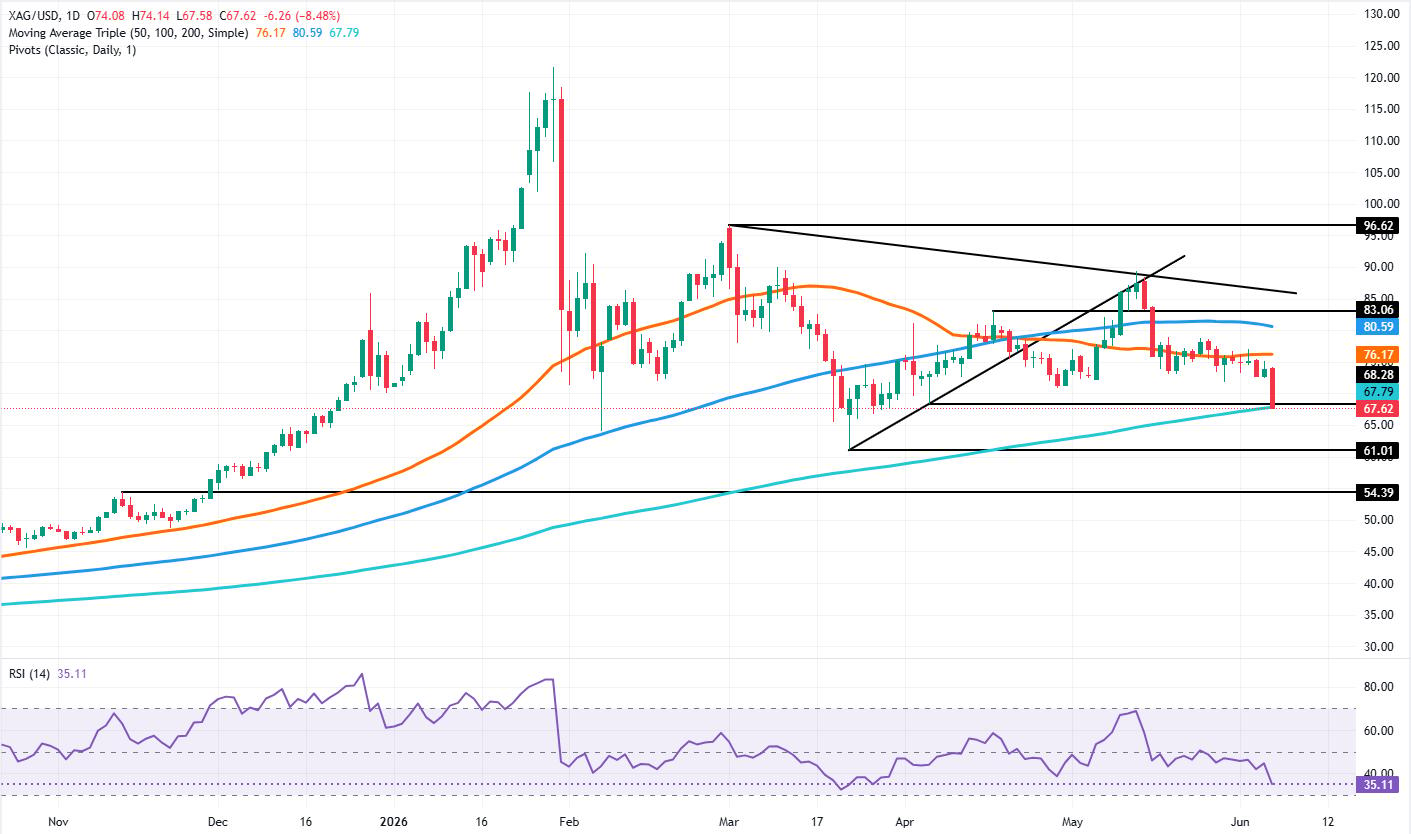
Silver (XAG/USD) price tanks and challenges the 200-day Simple Moving Average (SMA) near $67.79 on Friday, as the white metal registers a daily loss of nearly 8% and is poised to end the week down by almost 10%, amid a stronger-than-expected US Nonfarm Payrolls report.
XAG/USD Price Forecast: Technical outlook
Silver has extended its losses this week, hitting a nine-week low of $68.03, as sellers target the 200-day SMA. Momentum, as measured by the Relative Strength Index (RSI), shows that sellers are in charge as the index approaches oversold territory.
If XAG/USD tumbles below the 200-day SMA, the next area of interest would be the March 23 swing low of $61.01, ahead of the psychological $60.00 mark. Below this area, the next support would be the November 13 low, which turned into support at $54.39.
For a bullish reversal, Silver’s first resistance is the $70.00 mark. Above this level, the next resistance is the May 28 low-turned-resistance at $71.79, followed by the psychological $75.00 level. A breach of the latter will expose the 50-day SMA at $76.17.
XAG/USD Price Chart – Daily
Silver FAQs
Silver is a precious metal highly traded among investors. It has been historically used as a store of value and a medium of exchange. Although less popular than Gold, traders may turn to Silver to diversify their investment portfolio, for its intrinsic value or as a potential hedge during high-inflation periods. Investors can buy physical Silver, in coins or in bars, or trade it through vehicles such as Exchange Traded Funds, which track its price on international markets.
Silver prices can move due to a wide range of factors. Geopolitical instability or fears of a deep recession can make Silver price escalate due to its safe-haven status, although to a lesser extent than Gold’s. As a yieldless asset, Silver tends to rise with lower interest rates. Its moves also depend on how the US Dollar (USD) behaves as the asset is priced in dollars (XAG/USD). A strong Dollar tends to keep the price of Silver at bay, whereas a weaker Dollar is likely to propel prices up. Other factors such as investment demand, mining supply – Silver is much more abundant than Gold – and recycling rates can also affect prices.
Silver is widely used in industry, particularly in sectors such as electronics or solar energy, as it has one of the highest electric conductivity of all metals – more than Copper and Gold. A surge in demand can increase prices, while a decline tends to lower them. Dynamics in the US, Chinese and Indian economies can also contribute to price swings: for the US and particularly China, their big industrial sectors use Silver in various processes; in India, consumers’ demand for the precious metal for jewellery also plays a key role in setting prices.
Silver prices tend to follow Gold’s moves. When Gold prices rise, Silver typically follows suit, as their status as safe-haven assets is similar. The Gold/Silver ratio, which shows the number of ounces of Silver needed to equal the value of one ounce of Gold, may help to determine the relative valuation between both metals. Some investors may consider a high ratio as an indicator that Silver is undervalued, or Gold is overvalued. On the contrary, a low ratio might suggest that Gold is undervalued relative to Silver.
Philippines: BSP seen staying hawkish on inflation – Standard Chartered

Standard Chartered economists Jonathan Koh and Edward Lee revise their Bangko Sentral ng Pilipinas (BSP) policy rate path, dropping expectations for a 50bps off-cycle hike before the 18 June meeting. They still project a 50bps increase in June and 25bps in August as inflation risks persist and PHP weakness raises imported inflation concerns. Policy easing is only expected from Q2-2027.
BSP path revised but still hawkish
“We no longer expect Bangko Sentral ng Pilipinas (BSP) to deliver a 50bps off-cycle rate hike ahead of its scheduled 18 June monetary policy meeting.”
“That said, we maintain our call for a 50bps hike at the June meeting, followed by a further 25bps increase in August, as inflation risks have moderated but not disappeared.”
“Continued PHP depreciation also reinforces concerns on imported inflation and supports BSP’s hawkish rhetoric.”
“With the off-cycle hike no longer in our baseline, we lower our end-2026 policy rate forecast to 5.25% (from 5.75% previously).”
“We continue to expect these hikes to be reversed from Q2-2027, once inflation eases more convincingly, bringing the policy rate back to 4.50% by end-2027.”
(This article was created with the help of an Artificial Intelligence tool and reviewed by an editor.)
XRP nears key support as derivatives sell-off outweighs modest ETF inflows
Ripple (XRP) extends its downtrend, trading around $1.09 at the time of writing on Friday, its lowest level since November 2024. The cross-border remittance token’s free fall since the week began aligns with a broader crypto market sell-off, with Bitcoin (BTC) closing in on the critical $60,000 level and Ethereum (ETH) approaching support at $1,600. Capital outflows continue to weigh on the overall outlook, increasing the odds of an extended sell-off.
XRP retail demand fades as declines deepen
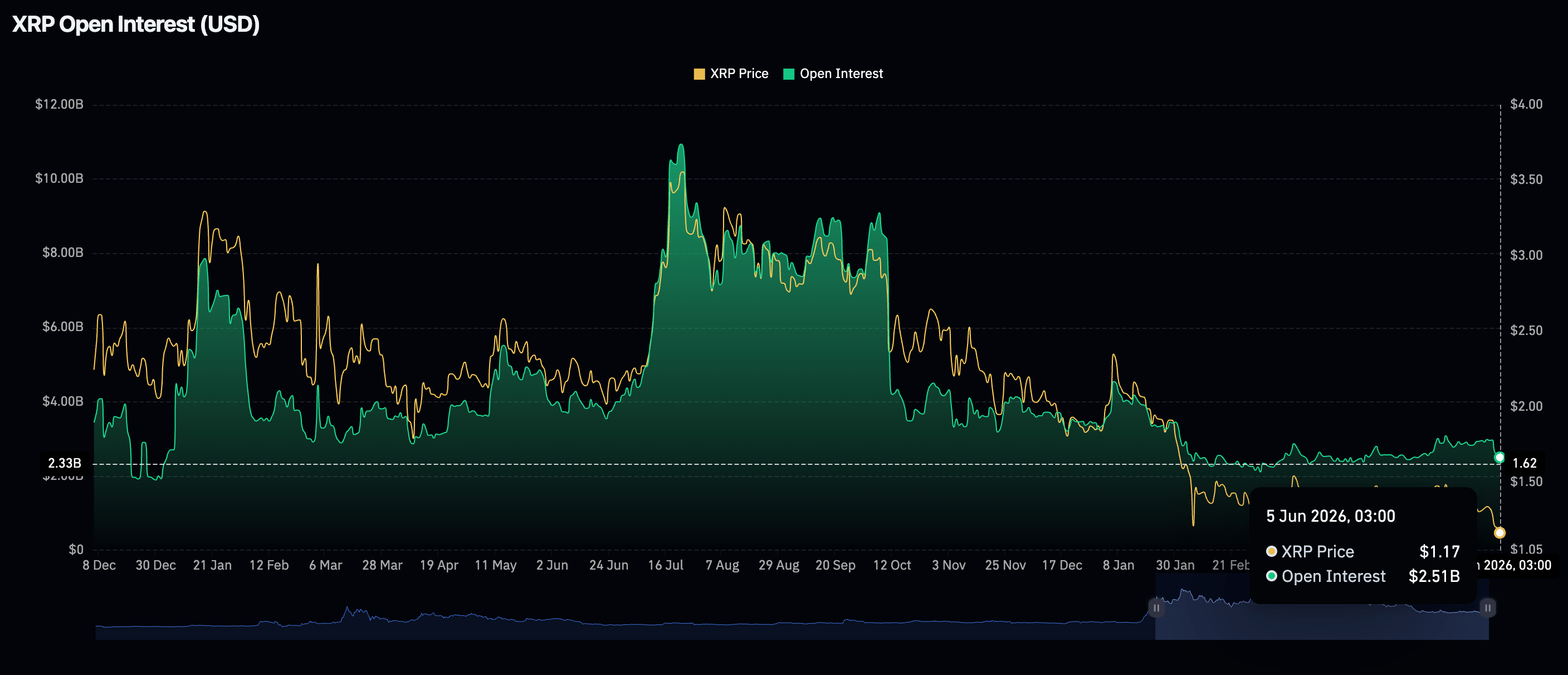
XRP remains under duress as risk-averse sentiment persists in the derivatives market. According to CoinGlass data, Open Interest (OI) in perpetual futures narrowed to $2.51 billion on Friday, down from $2.59 billion the day before and $2.96 billion on Monday.
A sustained drop in OI suggests that traders lack conviction in XRP’s ability to sustain an uptrend and are therefore unwilling to open new positions.
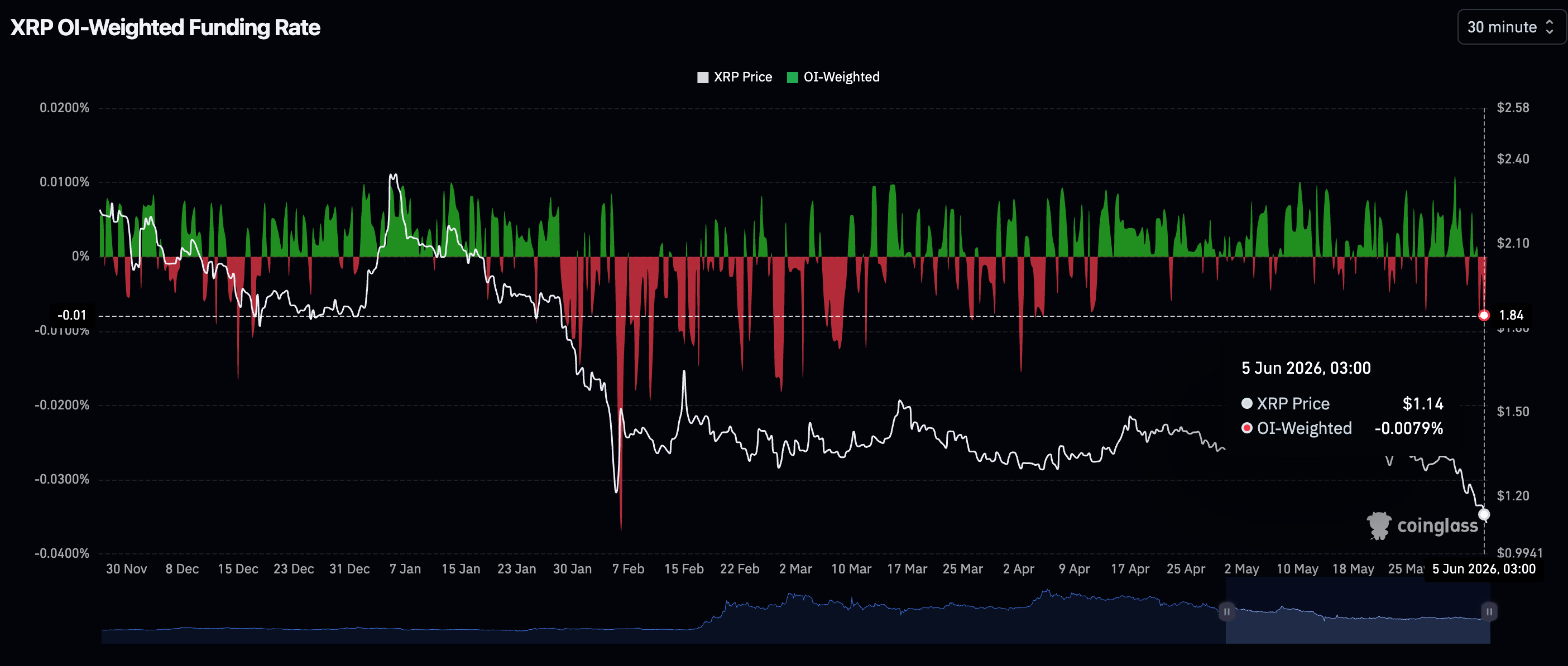
Retail participants remain primarily bearish, as evidenced by the OI-Weighted Funding Rate in negative territory at -0.0079% on Friday. This indicates that sellers are willing to pay a premium in fees to keep their short positions open, convinced that the decline will persist.
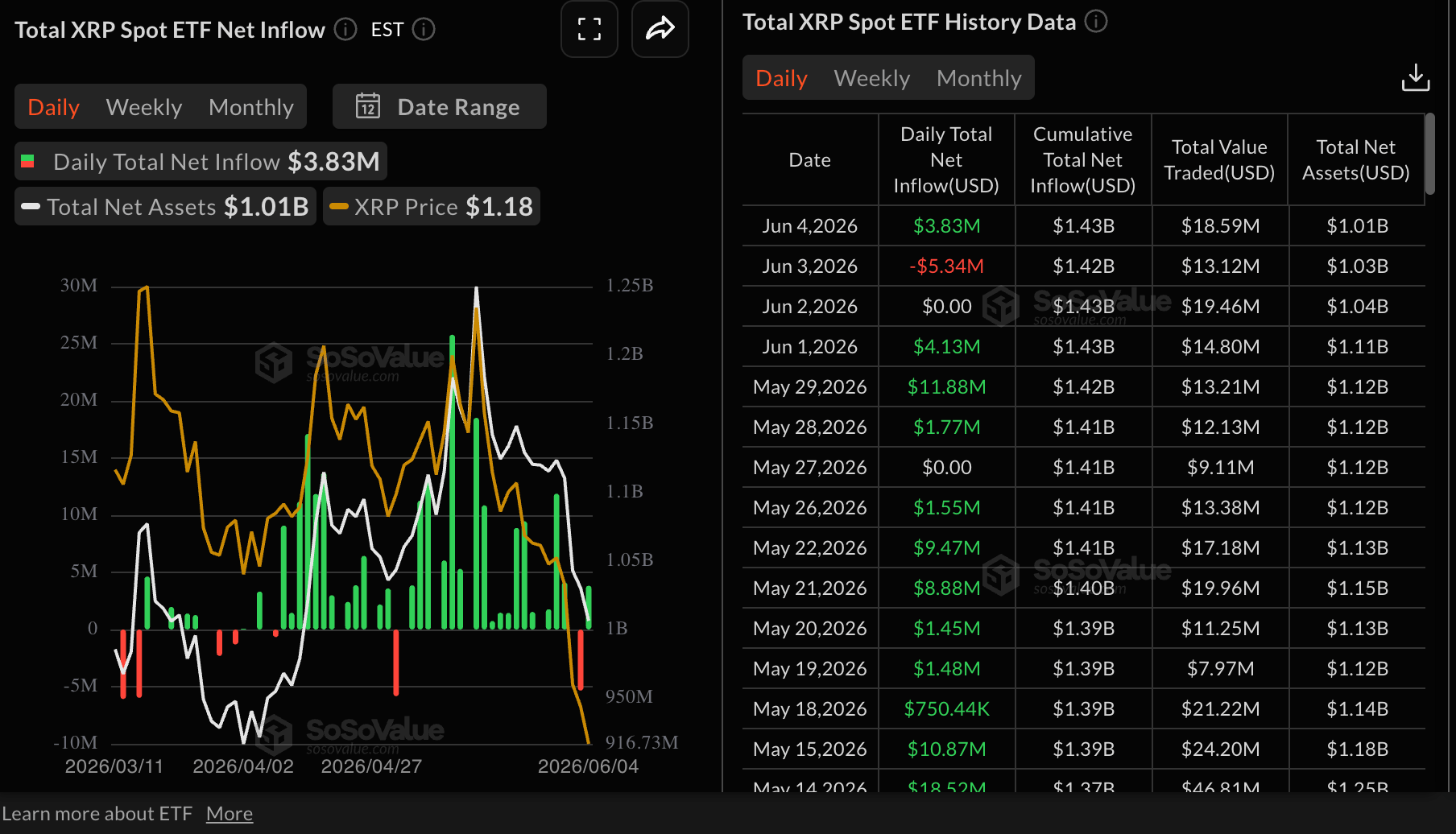
Despite a modest $3.83 million inflow into XRP spot ETFs from institutional investors on Thursday, XRP’s price continued its downward trajectory, edging closer to the pivotal $1.00 support. According to SoSoValue, cumulative inflows stand at $1.43 billion while net assets under management average $1.01 billion.
Price analysis: XRP bulls rely on $1.00 lifeline support
XRP trades at $1.12, extending a dominant bearish bias as price holds well beneath the 50-day, 100-day and 200-day Exponential Moving Averages (EMAs). The stacked bearish alignment of the short-, medium- and long-term EMAs above spot reinforces a downside-skewed structure, while the Relative Strength Index (RSI) near 20 highlights oversold conditions that could slow the decline.
The Moving Average Convergence Divergence (MACD) histogram remains in negative territory on the daily chart, suggesting persistent selling pressure despite the stretched momentum backdrop. Moreover, a heavily oversold Relative Strength Index (RSI) at 19 on the same chart suggests that the downtrend is overstretched and XRP may be due for a rebound.
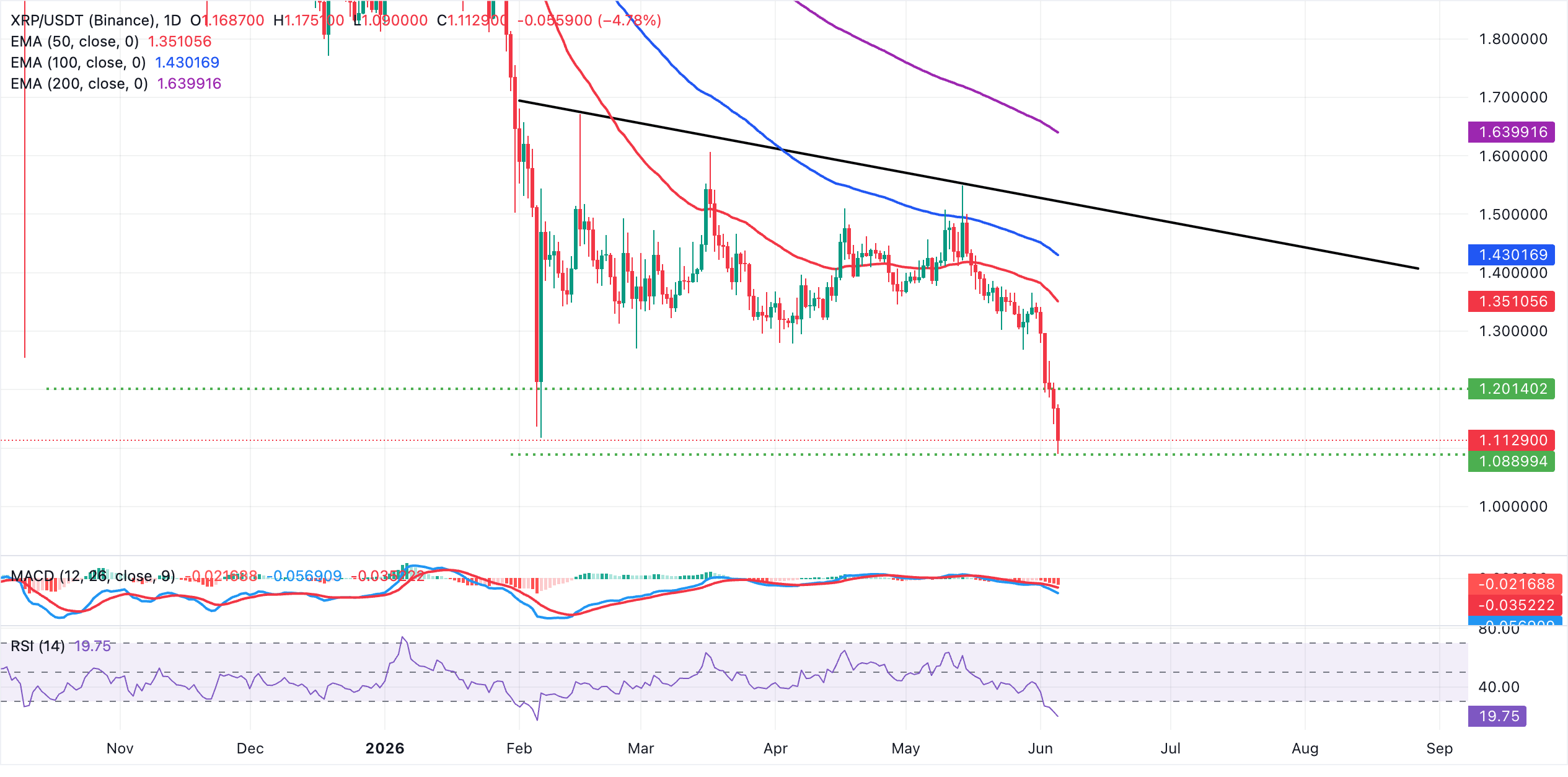
On the topside, initial resistance emerges at the 50-day EMA around $1.35, ahead of the 100-day EMA near 1$.43. Above these, the bearish downward resistance trendline, with a key break level around $1.52, is expected to cap recovery attempts before the more distant 200-day EMA near $1.64 comes into play.
A sustained sell-off could push XRP into the demand at $1.10, followed by a deeper correction to the critical $1.00 level, where interested buyers could seek re-engagement.
(The technical analysis of this story was written with the help of an AI tool.)
Ripple FAQs
XRP extends downtrend toward $1.00 as derivatives data underscore bearish sentiment
Ripple (XRP) extends its downtrend, trading around $1.09 at the time of writing on Friday, its lowest level since November 2024. The cross-border remittance token’s free fall since the week began aligns with a broader crypto market sell-off, with Bitcoin (BTC) closing in on the critical $60,000 level and Ethereum (ETH) approaching support at $1,600. Capital outflows continue to weigh on the overall outlook, increasing the odds of an extended sell-off.
XRP retail demand fades as declines deepen
XRP remains under duress as risk-averse sentiment persists in the derivatives market. According to CoinGlass data, Open Interest (OI) in perpetual futures narrowed to $2.51 billion on Friday, down from $2.59 billion the day before and $2.96 billion on Monday.
A sustained drop in OI suggests that traders lack conviction in XRP’s ability to sustain an uptrend and are therefore unwilling to open new positions.
Retail participants remain primarily bearish, as evidenced by the OI-Weighted Funding Rate in negative territory at -0.0079% on Friday. This indicates that sellers are willing to pay a premium in fees to keep their short positions open, convinced that the decline will persist.
Despite a modest $3.83 million inflow into XRP spot ETFs from institutional investors on Thursday, XRP’s price continued its downward trajectory, edging closer to the pivotal $1.00 support. According to SoSoValue, cumulative inflows stand at $1.43 billion while net assets under management average $1.01 billion.
Price analysis: XRP bulls rely on $1.00 lifeline support
XRP trades at $1.12, extending a dominant bearish bias as price holds well beneath the 50-day, 100-day and 200-day Exponential Moving Averages (EMAs). The stacked bearish alignment of the short-, medium- and long-term EMAs above spot reinforces a downside-skewed structure, while the Relative Strength Index (RSI) near 20 highlights oversold conditions that could slow the decline.
The Moving Average Convergence Divergence (MACD) histogram remains in negative territory on the daily chart, suggesting persistent selling pressure despite the stretched momentum backdrop. Moreover, a heavily oversold Relative Strength Index (RSI) at 19 on the same chart suggests that the downtrend is overstretched and XRP may be due for a rebound.
On the topside, initial resistance emerges at the 50-day EMA around $1.35, ahead of the 100-day EMA near 1$.43. Above these, the bearish downward resistance trendline, with a key break level around $1.52, is expected to cap recovery attempts before the more distant 200-day EMA near $1.64 comes into play.
A sustained sell-off could push XRP into the demand at $1.10, followed by a deeper correction to the critical $1.00 level, where interested buyers could seek re-engagement.
(The technical analysis of this story was written with the help of an AI tool.)
Crypto ETF FAQs
An Exchange-Traded Fund (ETF) is an investment vehicle or an index that tracks the price of an underlying asset. ETFs can not only track a single asset, but a group of assets and sectors. For example, a Bitcoin ETF tracks Bitcoin’s price. ETF is a tool used by investors to gain exposure to a certain asset.
Yes. The first Bitcoin futures ETF in the US was approved by the US Securities & Exchange Commission in October 2021. A total of seven Bitcoin futures ETFs have been approved, with more than 20 still waiting for the regulator’s permission. The SEC says that the cryptocurrency industry is new and subject to manipulation, which is why it has been delaying crypto-related futures ETFs for the last few years.
Yes. The SEC approved in January 2024 the listing and trading of several Bitcoin spot Exchange-Traded Funds, opening the door to institutional capital and mainstream investors to trade the main crypto currency. The decision was hailed by the industry as a game changer.
The main advantage of crypto ETFs is the possibility of gaining exposure to a cryptocurrency without ownership, reducing the risk and cost of holding the asset. Other pros are a lower learning curve and higher security for investors since ETFs take charge of securing the underlying asset holdings. As for the main drawbacks, the main one is that as an investor you can’t have direct ownership of the asset, or, as they say in crypto, “not your keys, not your coins.” Other disadvantages are higher costs associated with holding crypto since ETFs charge fees for active management. Finally, even though investing in ETFs reduces the risk of holding an asset, price swings in the underlying cryptocurrency are likely to be reflected in the investment vehicle too.