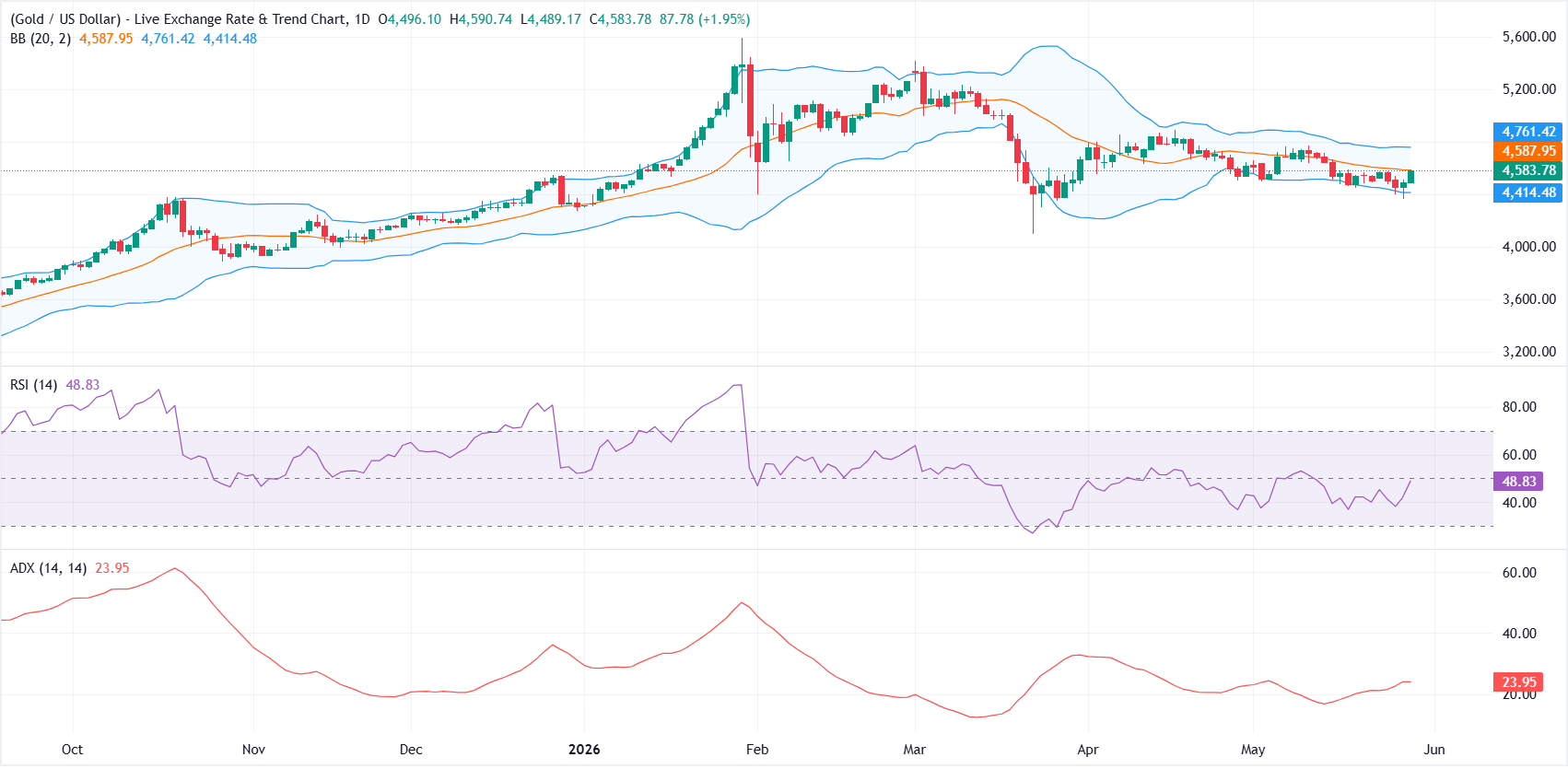
Gold witnessed an intraday turnaround from the $4,800 mark, or a fresh two-week high set earlier this Thursday, and for now, seems to have snapped a four-day winning streak amid resurgent US Dollar demand. Addressing the nation, US President Donald Trump threatened that Iran would be hit extremely hard over the next two to three weeks and would be brought to the Stone Age if no deal is reached.
Japanese Yen softens after Trump Iran war remarks

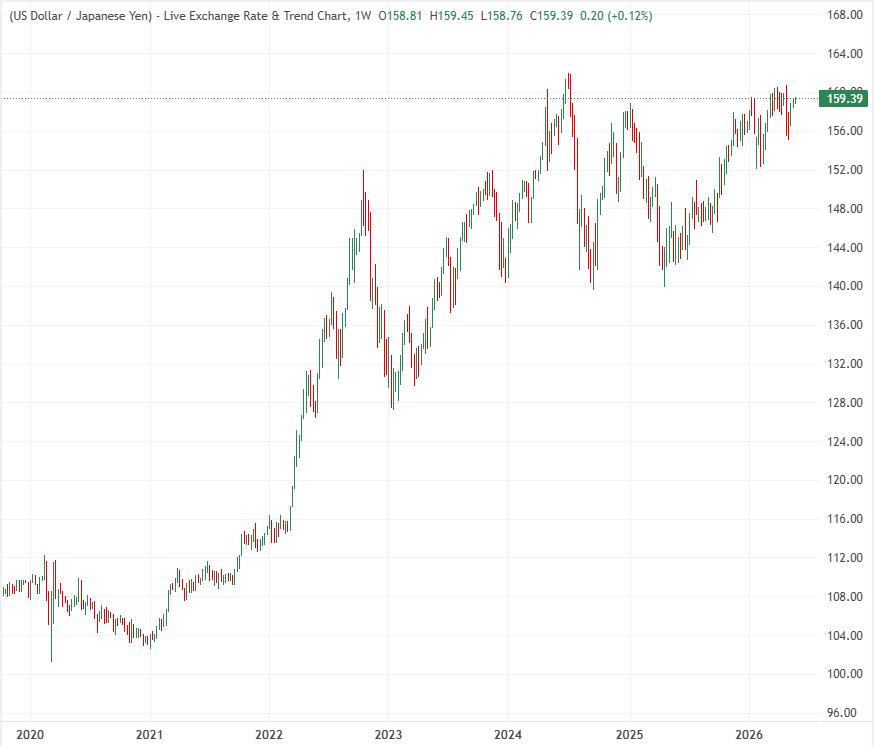
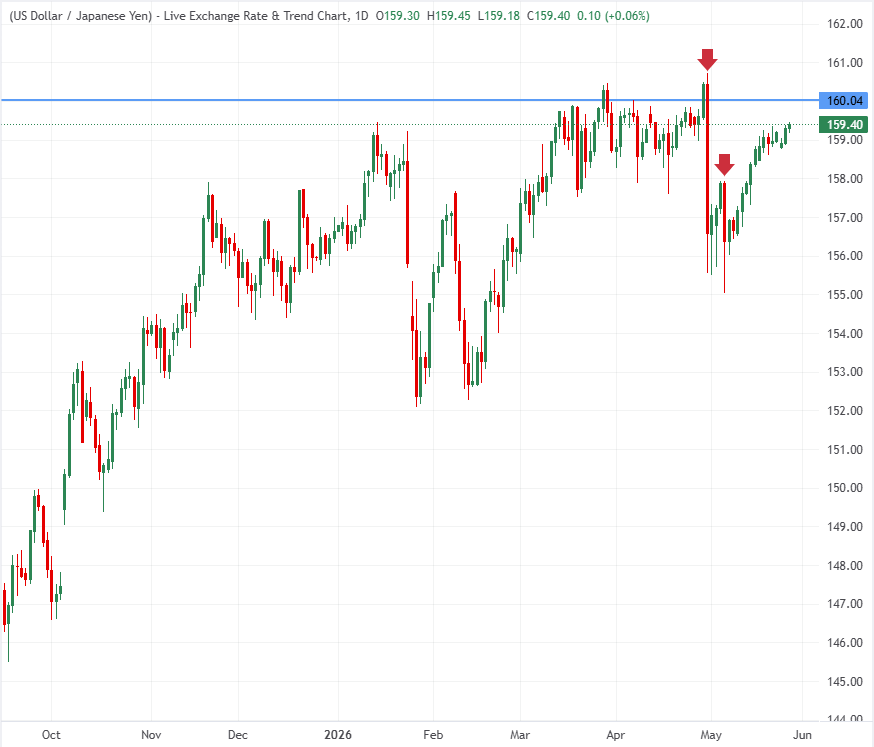
The USD/JPY pair gains momentum to near 159.20 during the Asian trading hours on Thursday. The US Dollar (USD) strengthens against the Japanese Yen (JPY) following US President Donald Trump’s speech from the White House.
Trump said on Thursday that the US is “systemically dismantling the regime’s ability to threaten America or project power outside of their borders.” He added that Iran’s ability to launch missiles and drones has been curtailed.
A White House official stated that the US President will focus on the operation having met or exceeded all of its benchmarks, including destroying Iran’s ballistic missiles and production facilities. Uncertainty surrounding the US-Iran ceasefire and persistent tensions in the Middle East continue to boost the Greenback in the near term.
Fears that Japanese authorities would step in to support the domestic currency could help limit the JPY’s losses. Japan’s top currency diplomat, Atsushi Mimura, said on Monday that officials may need to take “decisive” steps if speculative moves persist in the currency market.
“We are hearing that speculative moves are increasing in the currency market, in addition to the crude futures market. If this situation continues, it may be time to take decisive measures,” said Mimura.
Japanese Yen FAQs
The Japanese Yen (JPY) is one of the world’s most traded currencies. Its value is broadly determined by the performance of the Japanese economy, but more specifically by the Bank of Japan’s policy, the differential between Japanese and US bond yields, or risk sentiment among traders, among other factors.
One of the Bank of Japan’s mandates is currency control, so its moves are key for the Yen. The BoJ has directly intervened in currency markets sometimes, generally to lower the value of the Yen, although it refrains from doing it often due to political concerns of its main trading partners. The BoJ ultra-loose monetary policy between 2013 and 2024 caused the Yen to depreciate against its main currency peers due to an increasing policy divergence between the Bank of Japan and other main central banks. More recently, the gradually unwinding of this ultra-loose policy has given some support to the Yen.
Over the last decade, the BoJ’s stance of sticking to ultra-loose monetary policy has led to a widening policy divergence with other central banks, particularly with the US Federal Reserve. This supported a widening of the differential between the 10-year US and Japanese bonds, which favored the US Dollar against the Japanese Yen. The BoJ decision in 2024 to gradually abandon the ultra-loose policy, coupled with interest-rate cuts in other major central banks, is narrowing this differential.
The Japanese Yen is often seen as a safe-haven investment. This means that in times of market stress, investors are more likely to put their money in the Japanese currency due to its supposed reliability and stability. Turbulent times are likely to strengthen the Yen’s value against other currencies seen as more risky to invest in.
Asia FX: Defensive Dollar bias with KRW and INR vulnerable – TD Securities

TD Securities’ Alex Loo and Jayati Bharadwaj argue that Asia faces a dual shock from higher Oil prices and rapidly depleting inventories, hitting growth and lifting inflation. They see Asian central banks prioritizing growth, limiting rate hikes. Asia FX and equities remain pressured, with KRW and INR likely to stay weak, while SGD and CNY outperform and a defensive long USD bias dominates near term.
KRW and INR seen underperforming peers
“Asia faces a severe dual shock from the current energy crisis. Oil prices are up sharply, inventory buffers are rapidly depleting, and Asia—highly dependent on imported energy via the Straits of Hormuz—is disproportionately exposed.”
“This creates a sharp growth slowdown (at least ~1.0% GDP hit) alongside rising inflation, with risks of recession in energy-intensive economies like South Korea and Thailand.”
“Asian central banks are in a bind and unlikely to hike despite inflation pressure.”
“The energy-driven terms-of-trade shock, USD positioning correction, accelerating portfolio outflows and Asia central banks’ hesitance to hike should point to continued weakness in KRW and INR.”
“In contrast, SGD and CNY are relative winners due to its FX policies, reserves, and bond inflows.”
(This article was created with the help of an Artificial Intelligence tool and reviewed by an editor.)
FX Today: Trump and the US labour market come to the fore

The US Dollar (USD) kept its bearish impulse well in place for the second day in a row on Wednesday, this time retreating from recent multi-month tops on the back of the marked improvement in the risk-associated universe and rising hopes of a potential end to the conflict in the Middle East sooner rather than later.
Here’s what to watch on Thursday, April 2:
The US Dollar Index (DXY) dropped to fresh five-day lows near 99.30 amid mixed US Treasury yields and the broad-based better tone in the risk complex. US President Donald Trump is expected to comment on developments in the Middle East early in the Asian trading hours, while the usual Initial Jobless Claims and advanced Balance of Trade results will be the salient events on the US docket.
EUR/USD added to Tuesday’s marked advance, surpassing the 1.1600 barrier and coming close to the area of three-week peaks. The Euro docket will be empty on Maundy Thursday.
GBP/USD jumped to three-day highs north of 1.3300, always on the back of the firm risk-on sentiment. The BoE will publish its Decision Market Panel (DMP) in a single release across the Channel.
A vacillating price action saw USD/JPY trade in a narrow range, briefly challenging the 159.00 hurdle just to retreat a tad afterward. The usual weekly Foreign Bond Investment figures are due seconded by the Monetary Base readings.
AUD/USD built on Tuesday’s advance and reclaimed the area well beyond the 0.6900 barrier, up around one cent from Tuesday’s troughs. The Balance of Trade results will take centre stage in Oz.
WTI prices retreated further, coming close to the $96.00 mark per barrel before heading back to the $100.00 region as traders continue to assess developments from the Middle East crisis.
Gold kept its march north unabated, this time approaching the $4,800 mark per troy ounce on the back of the weaker US Dollar, mixed US Treasury yields and steady uncertainty surrounding the US-Israel-Iran conflict.
United States Retail Sales ex Autos (MoM) above forecasts (0.3%) in February: Actual (0.5%)
GBP/USD continues to push higher after closing in the green on Tuesday and trades above 1.3300 in the European session on Wednesday. The British currency gains as demand for riskier assets improves at the expense of the safe-haven US Dollar, following signals from US President Trump that the Middle East war could end in two or three weeks.
Greece S&P Global Manufacturing PMI up to 54.5 in March from previous 54.4
Gold surrenders modest Asian session gains to a nearly two-week top, and currently trades near the lower end of its daily range, below the $4,700 mark. President Donald Trump said on Tuesday that he expects the US to wrap up its military operation against Iran within two to three weeks and added that Tehran does not have to make a deal for him to end the war.
Gold Price Forecast: XAU/USD recaptures key 100-day SMA resistance, what’s next?
Gold is sitting close to eight-day highs of $4,724 early Wednesday amid renewed market optimism on a probable de-escalation of the conflict in the Middle East, bracing for the US ADP Employment Change data for fresh trading impetus.
Gold cheers Mideast de-escalation hopes
The recovery in risk sentiment across the financial markets remains intact so far this week, diminishing the appeal of the US Dollar (USD) as a safe-haven asset and the world’s reserve currency, while allowing Gold to reverse heavy losses incurred last month.
US President Donald Trump continued to hint at ending the military operation in Iran, with his latest comments in an NBC News interview, citing that the war will end in two or three weeks.
On the Strait of Hormuz reopening, Trump said, “that’s not for us. That’ll be for France. That’ll be for whoever’s using the Strait.”
Earlier in the week, the US President said that he was willing to end the war without the reopening of the Strait.
The focus now shifts to the key US employment data to gauge whether an interest rate hike by the Federal Reserve (Fed) is likely later this year.
Automatic Data Processing, Inc (ADP) will publish the private sector employment change data later in the day. A reading below the expected 40,000 number could weigh further on the USD, signalling worsening labor market conditions, which could prompt markets to price out a Fed rate hike this year.
The US Bureau of Labor Statistics (BLS) reported in its Job Openings and Labor Turnover (JOLTS) report on Tuesday, the number of job openings in the US fell to 6.882 million in February from 7.24 million in January. The reading came in below the market expectation of 6.92 million.
However, the main event this week remains the US Nonfarm Payrolls (NFP) data due on Good Friday. In the meantime, the development in the Mideast conflict will be closely monitored for further trading impetus in Gold.
Gold price technical analysis: Daily chart
In the daily chart, XAU/USD trades at $4,691.40, retaining a corrective bearish bias after the sharp pullback from recent record highs. The spot price holds above the 100-day and 200-day simple moving averages (SMAs), currently at $4,643.76 and $4,136.73 respectively, which suggests the broader uptrend remains intact even as the metal consolidates lower. However, the loss of the 21-day and 50-day SMAs, now overhead at $4,813.12 and $4,953.40, hints that rallies are likely to face selling interest. The Relative Strength Index (14) has recovered toward 46.05 from oversold territory but remains below the 50 line, signaling only modest, corrective upside momentum within a still-capped structure.
On the topside, initial resistance emerges at the 21-day SMA around $4,813.12, where short-term sellers may look to reassert control, followed by a more significant barrier at the 50-day SMA near $4,953.40. On the downside, immediate support is seen at the 100-day SMA at $4,643.76, with a daily close below this level opening the door toward the more substantial medium-term floor provided by the 200-day SMA at $4,136.73. As long as price trades between these moving-average bands, XAU/USD is likely to remain in a consolidation phase, with the bias tilted lower unless bulls can reclaim the short-term averages.
(The technical analysis of this story was written with the help of an AI tool.)
Economic Indicator
ADP Employment Change
The ADP Employment Change is a gauge of employment in the private sector released by the largest payroll processor in the US, Automatic Data Processing Inc. It measures the change in the number of people privately employed in the US. Generally speaking, a rise in the indicator has positive implications for consumer spending and is stimulative of economic growth. So a high reading is traditionally seen as bullish for the US Dollar (USD), while a low reading is seen as bearish.
Next release: Wed Apr 01, 2026 12:15
Frequency: Monthly
Consensus: 40K
Previous: 63K
Source: ADP Research Institute
Employment FAQs
Labor market conditions are a key element to assess the health of an economy and thus a key driver for currency valuation. High employment, or low unemployment, has positive implications for consumer spending and thus economic growth, boosting the value of the local currency. Moreover, a very tight labor market – a situation in which there is a shortage of workers to fill open positions – can also have implications on inflation levels and thus monetary policy as low labor supply and high demand leads to higher wages.
The pace at which salaries are growing in an economy is key for policymakers. High wage growth means that households have more money to spend, usually leading to price increases in consumer goods. In contrast to more volatile sources of inflation such as energy prices, wage growth is seen as a key component of underlying and persisting inflation as salary increases are unlikely to be undone. Central banks around the world pay close attention to wage growth data when deciding on monetary policy.
The weight that each central bank assigns to labor market conditions depends on its objectives. Some central banks explicitly have mandates related to the labor market beyond controlling inflation levels. The US Federal Reserve (Fed), for example, has the dual mandate of promoting maximum employment and stable prices. Meanwhile, the European Central Bank’s (ECB) sole mandate is to keep inflation under control. Still, and despite whatever mandates they have, labor market conditions are an important factor for policymakers given its significance as a gauge of the health of the economy and their direct relationship to inflation.
USD/IDR: Upside risks with BI liquidity tools – OCBC

OCBC strategists Sim Moh Siong and Christopher Wong highlight USD/IDR grinding higher toward 17,000 on firm Dollar, risk-off sentiment and Oil-related terms-of-trade pressures. Bank Indonesia’s (BI) new FX instruments (SVBI, SUVBI) are seen as helping to smooth volatility and USD liquidity but not changing the underlying FX anchor. External factors and Iran-related risks are expected to keep IDR under pressure near term, with resistance around 17,100.
Indonesia Rupiah pressured by external backdrop
“USD/IDR continued to edge modestly higher toward the 17,000 level, reflecting a still-challenging external backdrop marked by firm USD, risk-off sentiment and oil-related terms-of-trade pressures.”
“Bank Indonesia’s (BI) introduction of FX-denominated instruments such as SVBI and SUVBI should help mitigate volatility at the margin.”
“While these tools do not alter the underlying FX rate anchor, the measures may improve how USD liquidity is intermediated onshore.”
“By allowing exporters and banks to hold and recycle USD domestically, the need to source USD aggressively via the spot market is reduced, thereby partially help to ease pressures and limit the risk of disorderly overshoots in USD/IDR.”
“That said, external factors remain the dominant driver, and weaker risk sentiment alongside elevated oil prices amid risks of a more protracted Iran conflict are likely to continue weighing on the IDR, alongside other Asian FX.”
(This article was created with the help of an Artificial Intelligence tool and reviewed by an editor.)
Canada: Growth rebound faces policy headwinds – NBC

National Bank of Canada (NBC) economists Matthieu Arseneau and Alexandra Ducharme say Canada’s real GDP started 2026 on a firmer footing, with January growth beating expectations and preliminary data pointing to a solid Q1 gain. They highlight strong GDP per capita growth but stress that labour market softness, policy uncertainty around USMCA, and higher energy costs could limit sustained momentum and keep the Bank of Canada cautious.
Solid Q1 growth but fragile backdrop
“The year 2026 is off to a strong start in terms of economic growth.”
“As a result, even assuming the economy stagnated in March, the first quarter could have posted growth of 1.5% on an annualized basis.”
“Given the current population decline, this would mean a 2.5 % increase in GDP per capita, the strongest since Q2 2022.”
“This morning’s report is reassuring, but it doesn’t mean the Canadian economy is sailing smoothly and that the Bank of Canada needs to rein it in as the energy inflation shock looms on the horizon.”
“Furthermore, other indicators—particularly those related to the labour market—are cause for concern and stand in contrast to GDP growth. They likely signal that the renewal of the USMCA, which is still pending this year, continues to dampen businesses’ enthusiasm for hiring and investment.”
“Despite Canada’s status as a net oil exporter—a relative advantage—we remain skeptical about the economy’s overall ability to benefit from recent geopolitical developments.”
“The inverted forward curve of oil prices does not suggest a significant rebound in fossil fuel investment.”
“Gains from improved terms of trade are likely to be largely offset by rising energy costs for households.”
“Having successfully brought inflation under control—something not all central banks have achieved—the Bank of Canada can afford to be patient before raising rates, especially since they overall do not appear to be particularly stimulative, as evidenced by weak housing activity, moderate credit growth, and the expected mortgage repayment shock in 2026.”
(This article was created with the help of an Artificial Intelligence tool and reviewed by an editor.)
Aluminium: Middle East outages tighten supply – ING

ING’s commodities team highlights that Aluminium prices rallied toward $3,500/t on the LME as Middle East supply risks escalated. Damage at Emirates Global Aluminium and potential disruption at Aluminium Bahrain threaten around 3.2Mt of annual capacity. With prior curtailments in the Gulf and Aluminium on track for a 10% monthly gain, the market appears increasingly constrained.
Regional disruptions support Aluminium prices
“Aluminium prices rallied on Monday, briefly nearing $3,500/t on the LME, as Middle East supply risks escalated.”
“Emirates Global Aluminium (EGA) said it sustained significant damage at its Abu Dhabi smelter, while Aluminium Bahrain (Alba) is assessing the impact at its facility, after Iran’s Revolutionary Guard said the sites were targeted in retaliation for US‑Israeli strikes.”
“Together, the two smelters account for around 3.2Mt of annual capacity, and any prolonged outage would further tighten an already constrained market, where restarting smelters is costly, complex and time-consuming.”
“The escalation comes on top of already tightening supply conditions across the Gulf.”
“Recent curtailments at Alba and reduced operations at Qatalum have already affected around 560kt of annual capacity, equivalent to roughly 8-9% of regional supply.”
(This article was created with the help of an Artificial Intelligence tool and reviewed by an editor.)