Gold sticks to modest intraday gains through the early European session and currently trades around the $4,465 area, just below a one-week high touched this Tuesday. The US military strikes in Venezuela, heightened political tensions between Saudi Arabia and the UAE, the unrest in Iran, and the protracted Russia-Ukraine war keep geopolitical risks in play.
Gold advances to one-week top amid flight to safety, Fed rate cut bets
Gold (XAU/USD) attracts dip-buyers near the $4,428-4,427 region and climbs to a one-week high during the Asian session on Tuesday amid a combination of supporting factors. The US military strikes in Venezuela, heightened political tensions between Saudi Arabia and the UAE, the unrest in Iran, and the protracted Russia-Ukraine war keep geopolitical risks in play. This, in turn, is seen underpinning the safe-haven bullion, which, along with dovish US Federal Reserve (Fed) expectations, remains supportive of the positive momentum.
In fact, traders are still pricing in the possibility of two more interest rate cuts by the US central bank this year, and the bets were reaffirmed by Monday’s mixed US PMIs for December. Moreover, concerns about the Fed’s independence under US President Donald Trump’s administration drag the US Dollar (USD) away from a nearly four-week top set on Monday and further benefit the non-yielding Gold. Traders keenly await the US Nonfarm Payrolls (NFP) report on Friday for more cues about the Fed’s rate-cut path and some meaningful impetus.
Daily Digest Market Movers: Gold draws support from safe-haven flows, Fed rate cut bets, softer USD
- President Donald Trump said on Sunday that the US might launch a second military strike on Venezuela if the remaining members of the administration do not cooperate with his efforts to get the country fixed. Trump further warned that Colombia and Mexico could also face military action if they do not reduce the flow of illicit drugs to the US.
- The developments raised concerns about regional instability in Latin America. Separately, Saudi Arabia publicly accused the United Arab Emirates of undermining its national security. This, along with the lack of progress in the Russia-Ukraine peace deal, continues to underpin the safe-haven Gold price for the second consecutive day.
- On the economic data front, the S&P Global reported on Monday that the US Manufacturing PMI held steady at 51.8, pointing to continued expansion. In contrast, the Institute for Supply Management’s (ISM) Manufacturing PMI declined to 47.9 last month, from 48.2 in November, and indicated persistent contraction in the business activity.
- The data does little to temper dovish expectations, which drags the US Dollar away from a nearly four-week high touched on Monday and turns out to be another factor that benefits the non-yielding yellow metal. In fact, the Fed is expected to lower borrowing costs in March and deliver one more interest rate cut by the end of this year.
- Traders now look forward to this week’s other US macroeconomic indicators, scheduled at the start of a new month, for more cues about the Fed’s rate-cut path. The focus, however, will remain on the US Nonfarm Payrolls report on Friday, which will drive the USD in the near-term and provide a fresh directional impetus to bullion.
Gold seems poised to climb further; breakout through $4,445-4,450 remains in play
From a technical perspective, the overnight breakout through the 100-hour Simple Moving Average (SMA) and a subsequent move beyond the $4,445-4,450 congestion zone could be seen as a key trigger for the XAU/USD bulls. The Moving Average Convergence Divergence (MACD) histogram has turned positive and inches higher on the 1-hour chart, placing the MACD line marginally above the signal line near the zero mark and suggesting improving momentum.
Meanwhile, the RSI stands at 68 (near overbought), rising from mid-range and supporting firm upside momentum. A push through 70 would strengthen the bull case, while failure to do so could cap gains and encourage consolidation. With price holding above the rising 100-hour SMA and MACD just positive, dips could remain shallow and the near-term bias would stay positive. The 100-hour SMA stands at $4,373.28 and should offer dynamic support.
(The technical analysis of this story was written with the help of an AI tool)
Gold FAQs
Gold has played a key role in human’s history as it has been widely used as a store of value and medium of exchange. Currently, apart from its shine and usage for jewelry, the precious metal is widely seen as a safe-haven asset, meaning that it is considered a good investment during turbulent times. Gold is also widely seen as a hedge against inflation and against depreciating currencies as it doesn’t rely on any specific issuer or government.
Central banks are the biggest Gold holders. In their aim to support their currencies in turbulent times, central banks tend to diversify their reserves and buy Gold to improve the perceived strength of the economy and the currency. High Gold reserves can be a source of trust for a country’s solvency. Central banks added 1,136 tonnes of Gold worth around $70 billion to their reserves in 2022, according to data from the World Gold Council. This is the highest yearly purchase since records began. Central banks from emerging economies such as China, India and Turkey are quickly increasing their Gold reserves.
Gold has an inverse correlation with the US Dollar and US Treasuries, which are both major reserve and safe-haven assets. When the Dollar depreciates, Gold tends to rise, enabling investors and central banks to diversify their assets in turbulent times. Gold is also inversely correlated with risk assets. A rally in the stock market tends to weaken Gold price, while sell-offs in riskier markets tend to favor the precious metal.
The price can move due to a wide range of factors. Geopolitical instability or fears of a deep recession can quickly make Gold price escalate due to its safe-haven status. As a yield-less asset, Gold tends to rise with lower interest rates, while higher cost of money usually weighs down on the yellow metal. Still, most moves depend on how the US Dollar (USD) behaves as the asset is priced in dollars (XAU/USD). A strong Dollar tends to keep the price of Gold controlled, whereas a weaker Dollar is likely to push Gold prices up.
United Kingdom BRC Shop Price Index (YoY): 0.7% (December) vs 0.6%
GBP/USD keeps rallying in the American session on Monday, trading at around 1.3530. The US Dollar accelerated its slump following the release of the December ISM Manufacturing PMI. The index contracted to 47.9 from the 48.2 posted in November, also missing the expected 48.3.
Ethereum Price Forecast: BitMine continues accumulation as ETH flips 50-day EMA
Ethereum price today: $3,220
- Ethereum treasury firm BitMine Immersion acquired 32,977 ETH last week, pushing its total holdings to 4.14 million ETH.
- The move follows a rebound in ETH ETFs, which posted net inflows of $174 million on their first trading day of 2026 last week.
- ETH is testing the resistance near $3,260 after flipping the 50-day EMA.
Ethereum (ETH) treasury firm BitMine Immersion (BMNR) continued to accumulate the top altcoin, purchasing 32,977 ETH over the past week.
Despite the amount representing the firm’s lowest weekly purchase in months, Chairman Thomas Lee noted that BitMine has outpaced other Ethereum treasuries in ETH accumulation. “We remain the largest ‘fresh money’ buyer of ETH in the world,” said Lee in a Monday statement.
BitMine now holds a 4.14 million ETH stash, which is 3.43% of the global ETH circulating supply. The company has also staked 659,219 ETH from that balance across three staking providers ahead of the unveiling of its Made in America Validator Network (MAVAN).
BitMine’s other holdings comprise 192 Bitcoin (BTC), a $25 million stake in Worldcoin (WLD) treasury, Eightco Holdings and a cash balance of $915 million.
In its chairman’s message last week, Thomas Lee urged shareholders to increase the firm’s authorized shares from 500 million to 50 billion, arguing that it’s required to accommodate future share splits and support capital market activities.
Meanwhile, ETH began the year on a positive note as US spot Ethereum exchange-traded funds (ETFs) recorded $174.4 million in net inflows on their first trading day of 2026 last Friday, according to SoSoValue data.
The newly found momentum follows months of underperformance relative to commodities Gold and Silver. “The surge in commodity and precious metals in 2025 bodes well for crypto prices in 2026, which tend to follow metal price moves,” Lee added.
BMNR trades at $32.3, up 3% at the time of publication on Monday.
Ethereum Price Forecast: ETH flips 50-day EMA, faces $3,260 resistance
Ethereum saw $72 million in futures liquidations over the past 24 hours, driven by $54.5 million in short liquidations, per Coinglass data.
ETH has risen above the 50-day Exponential Moving Average (EMA) and is testing the $3,260 resistance level. A firm rise above the resistance alongside the 100-day EMA could see ETH tackle the $3,480 hurdle.
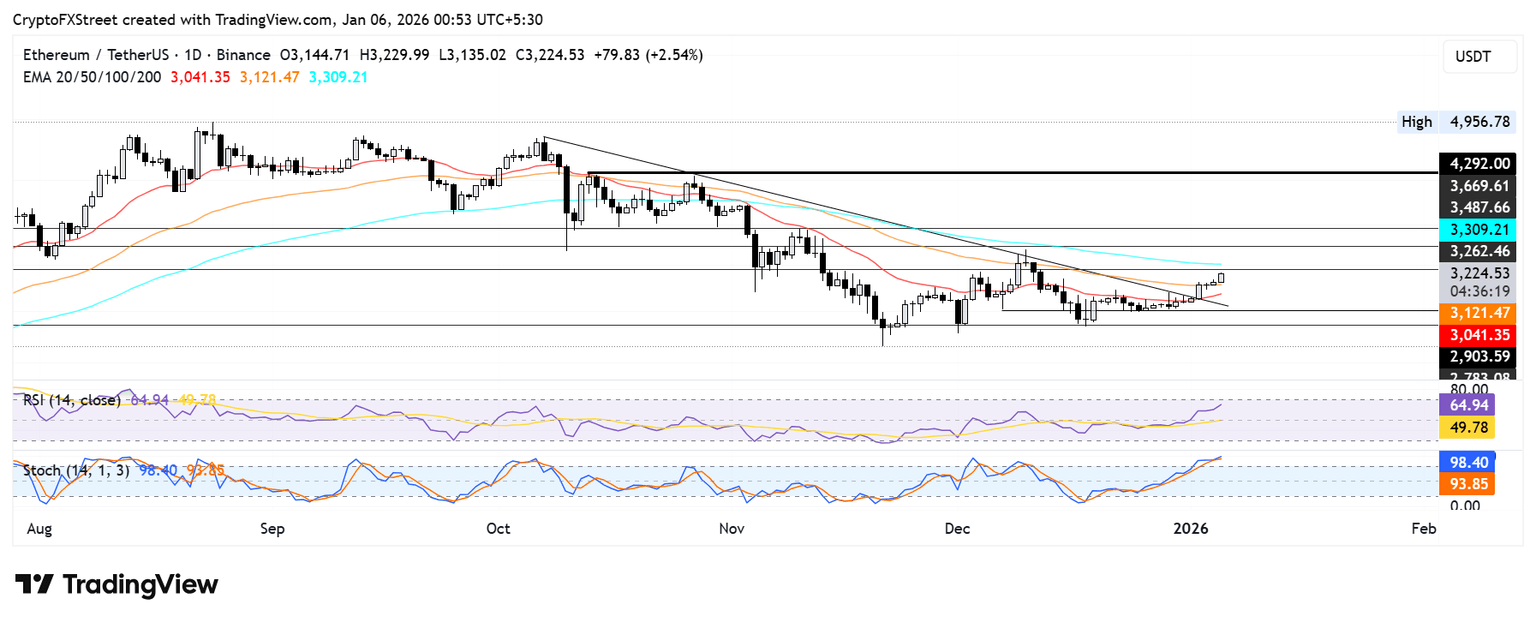
On the downside, ETH could bounce at the $2,900 support — which has held for the past two weeks — if it breaches the 20-day EMA.
The Relative Strength Index (RSI) is above its neutral level while the Stochastic Oscillator (Stoch) is in overbought territory, signalling a dominant bullish momentum. However, sustained oversold conditions in the Stoch often lead to a short-term pullback.
Ripple gains momentum as ETF inflows and derivatives demand rise
Ripple (XRP) edges up above $2.13 at the time of writing on Monday, reflecting steady interest in risk assets across the cryptocurrency market despite geopolitical tensions.
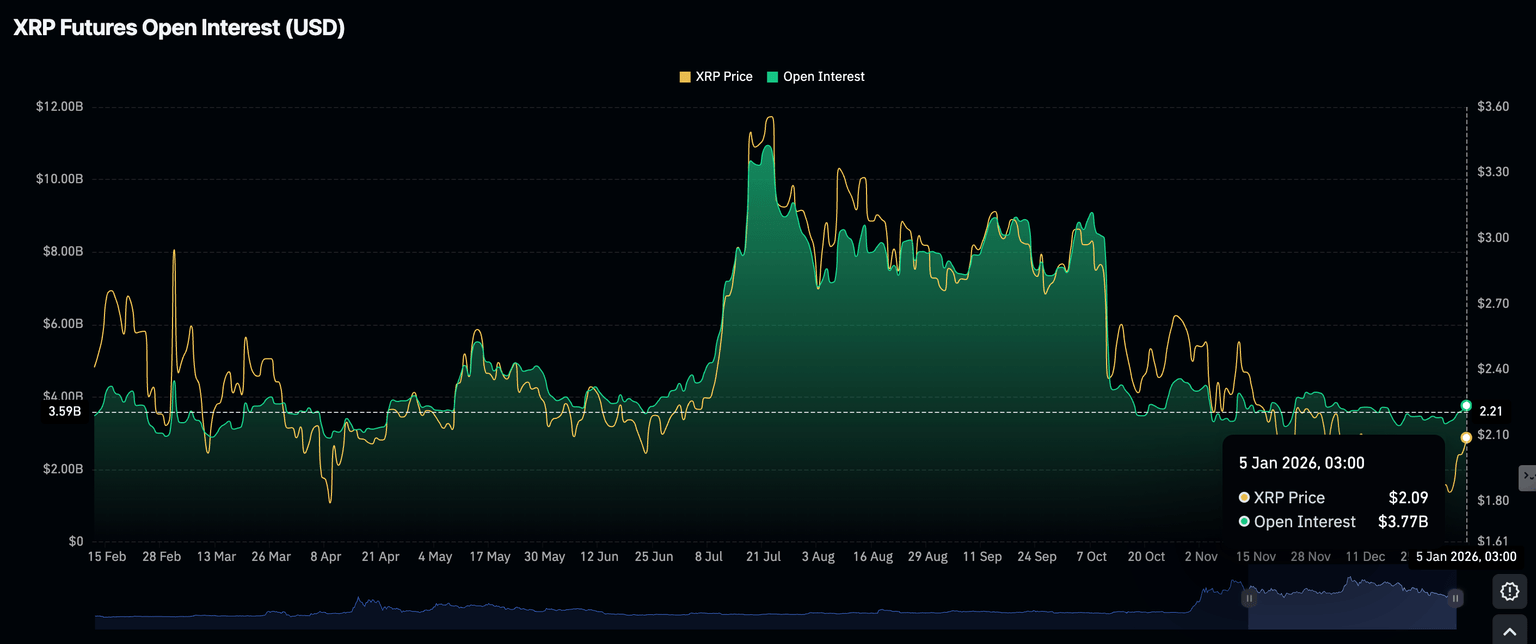
XRP is rising for the fifth consecutive day, supported by steady inflows into spot Exchange Traded Funds (ETFs). Retail interest in the cross-border remittance token shows signs of a gradual comeback, as evidenced by futures Open Interest (OI) rising to $3.8 billion.
Key milestones remain critical to the uptrend’s continuation, including a breakout above a multi-month trendline on the daily chart. On the other hand, a daily close below the pivotal $2.00 level could see XRP resume the downtrend amid rising volatility.
XRP holds steady amid institutional and retail growth
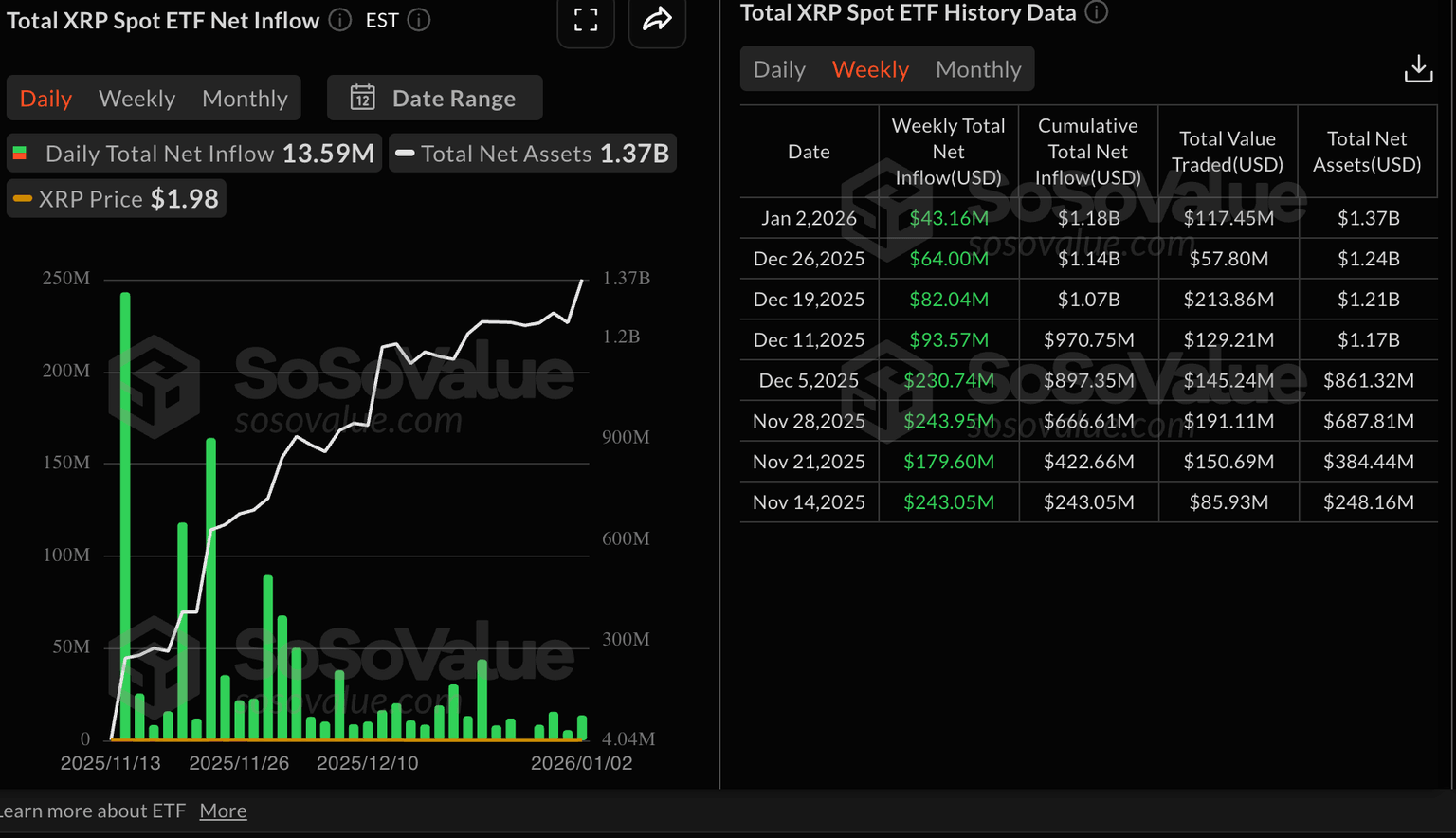
XRP spot ETFs listed in the United States (US) experienced inflows of $43 million last week. Since their debut in November, XRP ETFs have maintained steady weekly inflows, suggesting growing institutional investor interest.
SoSoValue data shows that the five ETF products recorded approximately $13.6 million in inflows on Friday, bringing the cumulative net inflow to $1.18 billion and net assets to $1.37 billion.
Meanwhile, the uptake of XRP derivatives continues to gradually improve, as evidenced by futures OI increasing to approximately $3.8 billion on Monday, up from $3.6 billion the previous day. The OI averaged $3.3 billion on Thursday, signaling that retail demand is making a comeback and may continue to support the uptrend in prices.
Technical outlook: XRP holds support ahead of a potential breakout
XRP is trading at $2.13 at the time of writing on Monday. The 50-day Exponential Moving Average (EMA) provides support at $2.05, which suggests that bulls have a slight edge over bears.
The Moving Average Convergence Divergence (MACD) indicator upholds a positive outlook on the daily chart, with green histogram bars expanding above the mean line. Moreover, the blue MACD line sits above the red signal line, suggesting strengthening bullish momentum.
Similarly, the Relative Strength Index (RSI) at 65 and rising supports XRP’s bullish thesis. A further increase of the RSI into overbought territory would boost the odds of a breakout above the moving average cluster, represented by the 100-day EMA at $2.22 and the 200-day EMA at $2.34.
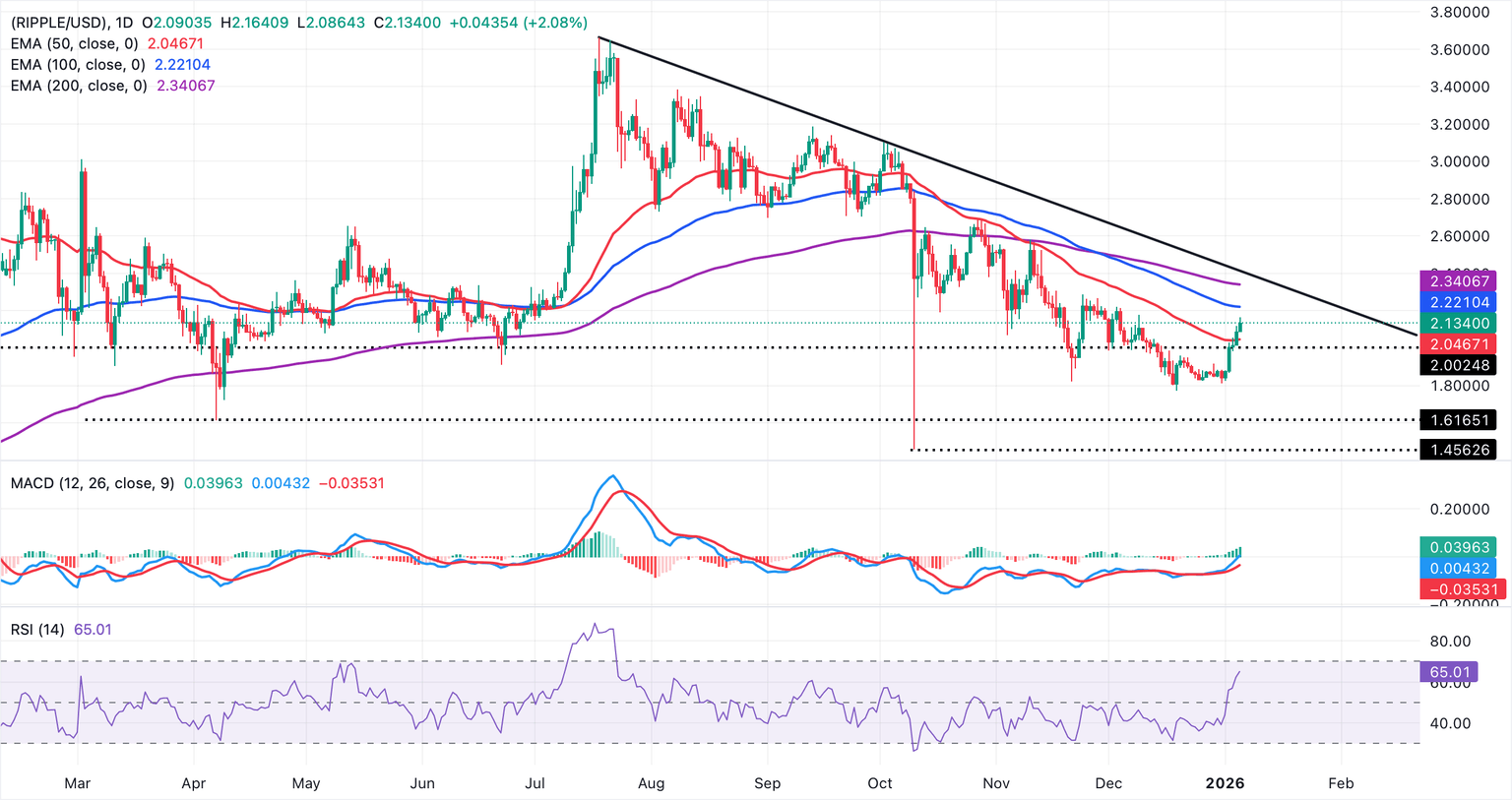
A descending trend line from $3.66 record high limits the advance, with resistance seen near $2.41. A daily close above the 100-day EMA would open the door toward the 200-day EMA barrier, reinforcing a recovery phase, while the 50-day EMA underpins pullbacks to keep the bounce intact.
Failure to clear the trend line and the 100-day EMA cap would leave the broader bias heavy and risk a return to consolidation or an extended decline below the $2.00 level.
Open Interest, funding rate FAQs
(The technical analysis of this story was written with the help of an AI tool)
ISM Manufacturing PMI set to tick up marginally in December, remaining in contraction area

The Institute for Supply Management (ISM) is scheduled to release the December Manufacturing Purchasing Managers’ Index (PMI) on Monday. The index is a trusted measure of the health of the United States (US) manufacturing sector, closely followed by market players. It is based on a survey conducted by ISM among companies around the US, and the index revolves around the 50 threshold. A reading above the level indicates an expanding manufacturing sector, while a reading below it indicates contraction.
The December ISM Manufacturing PMI is forecast at 48.3, slightly better than the 48.2 posted in November.
What to expect from the ISM manufacturing PMI report?
The November ISM report showed that economic activity in the manufacturing sector remained in contraction territory for the ninth consecutive month, following a two-month expansion that was preceded by twenty-six straight months of contraction. The index declined to 48.2 from 48.7 in October. Key drivers behind the slide were declines in new orders and employment, although production recovered into expansion territory.
The New Orders Index contracted for a third straight month to 47.4, lower than the 49.4 recorded in October. The Production Index in the same period improved to 51.4 from the previous 48.2. Also, the Prices Index remained in expansion, registering 58.5, up from the previous reading of 58, while the Employment Index came in at 44, down from October’s figure of 46.
“The manufacturing sector continues to be weighed down by the unpredictable tariffs landscape,” said Stephen Stanley, chief US economist at Santander U.S. Capital Markets.
Market participants will pay close attention to the employment-related sub-index ahead of the Nonfarm Payrolls (NFP) report, scheduled for release on Friday. The labor market is likely to be at the top of investors’ priorities this week, given its influence on the Federal Reserve’s (Fed) monetary policy decisions.
The headline reading will also be relevant and likely trigger the initial market reaction. A better-than-anticipated outcome, with a reading above the 50 threshold, should boost demand for the US Dollar (USD), as it would both signal economic progress and diminish the odds of upcoming interest rate cuts. The opposite scenario is also valid, with a discouraging result putting pressure on the Greenback and boosting bets for a March interest rate cut.
When will the ISM Manufacturing PMI report be released and how could it affect EUR/USD?
The ISM Manufacturing PMI report is scheduled for release at 15:00 GMT on Monday. As investors slowly return to their desks from the winter holiday season, the EUR/USD pair maintains its near-term negative tone but holds above the 1.1700 mark. Geopolitical tensions and limited volumes have supported the US Dollar (USD) in the past few days, but not enough to change its bearish bias.
Valeria Bednarik, FXStreet Chief Analyst, notes: “The EUR/USD pair closed November and December in the red, extending its decline in early January. The pair has found near-term buyers around the 1.1700 level, but can pierce it on an upbeat outcome. The ISM Manufacturing PMI, however, needs to print above 50 to provide sustained support for the USD. A slide below the 1.1680 price zone would likely trigger stops and exacerbate the slide, with EUR/USD likely to near the 1.1600 threshold before finding more solid buying interest.”
Bednarik adds: “If the ISM Manufacturing PMI comes below expected and even below the November reading, the USD is likely to edge sharply lower across the FX board. The January 2 high at 1.1765 is the immediate resistance level ahead of the 1.1800 mark. Additional gains could see the pair rallying towards the 1.1860 price zone.”
US Dollar FAQs
The US Dollar (USD) is the official currency of the United States of America, and the ‘de facto’ currency of a significant number of other countries where it is found in circulation alongside local notes. It is the most heavily traded currency in the world, accounting for over 88% of all global foreign exchange turnover, or an average of $6.6 trillion in transactions per day, according to data from 2022.
Following the second world war, the USD took over from the British Pound as the world’s reserve currency. For most of its history, the US Dollar was backed by Gold, until the Bretton Woods Agreement in 1971 when the Gold Standard went away.
The most important single factor impacting on the value of the US Dollar is monetary policy, which is shaped by the Federal Reserve (Fed). The Fed has two mandates: to achieve price stability (control inflation) and foster full employment. Its primary tool to achieve these two goals is by adjusting interest rates.
When prices are rising too quickly and inflation is above the Fed’s 2% target, the Fed will raise rates, which helps the USD value. When inflation falls below 2% or the Unemployment Rate is too high, the Fed may lower interest rates, which weighs on the Greenback.
In extreme situations, the Federal Reserve can also print more Dollars and enact quantitative easing (QE). QE is the process by which the Fed substantially increases the flow of credit in a stuck financial system.
It is a non-standard policy measure used when credit has dried up because banks will not lend to each other (out of the fear of counterparty default). It is a last resort when simply lowering interest rates is unlikely to achieve the necessary result. It was the Fed’s weapon of choice to combat the credit crunch that occurred during the Great Financial Crisis in 2008. It involves the Fed printing more Dollars and using them to buy US government bonds predominantly from financial institutions. QE usually leads to a weaker US Dollar.
Quantitative tightening (QT) is the reverse process whereby the Federal Reserve stops buying bonds from financial institutions and does not reinvest the principal from the bonds it holds maturing in new purchases. It is usually positive for the US Dollar.
Economic Indicator
ISM Manufacturing PMI
The Institute for Supply Management (ISM) Manufacturing Purchasing Managers Index (PMI), released on a monthly basis, is a leading indicator gauging business activity in the US manufacturing sector. The indicator is obtained from a survey of manufacturing supply executives based on information they have collected within their respective organizations. Survey responses reflect the change, if any, in the current month compared to the previous month. A reading above 50 indicates that the manufacturing economy is generally expanding, a bullish sign for the US Dollar (USD). A reading below 50 signals that factory activity is generally declining, which is seen as bearish for USD.
NZD/USD loses ground to near 0.5750 on Venezuela raid, geopolitical risks

The NZD/USD pair attracts some sellers to around 0.5755 during the early European session on Monday. The US Dollar (USD) edges higher against the New Zealand Dollar (NZD) on the global flight to safety, bolstered by rising geopolitical tensions. The US ISM Manufacturing Purchasing Managers Index (PMI) data will be in the spotlight later on Monday. The attention will shift to the US December employment report on Friday.
The United States (US) carried out a large-scale military strike against Venezuela on Saturday. US President Donald Trump said that Venezuelan President Nicolas Maduro and his wife have been captured and flown out of the country. Trump added early Monday that Washington might make a second military attack if Venezuela’s interim president, Delcy Rodríguez, did not accommodate their demands, per the Guardian. The escalating tensions in the Venezuela crisis could boost the safe-haven currency like the Greenback and act as a headwind for the pair.
However, the upside for the US Dollar might be limited amid concerns over the Federal Reserve (Fed) independence. Traders await Trump’s decision for the next Fed Chair as Jerome Powell’s term ends in May. Trump said he will announce his pick this month and has said Powell’s successor will be “someone who believes in lower interest rates, by a lot.”
On the Kiwi front, the Reserve Bank of New Zealand’s (RBNZ) hawkish outlook on the future policy path could lift the NZD. RBNZ Governor Ann Breman said that the policy rate is likely to remain at its current level for an extended period if economic conditions unfold as expected. Economists anticipate the Official Cash Rate (OCR) to remain at 2.25% for a period, potentially until mid-2027, before gradually increasing.
US Dollar FAQs
The US Dollar (USD) is the official currency of the United States of America, and the ‘de facto’ currency of a significant number of other countries where it is found in circulation alongside local notes. It is the most heavily traded currency in the world, accounting for over 88% of all global foreign exchange turnover, or an average of $6.6 trillion in transactions per day, according to data from 2022.
Following the second world war, the USD took over from the British Pound as the world’s reserve currency. For most of its history, the US Dollar was backed by Gold, until the Bretton Woods Agreement in 1971 when the Gold Standard went away.
The most important single factor impacting on the value of the US Dollar is monetary policy, which is shaped by the Federal Reserve (Fed). The Fed has two mandates: to achieve price stability (control inflation) and foster full employment. Its primary tool to achieve these two goals is by adjusting interest rates.
When prices are rising too quickly and inflation is above the Fed’s 2% target, the Fed will raise rates, which helps the USD value. When inflation falls below 2% or the Unemployment Rate is too high, the Fed may lower interest rates, which weighs on the Greenback.
In extreme situations, the Federal Reserve can also print more Dollars and enact quantitative easing (QE). QE is the process by which the Fed substantially increases the flow of credit in a stuck financial system.
It is a non-standard policy measure used when credit has dried up because banks will not lend to each other (out of the fear of counterparty default). It is a last resort when simply lowering interest rates is unlikely to achieve the necessary result. It was the Fed’s weapon of choice to combat the credit crunch that occurred during the Great Financial Crisis in 2008. It involves the Fed printing more Dollars and using them to buy US government bonds predominantly from financial institutions. QE usually leads to a weaker US Dollar.
Quantitative tightening (QT) is the reverse process whereby the Federal Reserve stops buying bonds from financial institutions and does not reinvest the principal from the bonds it holds maturing in new purchases. It is usually positive for the US Dollar.
NZD/USD bounces off one-month low, down a little above mid-0.5700s after Chinese PMI

The NZD/USD pair rebounds from its lowest level since early December, around the 0.5725-0.5720 region, touched during the Asian session on Monday, and fills the weekly bearish gap opening. Spot prices, however, struggle to capitalize on the move up and currently trade just above mid-0.5700s, down 0.15% for the day.
The US Dollar (USD) prolongs its recent goodish recovery move from a multi-month trough, touched in December, and climbs to a three-week high amid the global flight to safety, bolstered by rising geopolitical tensions. The US Army’s Delta Force, an elite special forces unit, attacked Venezuela and captured its President Nicolás Maduro, along with his wife, on Saturday. This comes on top of the protracted Russia-Ukraine war, unrest in Iran, and issues surrounding Gaza, which benefits the safe-haven buck and acts as a headwind for the risk-sensitive Kiwi.
The upside for the USD, however, seems limited in the wake of speculation about more interest rate cuts by the Federal Reserve (Fed) this year. This marks a significant divergence as compared to the Reserve Bank of New Zealand’s (RBNZ) hawkish outlook on the future policy path. In fact, RBNZ Governor Ann Breman had said that the policy rate is likely to remain at its current level for an extended period if economic conditions unfold as expected. This, in turn, supports the New Zealand Dollar (NZD) and further limits deeper losses for the NZD/USD pair.
Spot prices, meanwhile, move little after data published by RatingDog showed that China’s Services Purchasing Managers’ Index (PMI) edged lower to 52.0 in December from 52.1 in the previous month. Moving ahead, traders now look forward to the release of the US ISM Manufacturing PMI for some impetus later during the North American session. Furthermore, this week’s important US macro data, scheduled at the start of a new month, including the closely-watched Nonfarm Payrolls (NFP) report, will play a key role in influencing the USD price dynamics. Apart from this, geopolitical developments would drive the NZD/USD pair in the near term.
New Zealand Dollar FAQs
The New Zealand Dollar (NZD), also known as the Kiwi, is a well-known traded currency among investors. Its value is broadly determined by the health of the New Zealand economy and the country’s central bank policy. Still, there are some unique particularities that also can make NZD move. The performance of the Chinese economy tends to move the Kiwi because China is New Zealand’s biggest trading partner. Bad news for the Chinese economy likely means less New Zealand exports to the country, hitting the economy and thus its currency. Another factor moving NZD is dairy prices as the dairy industry is New Zealand’s main export. High dairy prices boost export income, contributing positively to the economy and thus to the NZD.
The Reserve Bank of New Zealand (RBNZ) aims to achieve and maintain an inflation rate between 1% and 3% over the medium term, with a focus to keep it near the 2% mid-point. To this end, the bank sets an appropriate level of interest rates. When inflation is too high, the RBNZ will increase interest rates to cool the economy, but the move will also make bond yields higher, increasing investors’ appeal to invest in the country and thus boosting NZD. On the contrary, lower interest rates tend to weaken NZD. The so-called rate differential, or how rates in New Zealand are or are expected to be compared to the ones set by the US Federal Reserve, can also play a key role in moving the NZD/USD pair.
Macroeconomic data releases in New Zealand are key to assess the state of the economy and can impact the New Zealand Dollar’s (NZD) valuation. A strong economy, based on high economic growth, low unemployment and high confidence is good for NZD. High economic growth attracts foreign investment and may encourage the Reserve Bank of New Zealand to increase interest rates, if this economic strength comes together with elevated inflation. Conversely, if economic data is weak, NZD is likely to depreciate.
The New Zealand Dollar (NZD) tends to strengthen during risk-on periods, or when investors perceive that broader market risks are low and are optimistic about growth. This tends to lead to a more favorable outlook for commodities and so-called ‘commodity currencies’ such as the Kiwi. Conversely, NZD tends to weaken at times of market turbulence or economic uncertainty as investors tend to sell higher-risk assets and flee to the more-stable safe havens.
Breaking: US Trump speaks about Venezuelan President Maduro’s capture

United States (US) President Donald Trump gave a press conference at his residence in Mar-a-Lago. Trump confirmed the capture of Venezuelan President Nicolás Maduro and his wife: “Maduro and his wife both will face US justice,” Trump said, adding the US will be running Venezuela until they can do a safe, proper, and judicious transition.
Key takeaways:
- Air, land, and sea were used in the Venezuela operation.
- This was one of the most stunning, effective, and powerful displays of US military might and competency.
- All Venezuelan military capacity was rendered powerless.
- The lights of Caracas were turned off due to a certain expertise we have.
- Maduro and wife both face US justice.
- Maduro and his wife are on a ship right now that will head to New York.
- They were waiting for us; they knew we were coming.
- We’re going to run Venezuela until we can do a safe, proper, and judicious transition.
- Going to have our large US oil companies go into Venezuela.
- We’re ready to stage a second attack if we need to do so.
- We assumed a second wave was necessary, but now probably not.
- Maduro will not threaten US or Venezuelan citizens anymore.
- They took all our property, we built it, costing us billions and billions of dollars.
- We built the Venezuelan oil industry with American talent, and they stole it through force.
- Embargo on all Venezuelan oil remains in full effect.
- US retains all military operations until the US demands have been fully met.
- Previous administrations have neglected or contributed to these growing security threats in the Western Hemisphere.
As it happened
US President Donald Trump fulfilled his threats and finally struck Venezuela. Different media reports that explosions in Caracas began around 1:50 am local time on Saturday, leaving multiple areas of the city without power.
As the day unfolded, Venezuelan Vice President Delcy Rodriguez stated the government was unaware of President Maduro and his wife’s location. Finally, US President Trump confirmed the attack on the country and shared on social media:
The United States of America has successfully carried out a large-scale strike against Venezuela and its leader, President Nicolas Maduro, who has been, along with his wife, captured and flown out of the Country. This operation was done in conjunction with U.S. Law Enforcement. Details to follow. There will be a News Conference today at 11 A.M., at Mar-a-Lago. Thank you for your attention to this matter! President DONALD J. TRUMP.”
US Attorney indicts President Maduro and his wife
US Attorney General Pamela Jo Bondi has just announced that Venezuelan President Nicolás Maduro and his wife, Cilia Flores, have been indicted in the Southern District of New York, through her X account:
Nicolas Maduro and his wife, Cilia Flores, have been indicted in the Southern District of New York. Nicolas Maduro has been charged with Narco-Terrorism Conspiracy, Cocaine Importation Conspiracy, Possession of Machineguns and Destructive Devices, and Conspiracy to Possess Machineguns and Destructive Devices against the United States. They will soon face the full wrath of American justice on American soil in American courts. On behalf of the entire U.S. DOJ, I would like to thank President Trump for having the courage to demand accountability on behalf of the American People, and a huge thank you to our brave military who conducted the incredible and highly successful mission to capture these two alleged international narco traffickers.”
Venezuelan official statement
The Venezuelan government has released an official statement about the ongoing conflict with the US. The following is an extract of the most relevant parts of it:
“The Bolivarian Republic of Venezuela rejects, repudiates, and denounces before the international community the grave military aggression perpetrated by the current government of the United States of America against Venezuelan territory and its population in the civilian and military areas of Caracas, the capital of the Republic, and the states of Miranda, Aragua, and La Guaira. This act constitutes a flagrant violation of the Charter of the United Nations, especially Articles 1 and 2, which enshrine respect for sovereignty, the legal equality of states, and the prohibition of the use of force. Such aggression threatens international peace and stability, specifically in Latin America and the Caribbean, and places the lives of millions of people at grave risk.”
“The objective of this attack is none other than to seize Venezuela’s strategic resources, particularly its oil and minerals, attempting to break the nation’s political independence forcibly. They will not succeed.”
“President Nicolás Maduro has ordered all national defense plans to be implemented at the appropriate time and under the appropriate circumstances, in strict adherence to the provisions of the Constitution of the Bolivarian Republic of Venezuela, the Organic Law on States of Emergency, and the Organic Law on National Security.”
“In strict adherence to Article 51 of the Charter of the United Nations, Venezuela reserves the right to exercise legitimate self-defense to protect its people, its territory, and its independence. We call upon the peoples and governments of Latin America, the Caribbean, and the world to mobilize in active solidarity against this imperialist aggression.”
“As Supreme Commander Hugo Chávez Frías stated, “In the face of any new difficulties, however great they may be, the response of all patriots…is unity, struggle, battle, and victory.”
Caracas, January 3, 2025
Meanwhile, Diosdado Cabello, the number two of the regime in Venezuela, appeared publicly and called for calm among the population and assured that the US “will not defeat” the Venezuelan people, despite the military operation that resulted in the capture of President Nicolás Maduro and his wife.
Additionally, Reuters reported that the Venezuelan Vice President Delsy Rodriguez is currently in Moscow. According to the news agency, Rodriguez left the country before the US strike. Russian authorities, however, denied the headline.
Breaking: US Trump strikes Venezuela, claims President Maduro was captured and flown out of the country
United States (US) President Donald Trump has fulfilled his threats and finally struck Venezuela. Different media reports that explosions in Caracas began around 1:50 am local time on Saturday, leaving multiple areas of the city without power.
As the day unfolded, Venezuelan Vice President Delcy Rodriguez stated the government was unaware of President Maduro and his wife’s location. Finally, US President Trump confirmed the attack on the country and shared on social media:
The United States of America has successfully carried out a large-scale strike against Venezuela and its leader, President Nicolas Maduro, who has been, along with his wife, captured and flown out of the Country. This operation was done in conjunction with U.S. Law Enforcement. Details to follow. There will be a News Conference today at 11 A.M., at Mar-a-Lago. Thank you for your attention to this matter! President DONALD J. TRUMP.”
US Attorney indicts President Maduro and his wife
US Attorney General Pamela Jo Bondi has just announced that Venezuelan President Nicolás Maduro and his wife, Cilia Flores, have been indicted in the Southern District of New York, through her X account:
Nicolas Maduro and his wife, Cilia Flores, have been indicted in the Southern District of New York. Nicolas Maduro has been charged with Narco-Terrorism Conspiracy, Cocaine Importation Conspiracy, Possession of Machineguns and Destructive Devices, and Conspiracy to Possess Machineguns and Destructive Devices against the United States. They will soon face the full wrath of American justice on American soil in American courts. On behalf of the entire U.S. DOJ, I would like to thank President Trump for having the courage to demand accountability on behalf of the American People, and a huge thank you to our brave military who conducted the incredible and highly successful mission to capture these two alleged international narco traffickers.”
Venezuelan official statement
The Venezuelan government has released an official statement about the ongoing conflict with the US. The following is an extract of the most relevant parts of it:
“The Bolivarian Republic of Venezuela rejects, repudiates, and denounces before the international community the grave military aggression perpetrated by the current government of the United States of America against Venezuelan territory and its population in the civilian and military areas of Caracas, the capital of the Republic, and the states of Miranda, Aragua, and La Guaira. This act constitutes a flagrant violation of the Charter of the United Nations, especially Articles 1 and 2, which enshrine respect for sovereignty, the legal equality of states, and the prohibition of the use of force. Such aggression threatens international peace and stability, specifically in Latin America and the Caribbean, and places the lives of millions of people at grave risk.”
“The objective of this attack is none other than to seize Venezuela’s strategic resources, particularly its oil and minerals, attempting to break the nation’s political independence forcibly. They will not succeed.”
“President Nicolás Maduro has ordered all national defense plans to be implemented at the appropriate time and under the appropriate circumstances, in strict adherence to the provisions of the Constitution of the Bolivarian Republic of Venezuela, the Organic Law on States of Emergency, and the Organic Law on National Security.”
“In strict adherence to Article 51 of the Charter of the United Nations, Venezuela reserves the right to exercise legitimate self-defense to protect its people, its territory, and its independence. We call upon the peoples and governments of Latin America, the Caribbean, and the world to mobilize in active solidarity against this imperialist aggression.”
“As Supreme Commander Hugo Chávez Frías stated, “In the face of any new difficulties, however great they may be, the response of all patriots…is unity, struggle, battle, and victory.”
Caracas, January 3, 2025
Meanwhile, Diosdado Cabello, the number two of the regime in Venezuela, appeared publicly and called for calm among the population and assured that the US “will not defeat” the Venezuelan people, despite the military operation that resulted in the capture of President Nicolás Maduro and his wife.
This is a developing story, more to come