Gold stays on the back foot on the last day of 2025 and trades near $4,300, possibly pressured by profit-taking and position adjustments. Nevertheless, XAU/USD remains on track to post gains for December and extend its winning streak into a fifth consecutive month.
USD/CAD Price Forecast: Holds ground above 1.3650 as US Dollar rises
The USD/CAD pair extends its three-day recovery move to near 1.3700 during the European trading session on Wednesday. The Loonie pair gains as the US Dollar rises despite most Federal Reserve (Fed) officials stressing the need to loosen monetary conditions further to support deteriorating job market conditions.
Most participants noted moving toward a more neutral policy stance would help forestall possible job market deterioration,” FOMC minutes showed.
In 2025, the Fed has already reduced interest rates by 75 basis points (bps) to 3.50%-3.75% and guided that there will be only one interest rate cut in 2026. On the contrary, the CME FedWatch tool shows that there will be at least 50 basis points (bps) reduction in interest rates by the end of 2026.
Meanwhile, the Canadian Dollar (CAD) trades marginally lower ahead of the New Year eve, with investors remaining uncertain about when the Bank of Canada (BoC) will make any monetary policy adjustment in early 2026.
USD/CAD technical analysis

In the daily chart, USD/CAD trades at 1.3707. The 20-day EMA slopes lower at 1.3772 and caps rebounds, keeping the pair under pressure. Price holds below the average, preserving a bearish tone. RSI at 33.85 remains below the midline, signaling weak momentum after a rebound from oversold.
Downside momentum has moderated as the oscillator lifts, but buyers lack control while the RSI stays sub-50. As long as the pair trades beneath the 20-day EMA, rallies could fade, and the risk would turn to a fresh leg lower. A daily close above the average could temper selling pressure and allow a corrective bounce.
US Dollar FAQs
The US Dollar (USD) is the official currency of the United States of America, and the ‘de facto’ currency of a significant number of other countries where it is found in circulation alongside local notes. It is the most heavily traded currency in the world, accounting for over 88% of all global foreign exchange turnover, or an average of $6.6 trillion in transactions per day, according to data from 2022.
Following the second world war, the USD took over from the British Pound as the world’s reserve currency. For most of its history, the US Dollar was backed by Gold, until the Bretton Woods Agreement in 1971 when the Gold Standard went away.
The most important single factor impacting on the value of the US Dollar is monetary policy, which is shaped by the Federal Reserve (Fed). The Fed has two mandates: to achieve price stability (control inflation) and foster full employment. Its primary tool to achieve these two goals is by adjusting interest rates.
When prices are rising too quickly and inflation is above the Fed’s 2% target, the Fed will raise rates, which helps the USD value. When inflation falls below 2% or the Unemployment Rate is too high, the Fed may lower interest rates, which weighs on the Greenback.
In extreme situations, the Federal Reserve can also print more Dollars and enact quantitative easing (QE). QE is the process by which the Fed substantially increases the flow of credit in a stuck financial system.
It is a non-standard policy measure used when credit has dried up because banks will not lend to each other (out of the fear of counterparty default). It is a last resort when simply lowering interest rates is unlikely to achieve the necessary result. It was the Fed’s weapon of choice to combat the credit crunch that occurred during the Great Financial Crisis in 2008. It involves the Fed printing more Dollars and using them to buy US government bonds predominantly from financial institutions. QE usually leads to a weaker US Dollar.
Quantitative tightening (QT) is the reverse process whereby the Federal Reserve stops buying bonds from financial institutions and does not reinvest the principal from the bonds it holds maturing in new purchases. It is usually positive for the US Dollar.
(The technical analysis of this story was written with the help of an AI tool)
USD/INR opens flat near 90.20 on last trading day of 2025

The Indian Rupee opens on a flat note against the US Dollar (USD) on the last trading day of 2025. The USD/INR pair wobbles around 90.20 as trading volume remains thin globally in the final stretch of the year. However, the outlook of the pair remains firm as interest of overseas investors toward the Indian stock market remains grim due to trade stalemate between the United States (US) and India.
This year, Foreign Institutional Investors (FIIs) remained net sellers in almost nine months, and offloaded stake worth Rs. 30,752.24 crore. So far in December, FIIs have pared stake worth Rs. 30,752.24 crore.
In 2025, trade relations between the US and India remained sour as Washington raised tariffs on imports from New Delhi to 50%, which included 25% punitive import duty for buying Oil from Russia.
Meanwhile, the US Dollar (USD) trades slightly higher in Asian trading hours, even as most Federal Reserve (Fed) officials have stressed the need for further monetary easing to support the US labor market.
“Most participants noted moving toward a more neutral policy stance would help forestall possible job market deterioration,” Federal Open Market Committee (FOMC) minutes of the December policy meeting showed on Tuesday.
In 2026, the major highlight for the FX market is expected to be the announcement of new Fed Chair by US President Donald Trump. On Monday, Trump said that he will announce Chairman Jerome Powell’s successor sometime in January.
Economic Indicator
FOMC Minutes
FOMC stands for The Federal Open Market Committee that organizes 8 meetings in a year and reviews economic and financial conditions, determines the appropriate stance of monetary policy and assesses the risks to its long-run goals of price stability and sustainable economic growth. FOMC Minutes are released by the Board of Governors of the Federal Reserve and are a clear guide to the future US interest rate policy.
Last release: Tue Dec 30, 2025 19:00
Frequency: Irregular
Actual: –
Consensus: –
Previous: –
Source: Federal Reserve
GBP/USD trades flat above 1.3450 amid thin trading volume

The GBP/USD pair holds steady around 1.3465 during the early Asian trading hours on Wednesday. However, the Bank of England (BoE) guided that monetary policy will remain on a gradual downward path, which might underpin the Cable against the US Dollar (USD). Financial markets are expected to trade on thin volumes as traders prepare for the New Year holiday.
The Bank of England (BoE) cut interest rates from 4.0% to 3.75% at its December policy meeting, the lowest level in nearly three years. Governor Andrew Bailey said during the press conference that rates are likely to continue on a gradual downward path, but “how much further we go becomes a closer call” with each cut. Money markets believe the UK central bank will deliver at least one rate reduction in the first half of the year and are pricing in nearly a 50% chance of a second before the year-end, according to Reuters.
On the USD’s front, the US Federal Reserve (Fed) decided to cut the interest rate by 25 basis points (bps) at its December meeting, bringing the federal funds rate to a target range of 3.50%–3.75%. FOMC Minutes released on Tuesday revealed that most participants judged that it would likely be appropriate to stand on further rate cuts if inflation declined over time.
Meanwhile, some Fed officials said it might be best to leave rates unchanged for a while after the committee made three rate reductions this year to support the weakening labor market. Following the FOMC minutes’ release, markets are now pricing in nearly an 85% chance that the Fed will leave rates unchanged in January, according to the CME FedWatch tool.
Pound Sterling FAQs
The Pound Sterling (GBP) is the oldest currency in the world (886 AD) and the official currency of the United Kingdom. It is the fourth most traded unit for foreign exchange (FX) in the world, accounting for 12% of all transactions, averaging $630 billion a day, according to 2022 data.
Its key trading pairs are GBP/USD, also known as ‘Cable’, which accounts for 11% of FX, GBP/JPY, or the ‘Dragon’ as it is known by traders (3%), and EUR/GBP (2%). The Pound Sterling is issued by the Bank of England (BoE).
The single most important factor influencing the value of the Pound Sterling is monetary policy decided by the Bank of England. The BoE bases its decisions on whether it has achieved its primary goal of “price stability” – a steady inflation rate of around 2%. Its primary tool for achieving this is the adjustment of interest rates.
When inflation is too high, the BoE will try to rein it in by raising interest rates, making it more expensive for people and businesses to access credit. This is generally positive for GBP, as higher interest rates make the UK a more attractive place for global investors to park their money.
When inflation falls too low it is a sign economic growth is slowing. In this scenario, the BoE will consider lowering interest rates to cheapen credit so businesses will borrow more to invest in growth-generating projects.
Data releases gauge the health of the economy and can impact the value of the Pound Sterling. Indicators such as GDP, Manufacturing and Services PMIs, and employment can all influence the direction of the GBP.
A strong economy is good for Sterling. Not only does it attract more foreign investment but it may encourage the BoE to put up interest rates, which will directly strengthen GBP. Otherwise, if economic data is weak, the Pound Sterling is likely to fall.
Another significant data release for the Pound Sterling is the Trade Balance. This indicator measures the difference between what a country earns from its exports and what it spends on imports over a given period.
If a country produces highly sought-after exports, its currency will benefit purely from the extra demand created from foreign buyers seeking to purchase these goods. Therefore, a positive net Trade Balance strengthens a currency and vice versa for a negative balance.
Forex Today: FOMC officials are willing to make further rate cuts, USD firmer

Here’s what you need to know on Wednesday, December 31st:
The highlight of the day was the Federal Open Market Committee (FOMC) Minutes from the December meeting, released in the American afternoon. The Minutes showed that most participants are willing to deliver additional rate cuts if inflation declines over time. The document also showed that economic growth is projected to move modestly faster than at the October meeting.
US Dollar Index (DXY) trades in the 98.20 price zone on Tuesday, gaining 0.2% for the day as the market digests the Federal Open Market Committee (FOMC) minutes released earlier today
US Dollar Price Today
The table below shows the percentage change of US Dollar (USD) against listed major currencies today. US Dollar was the strongest against the British Pound.
| USD | EUR | GBP | JPY | CAD | AUD | NZD | CHF | |
|---|---|---|---|---|---|---|---|---|
| USD | 0.16% | 0.25% | 0.19% | -0.03% | -0.10% | 0.14% | 0.22% | |
| EUR | -0.16% | 0.09% | 0.04% | -0.19% | -0.25% | -0.03% | 0.06% | |
| GBP | -0.25% | -0.09% | -0.04% | -0.28% | -0.35% | -0.13% | -0.05% | |
| JPY | -0.19% | -0.04% | 0.04% | -0.23% | -0.29% | -0.09% | 0.05% | |
| CAD | 0.03% | 0.19% | 0.28% | 0.23% | -0.05% | 0.19% | 0.24% | |
| AUD | 0.10% | 0.25% | 0.35% | 0.29% | 0.05% | 0.22% | 0.30% | |
| NZD | -0.14% | 0.03% | 0.13% | 0.09% | -0.19% | -0.22% | 0.08% | |
| CHF | -0.22% | -0.06% | 0.05% | -0.05% | -0.24% | -0.30% | -0.08% |
The heat map shows percentage changes of major currencies against each other. The base currency is picked from the left column, while the quote currency is picked from the top row. For example, if you pick the US Dollar from the left column and move along the horizontal line to the Japanese Yen, the percentage change displayed in the box will represent USD (base)/JPY (quote).
Gold: The Yellow Metal traded above $4,350 on Tuesday, trimming back a quarter of its weekly losses after bottoming at $4,300 on Monday. The XAU/USD pair declined sharply after hitting an all-time high of $4550 at the beginning of the week, due to profit-taking ahead of the New Year’s holiday.
EUR/USD: The pair traded near the 1.1750 region at the time of writing, amid current market calm as we approach the New Year holiday. The United States (US) Federal Reserve (Fed) is expected to cut rates between one and three times next year, helping keep the pair afloat ahead of year-end.
GBP/USD: traded around 1.3470 on Tuesday, consolidating after surging to a more than three-month high near 1.3530.
USD/JPY: traded near the 156.40 price zone as the USD recovers some ground following the FOMC Minutes release.
The AUD/USD and the USD/CAD are ending the day pretty much unchanged.
Most financial markets will remain closed on Wednesday due to the New Year’s holiday.
Gold FAQs
Gold has played a key role in human’s history as it has been widely used as a store of value and medium of exchange. Currently, apart from its shine and usage for jewelry, the precious metal is widely seen as a safe-haven asset, meaning that it is considered a good investment during turbulent times. Gold is also widely seen as a hedge against inflation and against depreciating currencies as it doesn’t rely on any specific issuer or government.
Central banks are the biggest Gold holders. In their aim to support their currencies in turbulent times, central banks tend to diversify their reserves and buy Gold to improve the perceived strength of the economy and the currency. High Gold reserves can be a source of trust for a country’s solvency. Central banks added 1,136 tonnes of Gold worth around $70 billion to their reserves in 2022, according to data from the World Gold Council. This is the highest yearly purchase since records began. Central banks from emerging economies such as China, India and Turkey are quickly increasing their Gold reserves.
Gold has an inverse correlation with the US Dollar and US Treasuries, which are both major reserve and safe-haven assets. When the Dollar depreciates, Gold tends to rise, enabling investors and central banks to diversify their assets in turbulent times. Gold is also inversely correlated with risk assets. A rally in the stock market tends to weaken Gold price, while sell-offs in riskier markets tend to favor the precious metal.
The price can move due to a wide range of factors. Geopolitical instability or fears of a deep recession can quickly make Gold price escalate due to its safe-haven status. As a yield-less asset, Gold tends to rise with lower interest rates, while higher cost of money usually weighs down on the yellow metal. Still, most moves depend on how the US Dollar (USD) behaves as the asset is priced in dollars (XAU/USD). A strong Dollar tends to keep the price of Gold controlled, whereas a weaker Dollar is likely to push Gold prices up.
AUD/USD trades higher on RBA hawkish stance, Fed Minutes awaited

AUD/USD trades around 0.6700 on Tuesday at the time of writing, up 0.10% on the day, as markets remain cautious ahead of the release of the Minutes from the December meeting of the Federal Open Market Committee (FOMC), due later in the day. The pair benefits from moderate support to the Australian Dollar (AUD), driven by expectations that the Reserve Bank of Australia (RBA) could maintain a more restrictive bias for longer than other major central banks.
Hawkish expectations surrounding the Australian central bank are underpinned by the still-uncertain inflation outlook. In its latest communication, the Reserve Bank of Australia reiterated that it stands ready to tighten monetary policy further if disinflation were to lose momentum. Against this backdrop, investors will closely monitor upcoming Consumer Price Index (CPI) data, due in January, ahead of the February monetary policy meeting.
On the US side, the US Dollar (USD) is trading without a clear direction as investors await the Federal Reserve (Fed) Minutes. At the December meeting, the Fed cut interest rates by 25 basis points, bringing the target range to 3.50%-3.75%, while signaling that only one additional rate cut could take place in 2026, after three reductions already delivered in 2025.
Beyond the FOMC Minutes, market attention is also starting to shift toward political factors. US President Donald Trump said he would announce the successor to Jerome Powell as Chair of the Federal Reserve in January, a development that could influence monetary policy expectations and, in turn, the trajectory of the US Dollar in the months ahead.
Australian Dollar Price Today
The table below shows the percentage change of Australian Dollar (AUD) against listed major currencies today. Australian Dollar was the strongest against the British Pound.
| USD | EUR | GBP | JPY | CAD | AUD | NZD | CHF | |
|---|---|---|---|---|---|---|---|---|
| USD | 0.07% | 0.21% | 0.11% | 0.05% | -0.12% | 0.02% | 0.09% | |
| EUR | -0.07% | 0.13% | 0.04% | -0.03% | -0.20% | -0.03% | 0.02% | |
| GBP | -0.21% | -0.13% | -0.08% | -0.16% | -0.33% | -0.16% | -0.12% | |
| JPY | -0.11% | -0.04% | 0.08% | -0.07% | -0.23% | -0.09% | 0.02% | |
| CAD | -0.05% | 0.03% | 0.16% | 0.07% | -0.16% | -0.01% | 0.04% | |
| AUD | 0.12% | 0.20% | 0.33% | 0.23% | 0.16% | 0.17% | 0.21% | |
| NZD | -0.02% | 0.03% | 0.16% | 0.09% | 0.00% | -0.17% | 0.04% | |
| CHF | -0.09% | -0.02% | 0.12% | -0.02% | -0.04% | -0.21% | -0.04% |
The heat map shows percentage changes of major currencies against each other. The base currency is picked from the left column, while the quote currency is picked from the top row. For example, if you pick the Australian Dollar from the left column and move along the horizontal line to the US Dollar, the percentage change displayed in the box will represent AUD (base)/USD (quote).
USD/JPY declines as BoJ tightening supports Yen, Fed Minutes awaited

USD/JPY trades slightly lower on Tuesday, hovering around 155.80 at the time of writing, down 0.15% on the day. The pair’s decline reflects a modest strengthening of the Japanese Yen (JPY) following the release of the Bank of Japan (BoJ) Summary of Opinions from its December policy meeting.
The document shows that several policymakers believe monetary policy should remain on a tightening path in 2026. One member noted that “there is still considerable distance to levels deemed neutral,” adding that the central bank should continue raising rates with intervals of a few months in mind. Other members also argued that additional rate hikes are necessary to support the Japanese currency.
At that meeting, the Bank of Japan raised its policy rate by 25 basis points to 0.75%, in line with market expectations, taking borrowing costs to their highest level in 30 years. Last week, Bank of Japan Governor Kazuo Ueda had already stressed the need to continue normalizing monetary policy, citing tighter labor market conditions and changes in wage- and price-setting behavior by firms, suggesting that inflationary pressures have sustainably returned toward the 2% target.
According to several officials, the persistent weakness of the Japanese Yen and the rise in long-term yields are partly due to policy rates remaining too low relative to inflation, strengthening the case for further monetary adjustments. In addition, Japan’s Finance Minister Satsuki Katayama recently said that Japan has full flexibility to respond to excessive movements in the JPY, leaving the door open to verbal intervention that could help underpin the currency.
On the US side, the US Dollar (USD) trades without a clear direction. The US Dollar Index (DXY), which measures the Greenback against six major currencies, hovers around 98.00 as investors await the release of the Federal Open Market Committee (FOMC) Minutes from the December meeting, due later in the day. At that meeting, the Federal Reserve (Fed) cut interest rates by 25 basis points to a 3.50%-3.75% range and signaled that only one additional rate cut could take place in 2026, after three reductions delivered in 2025.
Looking further ahead, market attention is also turning to the future of US monetary policy leadership. US President Donald Trump said he will announce the successor to Fed Chair Jerome Powell in January, an event that could influence expectations surrounding the US Dollar.
With trading volumes thinning ahead of the year-end holidays, expectations of additional Bank of Japan rate hikes in 2026 continue to provide underlying support to the Japanese Yen, creating a modest bearish bias for USD/JPY in the near term.
US Dollar Price Today
The table below shows the percentage change of US Dollar (USD) against listed major currencies today. US Dollar was the strongest against the Euro.
| USD | EUR | GBP | JPY | CAD | AUD | NZD | CHF | |
|---|---|---|---|---|---|---|---|---|
| USD | -0.03% | -0.13% | -0.17% | -0.09% | -0.29% | -0.11% | -0.20% | |
| EUR | 0.03% | -0.10% | -0.17% | -0.08% | -0.27% | -0.07% | -0.17% | |
| GBP | 0.13% | 0.10% | -0.04% | 0.04% | -0.17% | 0.02% | -0.09% | |
| JPY | 0.17% | 0.17% | 0.04% | 0.10% | -0.11% | 0.06% | 0.00% | |
| CAD | 0.09% | 0.08% | -0.04% | -0.10% | -0.19% | 0.01% | -0.12% | |
| AUD | 0.29% | 0.27% | 0.17% | 0.11% | 0.19% | 0.19% | 0.08% | |
| NZD | 0.11% | 0.07% | -0.02% | -0.06% | -0.01% | -0.19% | -0.11% | |
| CHF | 0.20% | 0.17% | 0.09% | -0.01% | 0.12% | -0.08% | 0.11% |
The heat map shows percentage changes of major currencies against each other. The base currency is picked from the left column, while the quote currency is picked from the top row. For example, if you pick the US Dollar from the left column and move along the horizontal line to the Japanese Yen, the percentage change displayed in the box will represent USD (base)/JPY (quote).
Gold rises on Fed rate cut bets, safe-haven flows
Gold price (XAU/USD) edges higher above $4,350 during the early European trading hours on Tuesday. The precious metal recovers some lost ground after falling 4.5% in the previous session, which was gold’s largest single-day loss since October. Increased margin requirements on gold and silver futures by the Chicago Mercantile Exchange (CME) Group, one of the world’s largest trading floors for commodities, prompted widespread profit-taking and portfolio rebalancing.
Nonetheless, the potential downside for the yellow metal might be limited amid the prospect of Fed rate cuts in 2026. Lower interest rates could reduce the opportunity cost of holding Gold, supporting the non-yielding precious metal. Furthermore, persistent global economic uncertainty and geopolitical tensions could boost traditional assets such as Gold.
Trading volumes are expected to remain thin ahead of the New Year holidays. Traders brace for the release of the Federal Open Market Committee (FOMC) Minutes later on Tuesday for fresh impetus.
Daily Digest Market Movers: Gold rises on Fed rate cuts bets in 2026 and geopolitical turmoil
- Russia accused Ukraine of launching a drone strike on the Russian presidential residence in northern Russia, prompting Moscow to reconsider its stance in peace negotiations, Reuters reported on Monday. Ukraine dismissed Russian statements about the drone attack, and its foreign minister said Moscow was seeking “false justifications” for further strikes against its neighbor.
- The CME raised margin requirements for gold, silver, and other metals in a notice posted to the exchange’s website on Friday. These notices require traders to put up more cash on their bets in order to insure against the possibility that the trader will default when they take delivery of the contract.
- The US Pending Home Sales rose 3.3% MoM in November after an upwardly revised 2.4% gain in October, according to the National Association of Realtors on Monday. This figure came in stronger than the estimations of 1.0% and registered its highest level since February 2023.
- US President Donald Trump said last week that he expects the next Fed Chairman to keep interest rates low and never “disagree” with him. The comments are likely to heighten concerns among investors and policymakers about Federal Reserve independence.
- Financial markets are pricing in nearly a 16.1% probability that the Fed will cut interest rates at its next meeting in January, according to the CME FedWatch tool.
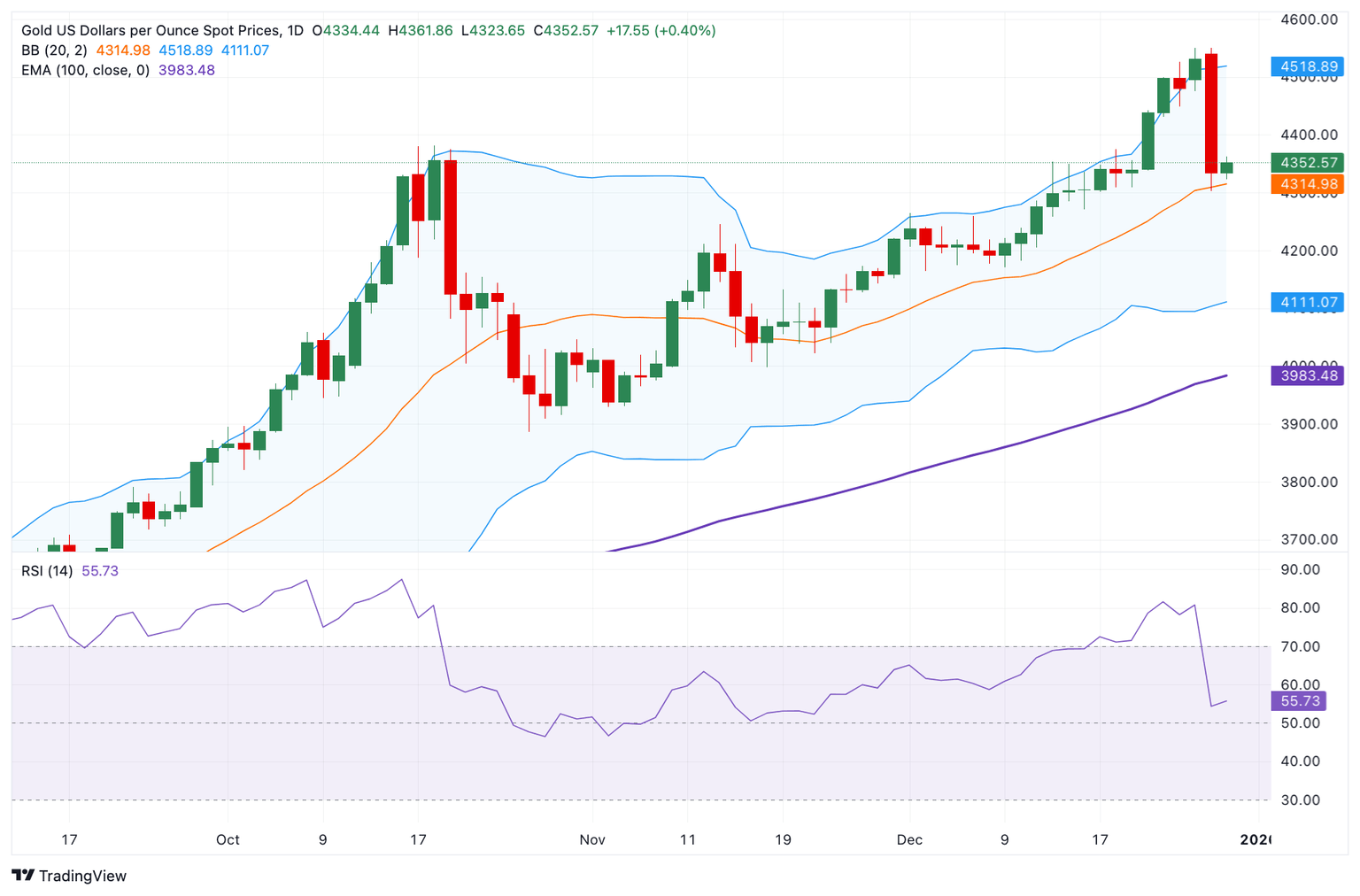
Gold maintains a bullish bias, RSI suggests near-term consolidation
Gold trades on a positive note on the day. The constructive outlook of the precious metal prevails as the price remains above the key 100-day Exponential Moving Average (EMA) on the daily chart, while the Bollinger Bands widen.
Nonetheless, further consolidation or temporary sell-off cannot be ruled out as the 14-day Relative Strength Index (RSI) hovers around the midline. This suggests the neutral momentum in the near term.
The immediate resistance level to watch is the upper boundary of the Bollinger Band of $4,520. A decisive break above this level would likely trigger a retest of the all-time high of $4,550, en route to the $4,600 psychological mark.
On the flip side, the initial support level for XAU/USD emerges in the $4,305-$4,300 zone, representing the December 29 low and round figure. Any follow-through selling below the mentioned level would signal that the correction has more room to run and could target the December 16 low of $4,271.
Gold FAQs
Gold has played a key role in human’s history as it has been widely used as a store of value and medium of exchange. Currently, apart from its shine and usage for jewelry, the precious metal is widely seen as a safe-haven asset, meaning that it is considered a good investment during turbulent times. Gold is also widely seen as a hedge against inflation and against depreciating currencies as it doesn’t rely on any specific issuer or government.
Central banks are the biggest Gold holders. In their aim to support their currencies in turbulent times, central banks tend to diversify their reserves and buy Gold to improve the perceived strength of the economy and the currency. High Gold reserves can be a source of trust for a country’s solvency. Central banks added 1,136 tonnes of Gold worth around $70 billion to their reserves in 2022, according to data from the World Gold Council. This is the highest yearly purchase since records began. Central banks from emerging economies such as China, India and Turkey are quickly increasing their Gold reserves.
Gold has an inverse correlation with the US Dollar and US Treasuries, which are both major reserve and safe-haven assets. When the Dollar depreciates, Gold tends to rise, enabling investors and central banks to diversify their assets in turbulent times. Gold is also inversely correlated with risk assets. A rally in the stock market tends to weaken Gold price, while sell-offs in riskier markets tend to favor the precious metal.
The price can move due to a wide range of factors. Geopolitical instability or fears of a deep recession can quickly make Gold price escalate due to its safe-haven status. As a yield-less asset, Gold tends to rise with lower interest rates, while higher cost of money usually weighs down on the yellow metal. Still, most moves depend on how the US Dollar (USD) behaves as the asset is priced in dollars (XAU/USD). A strong Dollar tends to keep the price of Gold controlled, whereas a weaker Dollar is likely to push Gold prices up.
PBOC sets USD/CNY reference rate at 7.0348 vs. 7.0056 previous

On Tuesday, the People’s Bank of China (PBOC) sets the USD/CNY central rate for the trading session ahead at 7.0348 compared to the previous day’s fix of 7.0056 and 7.0112 Reuters estimate.
PBOC FAQs
The primary monetary policy objectives of the People’s Bank of China (PBoC) are to safeguard price stability, including exchange rate stability, and promote economic growth. China’s central bank also aims to implement financial reforms, such as opening and developing the financial market.
The PBoC is owned by the state of the People’s Republic of China (PRC), so it is not considered an autonomous institution. The Chinese Communist Party (CCP) Committee Secretary, nominated by the Chairman of the State Council, has a key influence on the PBoC’s management and direction, not the governor. However, Mr. Pan Gongsheng currently holds both of these posts.
Unlike the Western economies, the PBoC uses a broader set of monetary policy instruments to achieve its objectives. The primary tools include a seven-day Reverse Repo Rate (RRR), Medium-term Lending Facility (MLF), foreign exchange interventions and Reserve Requirement Ratio (RRR). However, The Loan Prime Rate (LPR) is China’s benchmark interest rate. Changes to the LPR directly influence the rates that need to be paid in the market for loans and mortgages and the interest paid on savings. By changing the LPR, China’s central bank can also influence the exchange rates of the Chinese Renminbi.
Yes, China has 19 private banks – a small fraction of the financial system. The largest private banks are digital lenders WeBank and MYbank, which are backed by tech giants Tencent and Ant Group, per The Straits Times. In 2014, China allowed domestic lenders fully capitalized by private funds to operate in the state-dominated financial sector.
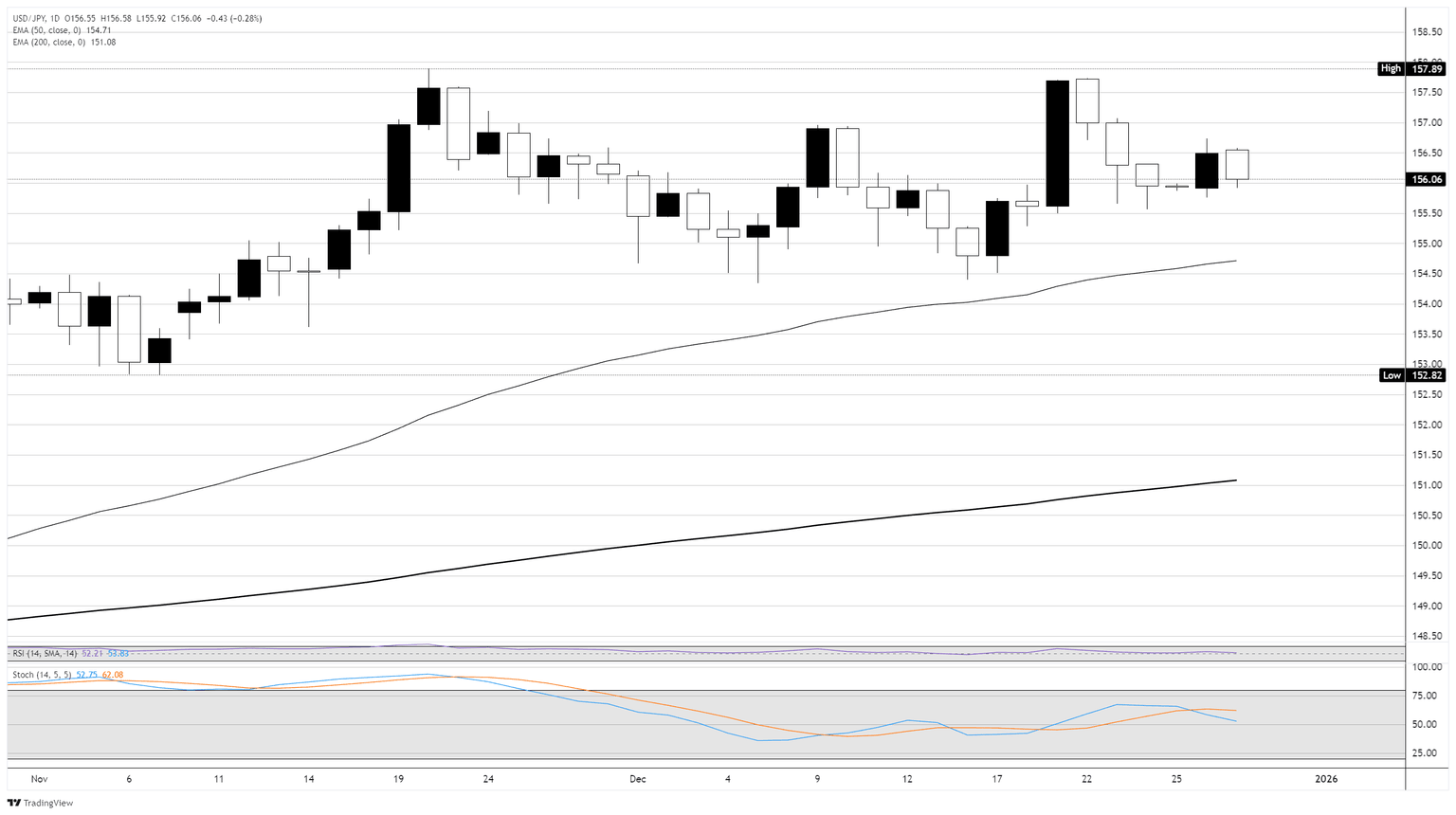
USD/JPY stalls as Yentervention risk weighs
USD/JPY reversed course to open the final week of the trading year, falling back to the 156.00 region and paring off last week’s late burst of bullish momentum. General volatility is expected to widen during the last trading week of 2025, and follow into early 2026 as holiday-thinned market volumes wreak havoc on general market trends.
Yen markets still aren’t in drastic-enough shape to warrant a direct intervention yet, but the risk of the Bank of Japan stepping directly into markets to bolster the Yen yet again remains nearby. Japanese Finance Minister Satsuki Katayama reiterated last week that the BoJ has “free hands” to deal with any “excessive moves” in Yen markets.
The latest interest rate decision from the Fed has sparked some exciting discussions, as they’ve implemented a third consecutive rate cut. According to their latest dot plot, policymakers anticipate a gradual easing in rates, with projections suggesting two additional cuts over the next two years.
Looking ahead, the CME’s FedWatch Tool is showing a growing expectation among traders for an accelerated rate-cutting schedule. Many are predicting at least two more cuts before September arrives, with the potential for even more easing down the line.
USD/JPY daily chart
Japanese Yen FAQs
The Japanese Yen (JPY) is one of the world’s most traded currencies. Its value is broadly determined by the performance of the Japanese economy, but more specifically by the Bank of Japan’s policy, the differential between Japanese and US bond yields, or risk sentiment among traders, among other factors.
One of the Bank of Japan’s mandates is currency control, so its moves are key for the Yen. The BoJ has directly intervened in currency markets sometimes, generally to lower the value of the Yen, although it refrains from doing it often due to political concerns of its main trading partners. The BoJ ultra-loose monetary policy between 2013 and 2024 caused the Yen to depreciate against its main currency peers due to an increasing policy divergence between the Bank of Japan and other main central banks. More recently, the gradually unwinding of this ultra-loose policy has given some support to the Yen.
Over the last decade, the BoJ’s stance of sticking to ultra-loose monetary policy has led to a widening policy divergence with other central banks, particularly with the US Federal Reserve. This supported a widening of the differential between the 10-year US and Japanese bonds, which favored the US Dollar against the Japanese Yen. The BoJ decision in 2024 to gradually abandon the ultra-loose policy, coupled with interest-rate cuts in other major central banks, is narrowing this differential.
The Japanese Yen is often seen as a safe-haven investment. This means that in times of market stress, investors are more likely to put their money in the Japanese currency due to its supposed reliability and stability. Turbulent times are likely to strengthen the Yen’s value against other currencies seen as more risky to invest in.