Gold reverses an Asian session dip to sub-$4,200 levels and trades with modest losses just below the highest level since October 20, touched the previous day. The growing acceptance that the US Federal Reserve will lower borrowing costs again fails to assist the US Dollar to capitalize on the overnight modest bounce from a two-week low.
USD/CAD holds onto recovery move near 1.4000 despite firm dovish Fed bets

The USD/CAD pair clings to Monday’s recovery move to near 1.4010 during the Asian trading session on Tuesday. The Loonie pair bounced back on Monday as the US Dollar (USD) rebounded despite weak United States (US) ISM Manufacturing Purchasing Managers’ Index (PMI) data for November strengthened the case for another interest rate cut by the Federal Reserve (Fed) this year.
At the press time, the US Dollar Index (DXY), which tracks the Greenback’s value against six major currencies, trades calmly near 99.40. The USD Index recovered on Monday after revisiting the monthly low around 99.00.
The ISM showed that the Manufacturing PMI declined at a faster pace to 48.2. Economists expected the PMI to come in lower a 48.6 from 48.7 in October. This was the ninth straight month when the Manufacturing PMI was expected to come in below 50.0. A figure below 50.0 is considered a contraction in the economic activity.
According to the CME FedWatch tool, the probability of the Fed cutting interest rates by 25 basis points (bps) to 3.50%-3.75% in December is 86.5%.
Going forward, the major trigger for the US Dollar will be the ADP Employment Change and the ISM Services PMI data for November, which are scheduled for Wednesday.
Meanwhile, the Canadian Dollar (CAD) is expected to trade on the sidelines as investors await the employment data for November, which will be released on Friday. The labor market data is expected to influence market expectations for the Bank of Canada’s monetary policy outlook.
Economists expect the Canadian Unemployment Rate to have accelerated to 7% from 6.9% in October. The Canadian laborforce is expected to have remained steady.
Economic Indicator
ISM Manufacturing PMI
The Institute for Supply Management (ISM) Manufacturing Purchasing Managers Index (PMI), released on a monthly basis, is a leading indicator gauging business activity in the US manufacturing sector. The indicator is obtained from a survey of manufacturing supply executives based on information they have collected within their respective organizations. Survey responses reflect the change, if any, in the current month compared to the previous month. A reading above 50 indicates that the manufacturing economy is generally expanding, a bullish sign for the US Dollar (USD). A reading below 50 signals that factory activity is generally declining, which is seen as bearish for USD.
South Korea Consumer Price Index Growth (MoM) came in at -0.2%, above forecasts (-0.3%) in November
Gold is kicking off the week with a solid bid, even after easing back from earlier two-month highs above $4,260. Investors are growing more confident that another Fed rate cut is coming, thanks to a fresh run of dovish commentary from officials, and that expectation is helping keep the precious metal supported with buyers still very much in charge.
USD/JPY Price Forecast: Bulls maintain control above 154.50 despite weakening momentum
USD/JPY trades on the defensive at the start of the week as the Japanese Yen (JPY) bulls regain control on the back of hawkish Bank of Japan (BoJ) signals. At the time of writing, the pair is hovering around 155.40, trimming a part of its earlier decline as the US Dollar (USD) steadies, tempering bearish momentum for now.
BoJ Governor Kazuo Ueda signalled on Monday that policymakers will actively weigh the pros and cons of a rate increase at the December 18-19 meeting. Ueda warned that delaying a rate hike too long could cause sharp inflation and force the central bank to make a rapid policy adjustment.
Elsewhere, traders in the US maintain a strong conviction that the Federal Reserve (Fed) will deliver a rate cut at the December 9-10 meeting. While the Dollar is attempting a modest rebound, the broader outlook remains tilted firmly to the downside.

From a technical perspective, USD/JPY continues to trade within a well-defined uptrend on the daily chart, characterised by a clear sequence of higher highs and higher lows. The latest swing low found support above 154.50, reinforcing this bullish structure and confirming that buyers are still defending the trend.
The 50-day Simple Moving Average (SMA) rises above the 100-day SMA, and the price holds above both, reinforcing a firm uptrend. However, momentum indicators point to some cooling, reflecting a pause in bullish momentum.
The Moving Average Convergence Divergence (MACD) has turned lower, with the MACD line slipping beneath the Signal line around the zero region and the histogram back in negative territory. The Relative Strength Index (RSI) has eased to around 54, a neutral reading after unwinding from recent overbought levels.
On the downside, a decisive break below 154.50 would expose the next support zone at the rising 50-day SMA near 152.69, while the 100-day SMA around 150.20 is expected to provide a firmer cushion in the event of a deeper pullback.
On the upside, initial resistance sits at 156.00, which may cap the immediate recovery. A sustained move above this barrier would signal a continuation of the prevailing uptrend, paving the way for another higher high toward the 158.00 region.
Japanese Yen Price Today
The table below shows the percentage change of Japanese Yen (JPY) against listed major currencies today. Japanese Yen was the strongest against the British Pound.
| USD | EUR | GBP | JPY | CAD | AUD | NZD | CHF | |
|---|---|---|---|---|---|---|---|---|
| USD | -0.14% | 0.20% | -0.53% | 0.13% | 0.02% | 0.08% | 0.08% | |
| EUR | 0.14% | 0.34% | -0.34% | 0.27% | 0.16% | 0.22% | 0.22% | |
| GBP | -0.20% | -0.34% | -0.66% | -0.07% | -0.17% | -0.12% | -0.12% | |
| JPY | 0.53% | 0.34% | 0.66% | 0.60% | 0.49% | 0.56% | 0.55% | |
| CAD | -0.13% | -0.27% | 0.07% | -0.60% | -0.11% | -0.05% | -0.05% | |
| AUD | -0.02% | -0.16% | 0.17% | -0.49% | 0.11% | 0.06% | 0.06% | |
| NZD | -0.08% | -0.22% | 0.12% | -0.56% | 0.05% | -0.06% | -0.00% | |
| CHF | -0.08% | -0.22% | 0.12% | -0.55% | 0.05% | -0.06% | 0.00% |
The heat map shows percentage changes of major currencies against each other. The base currency is picked from the left column, while the quote currency is picked from the top row. For example, if you pick the Japanese Yen from the left column and move along the horizontal line to the US Dollar, the percentage change displayed in the box will represent JPY (base)/USD (quote).
CAD holds steady despite slight pullback against USD – Scotiabank

The Canadian Dollar (CAD) is down fractionally on the session against the US Dollar (USD) but losses are very modest and spot is all but unchanged in effect over the weekend, Scotiabank’s Chief FX Strategists Shaun Osborne and Eric Theoret report.
Spot technicals signal CAD could rebound if key levels hold
“The CAD is retaining a good deal of the advance seen last week around the stronger than expected GDP report Friday. Details of the report were less impressive than the headline gain, with government spending and housing leading the advance while consumer spending and business investment remained weak.”
“But the data will reinforce the outlook for steady BoC policy for the foreseeable future and bolster the narrowing trend in short-term US/ Canada yield spreads. Spot losses have narrowed the CAD’s undervaluation versus our estimated equilibrium (1.3901) but there is still some ground for the CAD to make up.”
“The CAD closed out last week on a strong note but there is still some work to do in order to improve its technical position against the USD more materially. Spot dipped below the Nov 18th low at 1.3972 but could not hold that break. That is the low between last month’s twin tests of 1.4130/40 and counts as a potential double top trigger (for a push lower to the low 1.38s) if a clear break lower can be achieved. Resistance is 1.4025.”
United Kingdom M4 Money Supply (YoY) dipped from previous 3.6% to 3.5% in October
Bitcoin, Ethereum, and Ripple are off to a bearish start in December, with over 4% losses by press time on Monday. Bitcoin, Ethereum, and Ripple face renewed selling, risking further losses to $80,000 BTC, $2,100 ETH, and $1.90 XRP, respectively.
Top 3 Price Prediction: Bitcoin, Ethereum, XRP face major losses as December begins
Bitcoin (BTC), Ethereum (ETH), and Ripple (XRP) are off to a bearish start in December, with over 4% losses by press time on Monday. Bitcoin, Ethereum, and Ripple face renewed selling, risking further losses to $80,000 BTC, $2,100 ETH, and $1.90 XRP, respectively.
The fresh sell-off wave aligns with Bank of Japan (BoJ) Governor Kazuo Ueda’s statement that possible interest rate hikes could be considered if the economy continues to evolve as predicted, which could increase borrowing costs and negatively affect carry trades.
Bitcoin under pressure risks a steeper correction ahead
Bitcoin trades below $87,000 by press time on Monday, preparing for a potential bearish marubozu candle on the daily chart. The intraday sell-off extends the pullback after the $92,800 level retest seen last week.
In line with renewed selling, the Relative Strength Index (RSI) is at 33 on the daily chart, pivoting downside towards the oversold after last week’s recovery and indicating a fresh wave of supply pressure. If RSI remains below 30, it could signal an extended downtrend in BTC prices.
Furthermore, the Moving Average Convergence Divergence (MACD) shifts from an uptrend to risking a potential cross below the red line, which would trigger a sell signal.
The immediate target for Bitcoin bears remains the $80,600 support level from November 21. If the cryptocurrency market fails to find a new bullish catalyst, BTC could revisit the April 7 low of $74,508.
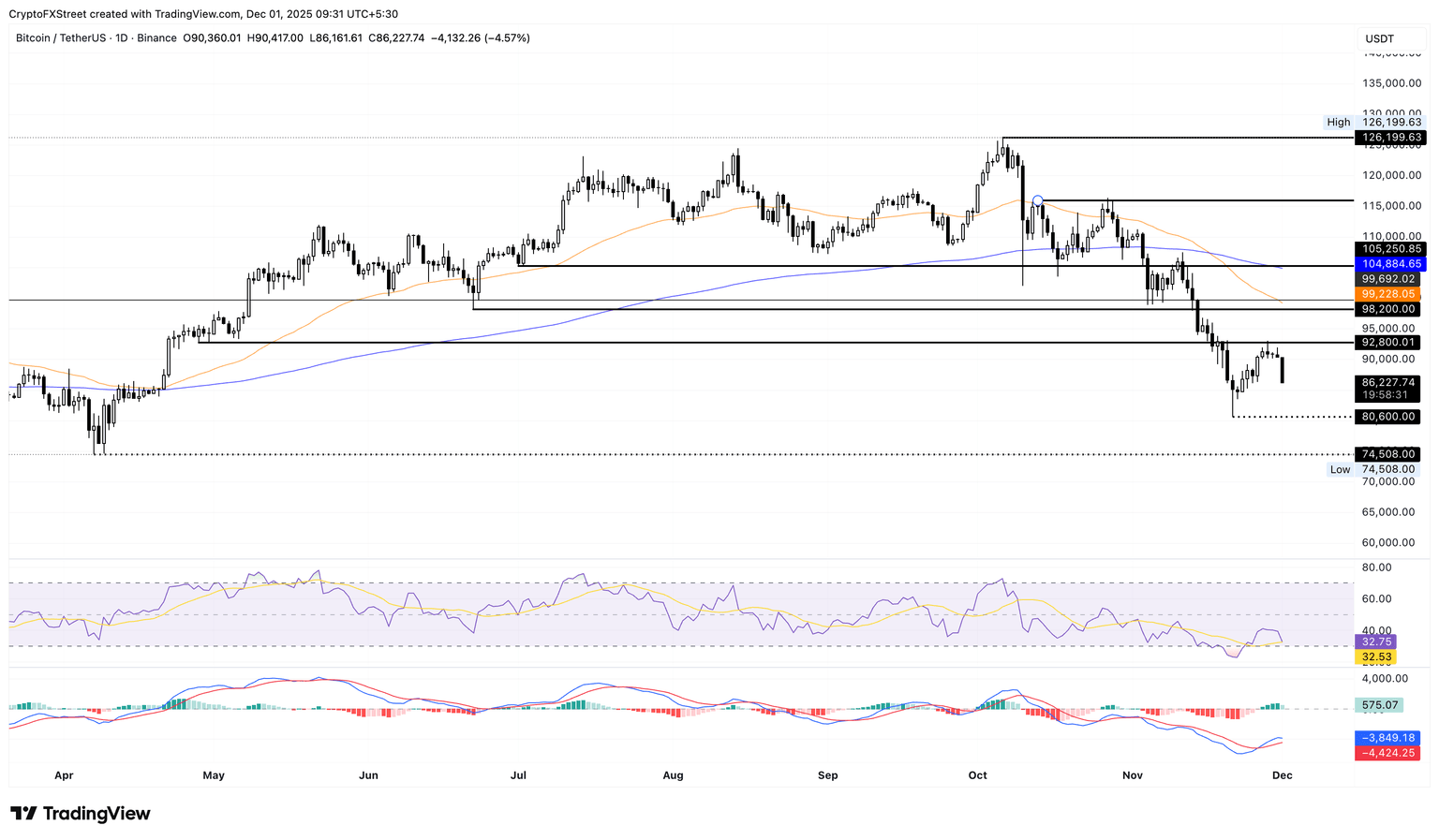
However, if a catalyst such as a potential US Federal Open Market Committee (FOMC) decision to cut interest rates, Bitcoin could rebound to $90,000 amid easier access to capital.
Ethereum bulls struggle to absorb incoming supply, risking further losses
Ethereum retraces 5% on the downside by press time on Monday from a resistance trendline on the daily chart. The bearish start to the week risks breaking below the supply zone near $2,800.
If ETH marks a successful daily close below the November 21 low of $2,623, it would confirm the range breakdown and potentially extend the decline to the June 22 low of $2,111.
Similar to BTC, the RSI at 34 and MACD risk a cross below the signal line indicate Ethereum is on the edge.
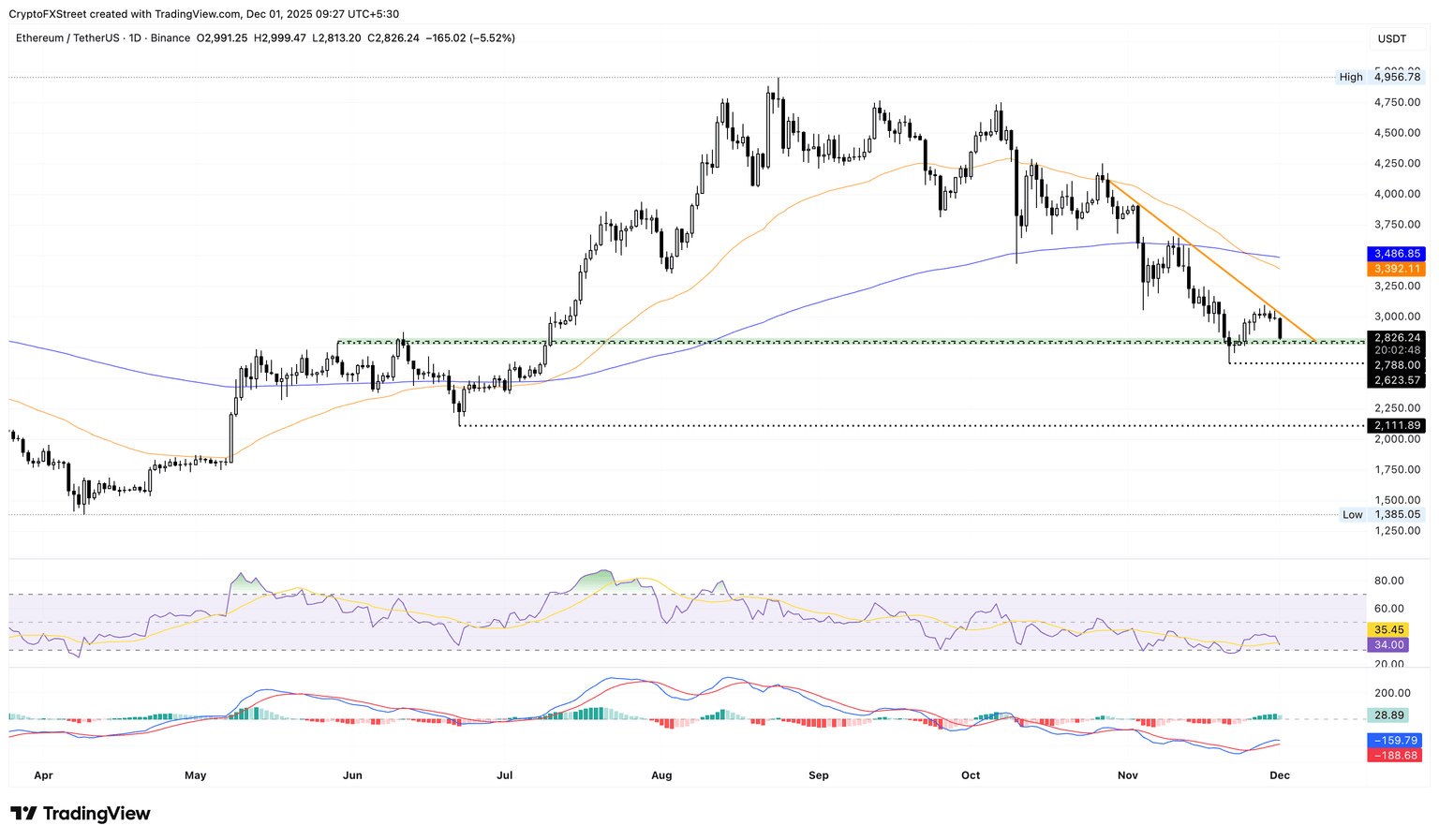
Looking up, a bounce back in Ethereum could challenge the overhead trendline near $3,000.
XRP experiences renewed bearish momentum
XRP price is down over 4% by press time on Monday, extending the 2% loss from Sunday. The cross-border remittance token is trading close to the $2.00 psychological level, with bears targeting the $1.90 support level, marked on June 22.
Momentum indicators on the daily chart signal similar bearishness for XRP, with the RSI at 40, suggesting increased selling pressure. Meanwhile, the MACD is closing towards the signal line for a potential crossover, which could confirm a bearish shift in the XRP price trend.
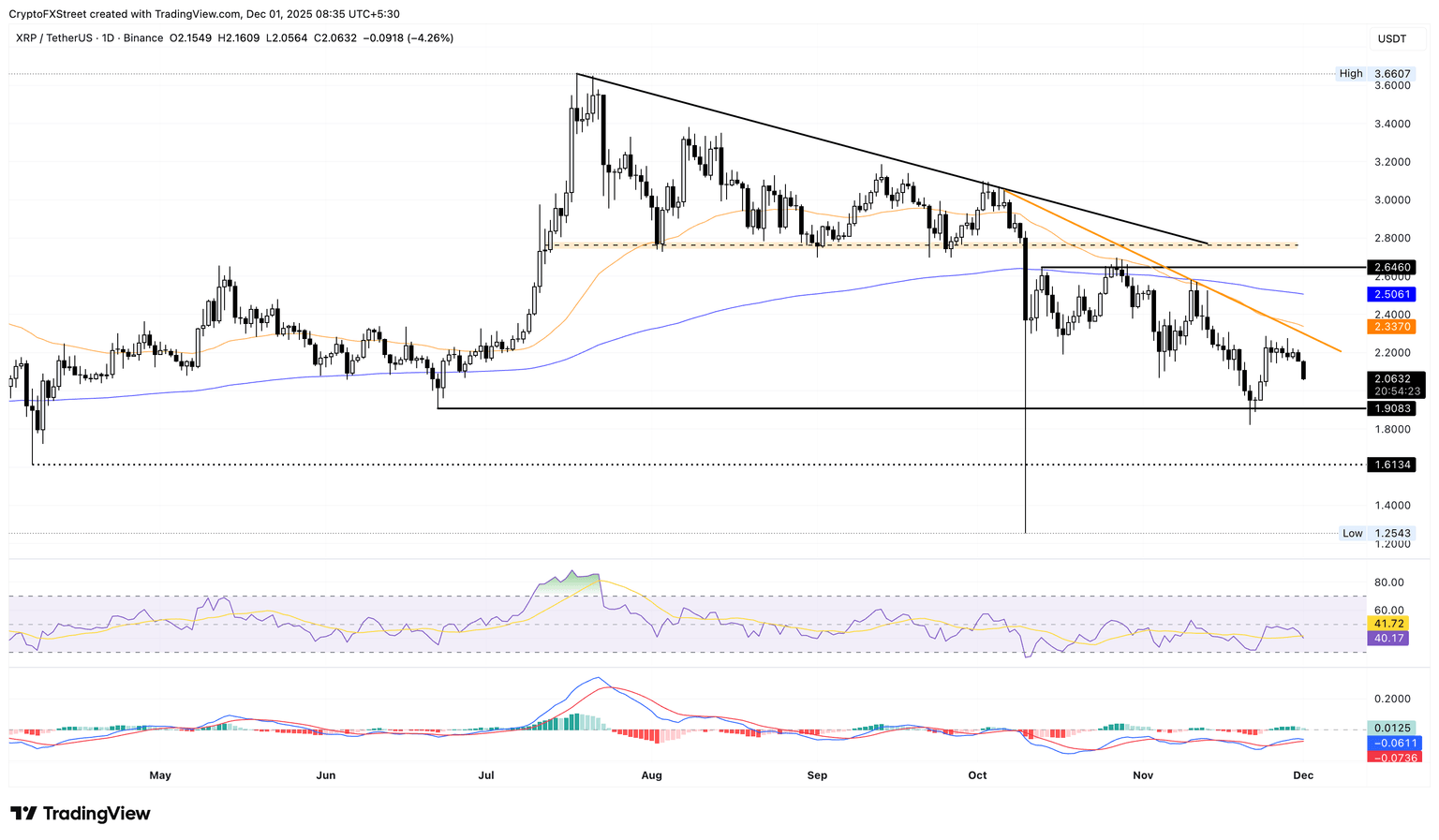
Optimistically, if XRP bulls hold dominance at the $2.00 level, a rebound towards the resistance trendline formed by connecting the October 6 and November 10 highs near the $2.20 level could be possible.
Bitcoin, altcoins, stablecoins FAQs
Bitcoin is the largest cryptocurrency by market capitalization, a virtual currency designed to serve as money. This form of payment cannot be controlled by any one person, group, or entity, which eliminates the need for third-party participation during financial transactions.
Altcoins are any cryptocurrency apart from Bitcoin, but some also regard Ethereum as a non-altcoin because it is from these two cryptocurrencies that forking happens. If this is true, then Litecoin is the first altcoin, forked from the Bitcoin protocol and, therefore, an “improved” version of it.
Stablecoins are cryptocurrencies designed to have a stable price, with their value backed by a reserve of the asset it represents. To achieve this, the value of any one stablecoin is pegged to a commodity or financial instrument, such as the US Dollar (USD), with its supply regulated by an algorithm or demand. The main goal of stablecoins is to provide an on/off-ramp for investors willing to trade and invest in cryptocurrencies. Stablecoins also allow investors to store value since cryptocurrencies, in general, are subject to volatility.
Bitcoin dominance is the ratio of Bitcoin’s market capitalization to the total market capitalization of all cryptocurrencies combined. It provides a clear picture of Bitcoin’s interest among investors. A high BTC dominance typically happens before and during a bull run, in which investors resort to investing in relatively stable and high market capitalization cryptocurrency like Bitcoin. A drop in BTC dominance usually means that investors are moving their capital and/or profits to altcoins in a quest for higher returns, which usually triggers an explosion of altcoin rallies.
Japan Jibun Bank Manufacturing PMI came in at 48.7, below expectations (48.8) in November
Gold kicks off the new week on a softer note, eroding part of Friday’s strong move up back toward the November swing high, though the downtick lacks bearish conviction. Dovish Fed expectations keep the USD depressed near its lowest level in nearly two weeks and continue to underpin the non-yielding bullion. Bulls, however, pause for a breather and await this week’s key US macro releases scheduled at the start of a new month.
China NBS Manufacturing PMI in line with expectations (49.2) in November
Bitcoin, Ethereum and Ripple are struggling to sustain their recovery on Friday, reflecting a sticky bearish sentiment. Since the October 10 flash crash, which liquidated over $19 billion in crypto assets in a single day, retail interest in crypto assets has been significantly suppressed.
China NBS Non-Manufacturing PMI down to 49.5 in November from previous 50.1
Bitcoin, Ethereum and Ripple are struggling to sustain their recovery on Friday, reflecting a sticky bearish sentiment. Since the October 10 flash crash, which liquidated over $19 billion in crypto assets in a single day, retail interest in crypto assets has been significantly suppressed.