GBP/USD is struggling to keep its daily advance, coming under fresh pressure and retreating to the 1.3320 zone following a mild bullish attempt in the Greenback. Even though US consumer sentiment surprised to the upside, the US Dollar isn’t getting much love, as traders are far more interested in what the Fed will say next week.
Forecasting the upcoming week: It’s all about the Federal Reserve

The US Dollar (USD) remained on the back foot this week, continuing the broad downward trend that has been in place since late November. As usual in the last few days, expectations for a more dovish Federal Reserve in 2026 as well as steady bets for a rate cut next week continued to keep the buck under persistent pressure.
The US Dollar Index (DXY) added to the prior week’s pullback, deflating below the 99.00 support to hit new multi-week troughs ahead of the upcoming FOMC gathering. The NY Fed will release its Consumer Inflation Expectations on December 8. On December 9 comes the NFIB Business Optimism Index, the ADP Employment Change Weekly, JOLTs Job Openings, and the API’s weekly report on US crude oil inventories. The Fed meeting takes centre stage on December 10, followed by the usual weekly MBA Mortgage Applications, the Employment Cost data and the EIA’s weekly report on US crude oil stockpiles. The usual weekly Initial Jobless Claims will be released on December 11, alongside the Balance of Trade results and Wholesale Inventories.
EUR/USD advanced for the second week in a row, this time briefly surpassing the 1.1680 level to hit new seven-week highs. Industrial Production in Germany is due on December 8, while the Balance of Trade results will be released on December 9. In addition, Germany’s final Inflation Rate will be published on December 10. On December 11, Industrial Production readings in the euro bloc are due alongside Germany’s Wholesale Prices.
In line with the rest of the risk complex, GBP/USD clocked marked gains this week, breaking above the 1.3300 barrier for the first time since late October. The BRC Retail Sales Monitor is due on December 9, followed by the RICS House Price Balance on December 11. A very interesting docket comes on December 12 with the releases of GDP figures, Balance of Trade, Industrial and Manufacturing Production, Construction Outout, and the NIESR Monthly GDP Tracker.
Another week of solid performance of the Japanese yen saw USD/JPY add to the previous weekly pullback and challenge the 155.00 support. The key Reuters Tankan Index is due on December 8, alongside Average Cash Earnings, Current Account results, the final Q3 GDP Growth Rate, and the Eco Watchers survey. On December 9 will come Machinery Tool Orders, while Producer Prices are expected on December 10. The BSI Large Manufacturing gauge will be released on December 11 along with the weekly Foreign Bond Investment prints. Industrial Production and Capacity Utilisation figures will wrap up the docket on December 12.
AUD/USD climbed to new three-month highs north of 0.6600 the figure, flirting at the same time with its 200-week SMA and adding to the sharp recovery seen in the last couple of weeks. The RBA interest rate decision takes centre stage on December 9, followed by the NAB Business Confidence index and the final prints of Building Permits and Private House Approvals. On December 11 will come the critical labour market report for the month of November.
Anticipating economic perspectives: Voices on the horizon
- The ECB’s Lagarde speaks on December 10, followed by the SNB’s Schlegel, the BoC’s Macklem and the Fed’s Powell.
- The BoE’s Bailey will speak on December 11.
- The Fed’s Goolsbee speaks on December 12.
Central banks: Upcoming meetings/releases to shape monetary policies
- The RBA will meet on December 9 (3.60% act vs. 3.60% exp).
- The BoC will decide on rates on December 10 (2.25% at vs. 2.25% exp) along with the Fed (3.75%-4.00% act vs. 3.50%-3.75% exp).
- The SNB meets on December 11 (0.00% act vs. 0.00% exp), alongside the CBRT (39.50% act vs. 37.25% exp).
Italy’s Gold reserves become the focus of politics – Commerzbank

Italy is considering declaring its central bank’s 2,452 tons of Gold as the property of the people, a move opposed by the ECB over fears it could threaten bank independence. While the Italian central bank is unlikely to be forced to sell, central banks in Brazil and Poland have shown strong appetite for Gold, with October purchases reaching 53 tons, Commerzbank’s commodity analyst Carsten Fritsch notes.
ECB urges Meloni government to rethink proposal
“Italy is apparently considering declaring the Gold reserves held by the central bank to be the property of the people. The ECB has called on Prime Minister Meloni’s government to reconsider this proposal. Apparently, there are fears that the central bank could be forced by the government, as the elected representative of the people, to sell Gold.”
“This, in turn, could undermine the independence of the central bank, which is guaranteed in the ECB’s statutes. The Italian central bank holds 2,452 tons of Gold in its vaults, making it the third-largest Gold reserve holder behind the US Federal Reserve and the Deutsche Bundesbank. It is very unlikely that the Italian central bank will actually be forced by the government to sell Gold.”
“If it did, it would have no trouble finding grateful buyers among other central banks. As reported by the World Gold Council, central bank Gold purchases rose to 53 tons in October, reaching their highest monthly level this year. The largest buyers in October were the central banks of Brazil with 16 tons and Poland with 15.6 tons.”
Austria Trade Balance: €-230.8M (September) vs €-1895.6M
Pi Network edges lower on Friday for the third consecutive day, approaching a local support trendline. The on-chain data suggests an increase in supply pressure as Centralized Exchanges experience a surge in inflows. Technically, the pullback in PI risks further losses, as the Moving Average Convergence Divergence indicator is flashing a sell signal.
Top Crypto Gainers: Zcash rallies as MYX Finance, Dash test critical EMA levels
Zcash (ZEC), MYX Finance (MYX), and Dash (DASH) are the top-performing assets in the top 100 cryptocurrency list over the last 24 hours. The privacy coin leads the rally while MYX and DASH struggle to clear their 100-day Exponential Moving Averages (EMA).
Zcash approaches $400 with bulls aiming for a breakout rally
Zcash edges higher by 5% at press time on Friday, extending its 8% rise from the previous day. The privacy coin performs a V-shaped reversal on the daily logarithmic chart from the $300 psychological support, marked by three consecutive bullish candles.
The recovery run approaches the 50-day EMA at $420, which serves as the immediate resistance. A successful close above this level could extend the rally toward the $550 supply zone.
The Relative Strength Index (RSI) at 42 on the daily chart indicates an upward tilt toward the midpoint, suggesting a decrease in selling pressure. At the same time, the Moving Average Convergence Divergence (MACD) shifts toward the signal line, a sign of reduced bearish momentum and a potential crossover which would indicate renewed bullish drive.
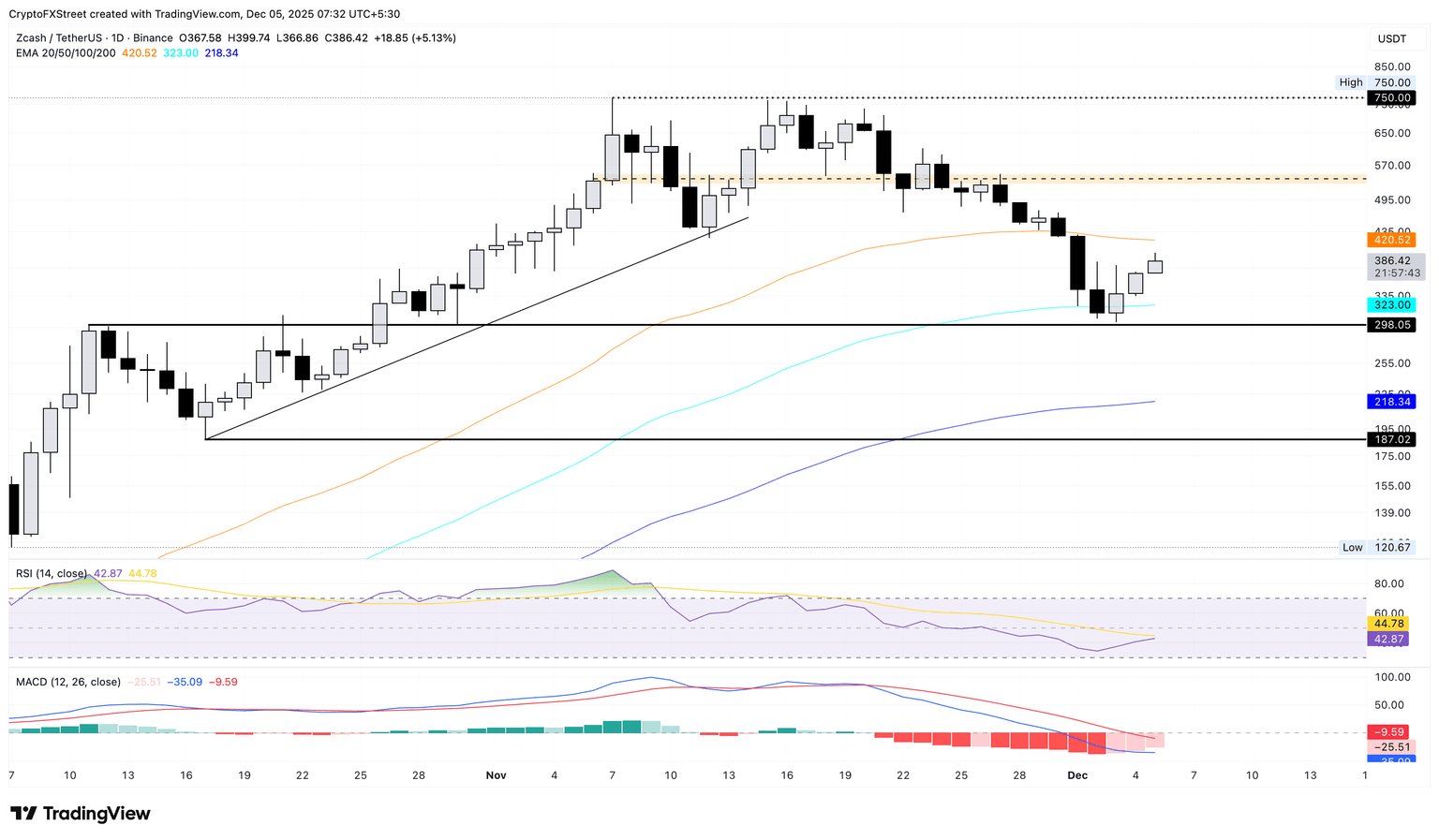
On the downside, if Zcash flips from $400, the 100-day EMA at $323 could provide support.
MYX Finance struggles at a resistance
MYX Finance token is up 4% by press time on Friday, extending the uptrend for the eighth day. The MYX recovery inches closer to the 100-day EMA at $3.58, which serves as immediate resistance. If the token clears this dynamic resistance, it could aim for $4.46, aligning with the October 5 low.
The momentum indicators show a steady increase in buying pressure as the RSI at 61 extends towards the overbought zone, while the MACD and signal line extend the uptrend above the zero line.
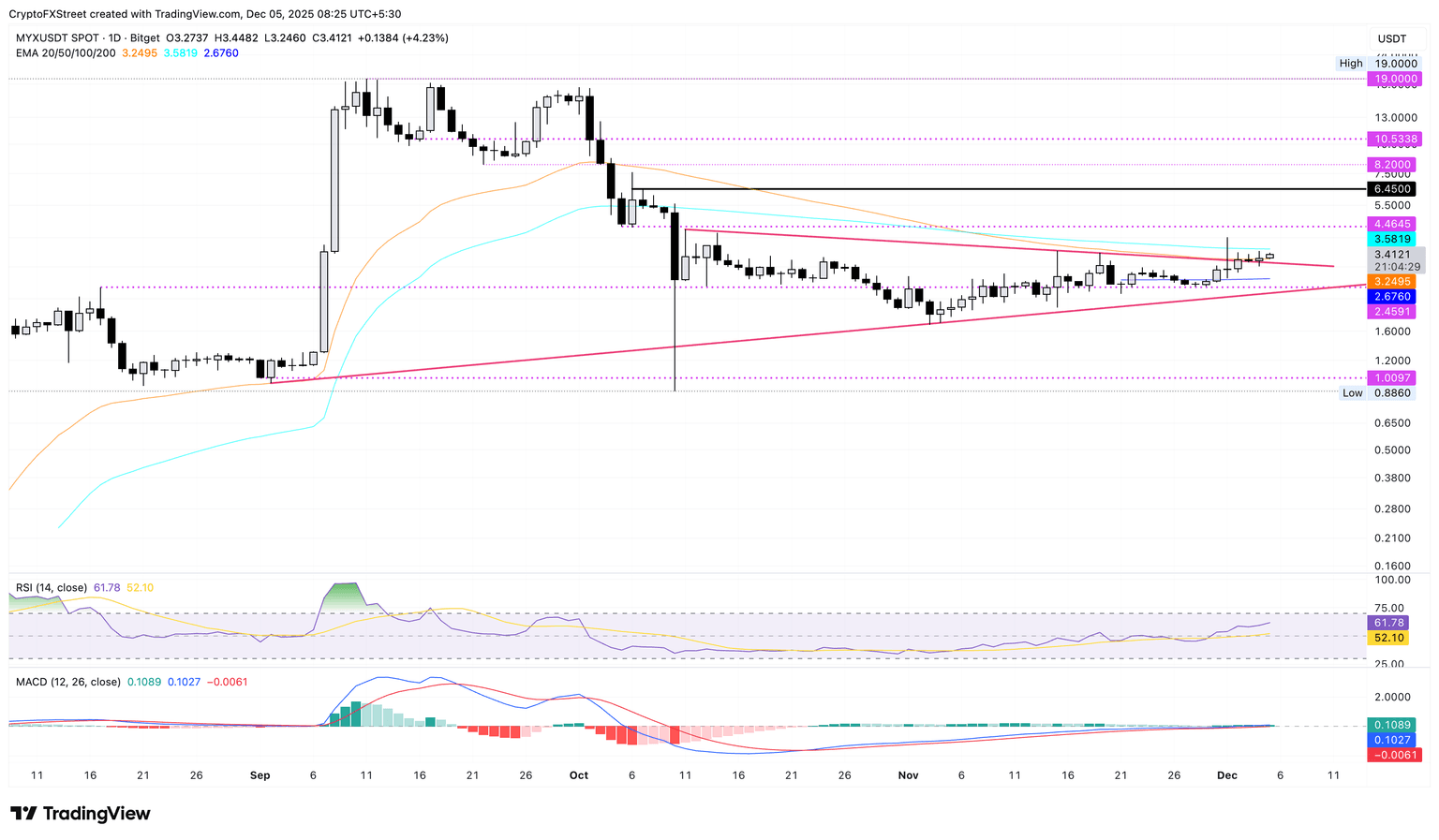
Looking down, the key support levels for MYX are the 50-day EMA at $3.24, followed by the 200-day EMA at $2.67.
Dash aims for the 100-day EMA breakout
Dash extends its recovery for the third consecutive day, aiming to clear the 100-day EMA at $50.98. At the time of writing, DASH trades near $52.00, up 5% on Friday.
If the privacy coin secures a daily close above $50.98, it would confirm the 100-day EMA breakout and aim for the 50-day EMA at $59.50.
Similar to Zcash, the momentum indicators on the daily timeframe signal a positive shift in the DASH price trend. The RSI at 42 is shifting upward towards the midline, while the MACD and signal line prepare for a bullish crossover.
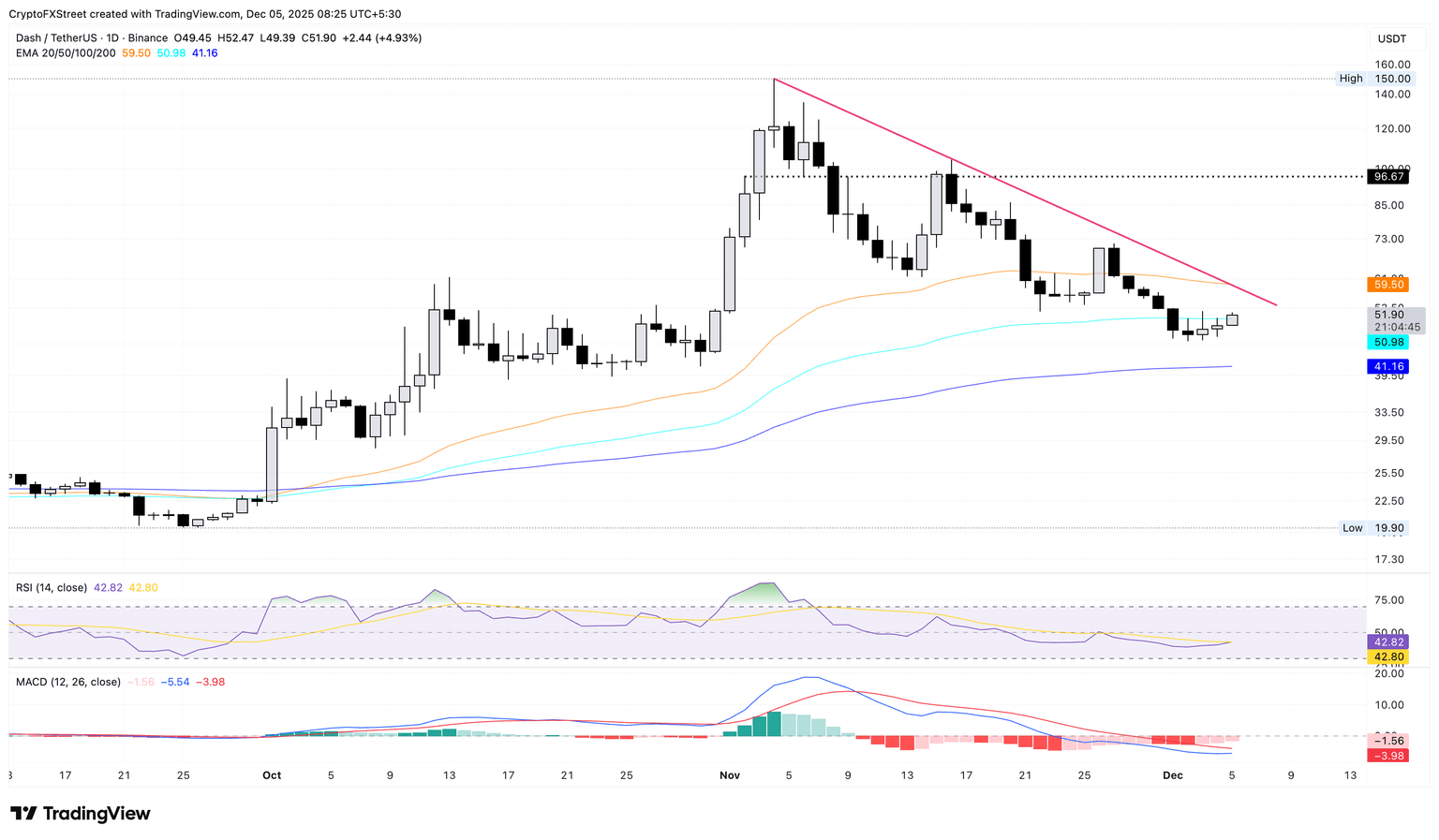
However, if DASH reverses from $50.00, it could extend the decline to the 200-day EMA at $41.16.
Euro dips as US jobs data boosts the Dollar despite Fed-cut buzz
Euro retreats somewhat on Thursday as traders digest the last round of US jobs data as they also brace for the release of the Federal Reserve’s preferred inflation gauge, the Core Personal Consumption Expenditures (PCE) Price Index. At the time of writing, the EUR/USD trades at 1.1649, down 0.19%.
EUR/USD poised for further upside on possible Fed rate cut
The financial markets narrative hasn’t changed, as investors are waiting for December 10, the Fed’s D day. Economic data in the US was a tailwind for the Dollar, as Initial Jobless Claims for the week ending November 29 dipped sharply, an indication that the labor market is still firm.
Contrarily, the Challenger Jobs Cut data reported that employers cut over 70,000 jobs in November, its highest level for that month since 2022.
Given the fundamental backdrop, traders priced in an 85% chance for a Fed rate cut next week. Nevertheless, this could change if the release of the Fed’s favorite inflation gauge, the Core Personal Consumption Expenditures (PCE) Price Index for September, surpasses the 3% threshold on Friday.
For the Euro, the main supporter is the European Central Bank (ECB) which set interest rates at around 2%, hinted that the easing cycle was over and Lagarde’s remarks on Wednesday, when she said, “inflation to stay near 2% in months ahead.”
Data-wise Retail Sales in the Eurozone exceeded estimates in October, and Construction PMI readings for the EZ, Germany, France and Italy, improved, despite remaining in contractionary territory.
Daily market movers: Euro boosted by Lagarde’s comments, weak Dollar
- The Dollar is poised to weaken further, yet as of writing, the US Dollar Index (DXY), which tracks the buck’s performance against six major currencies, gains 0.19% up at 99.05.
- Initial Jobless Claims for the week ending November 29 were 191K, lower than the estimated 220K and last week’s revised 218K. Continuing Claims for November 22 fell to 1.939 million from 1.943 million the prior week.
- According to Challenger, Gray & Christmas, employers reported 71,321 job cuts in November. This figure represents a 24% increase compared to the same period last year, but a 53% decrease from the number recorded in October of this year.
- ECB’s President Lagarde added that the EZ economy is in good shape due to a steady household spending and a resilient labor market. The central bank is expected to hold rates unchanged at the December 18 meeting.
Technical analysis: EUR/USD holds steady within new range amid fading momentum
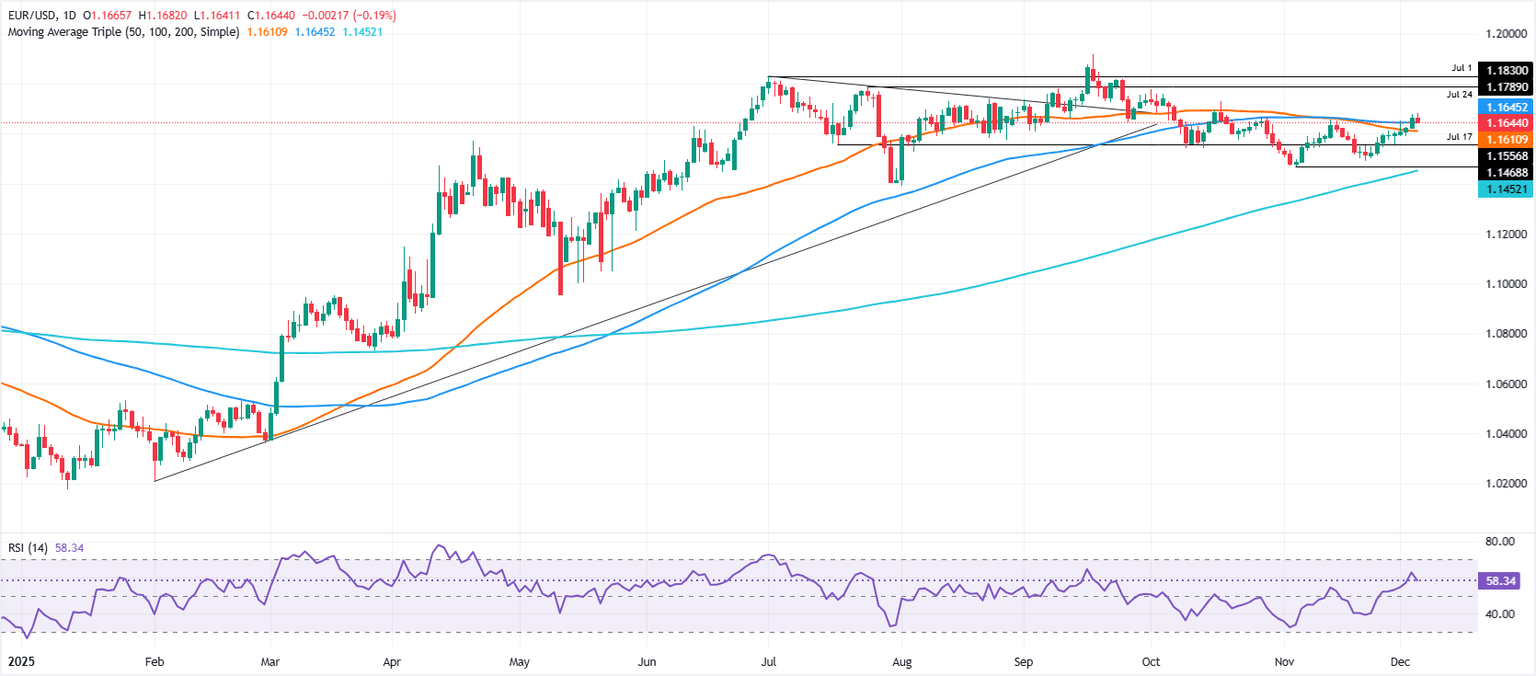
The EUR/USD despite dipping, remains stable at around the 1.1650 area for four consecutive sessions, establishing a new trading range between this threshold and 1.1700. Buying momentum has faded as depicted by the Relative Strength Index (RSI), putting in danger a possible test of the 1.1800 figure, before traders could challenge the year-to-date (YTD) high at 1.1918.
Should the EUR/USD decline below 1.1650, initial support is provided by the 50-day Simple Moving Average (SMA) at 1.1610, followed by the 20-day SMA at 1.1589, and subsequently at 1.1500.
Euro FAQs
The Euro is the currency for the 20 European Union countries that belong to the Eurozone. It is the second most heavily traded currency in the world behind the US Dollar. In 2022, it accounted for 31% of all foreign exchange transactions, with an average daily turnover of over $2.2 trillion a day.
EUR/USD is the most heavily traded currency pair in the world, accounting for an estimated 30% off all transactions, followed by EUR/JPY (4%), EUR/GBP (3%) and EUR/AUD (2%).
The European Central Bank (ECB) in Frankfurt, Germany, is the reserve bank for the Eurozone. The ECB sets interest rates and manages monetary policy.
The ECB’s primary mandate is to maintain price stability, which means either controlling inflation or stimulating growth. Its primary tool is the raising or lowering of interest rates. Relatively high interest rates – or the expectation of higher rates – will usually benefit the Euro and vice versa.
The ECB Governing Council makes monetary policy decisions at meetings held eight times a year. Decisions are made by heads of the Eurozone national banks and six permanent members, including the President of the ECB, Christine Lagarde.
Eurozone inflation data, measured by the Harmonized Index of Consumer Prices (HICP), is an important econometric for the Euro. If inflation rises more than expected, especially if above the ECB’s 2% target, it obliges the ECB to raise interest rates to bring it back under control.
Relatively high interest rates compared to its counterparts will usually benefit the Euro, as it makes the region more attractive as a place for global investors to park their money.
Data releases gauge the health of the economy and can impact on the Euro. Indicators such as GDP, Manufacturing and Services PMIs, employment, and consumer sentiment surveys can all influence the direction of the single currency.
A strong economy is good for the Euro. Not only does it attract more foreign investment but it may encourage the ECB to put up interest rates, which will directly strengthen the Euro. Otherwise, if economic data is weak, the Euro is likely to fall.
Economic data for the four largest economies in the euro area (Germany, France, Italy and Spain) are especially significant, as they account for 75% of the Eurozone’s economy.
Another significant data release for the Euro is the Trade Balance. This indicator measures the difference between what a country earns from its exports and what it spends on imports over a given period.
If a country produces highly sought after exports then its currency will gain in value purely from the extra demand created from foreign buyers seeking to purchase these goods. Therefore, a positive net Trade Balance strengthens a currency and vice versa for a negative balance.
EUR/USD softens after eight-day rally ahead of key US PCE, Eurozone data

The Euro (EUR) trades slightly lower against the US Dollar (USD) on Thursday, weighed down by a modest uptick in the Greenback. At the time of writing, the pair is hovering near 1.1659, snapping an eight-day winning streak after briefly climbing to its highest level since October 17 earlier in the day.
Overall sentiment continues to support the Euro as the Greenback remains under broad pressure ahead of next week’s Federal Reserve (Fed) meeting, where markets expect policymakers to lower interest rates.
Recent soft US economic data and remarks from key Fed officials expressing concern about the labour market have strengthened expectations for another rate cut. According to the CME FedWatch Tool, markets now assign nearly an 87% probability of a 25 bps cut at the December 9-10 meeting.
A separate Reuters poll offered further insight into market expectations for the Fed’s policy path. In the survey, 89 of 108 economists said they expect the central bank to cut the Fed Funds Rate by 25 bps to the 3.50%-3.75% range at the December 10 decision. Looking further ahead, 50 of 100 economists projected that the rate could fall to the 3.25%-3.50% range in the first quarter of 2026.
Fresh US data released on Thursday provided new insight into labour-market conditions. Challenger Job Cuts dropped sharply to 71.3K in November from 153.1K, pointing to fewer announced layoffs across major industries. Initial Jobless Claims also improved, falling to 191K versus expectations of 220K and down from 218K last week.
On the Euro side, the latest Retail Sales figures released today showed a mixed performance. Eurozone Retail Sales were flat at 0% MoM in October, missing expectations for a 0.1% increase. On a yearly basis, Retail Sales rose 1.5%, slightly above the 1.4% forecast and improving from the 1.2% reading in September.
Looking ahead, the Eurozone calendar on Friday will offer traders more direction, with key releases including Q3 Employment Change and updated Gross Domestic Product (GDP) figures.
In the United States, attention will turn to the September Personal Consumption Expenditures (PCE) Price Index, the Fed’s preferred inflation gauge. The day will also bring updates on Personal Income and Personal Spending, followed by preliminary Michigan Consumer Sentiment readings and inflation expectations.
US Dollar Price Today
The table below shows the percentage change of US Dollar (USD) against listed major currencies today. US Dollar was the strongest against the Swiss Franc.
| USD | EUR | GBP | JPY | CAD | AUD | NZD | CHF | |
|---|---|---|---|---|---|---|---|---|
| USD | 0.06% | -0.04% | -0.22% | -0.06% | -0.24% | -0.00% | 0.29% | |
| EUR | -0.06% | -0.09% | -0.29% | -0.11% | -0.30% | -0.06% | 0.23% | |
| GBP | 0.04% | 0.09% | -0.21% | -0.02% | -0.21% | 0.04% | 0.33% | |
| JPY | 0.22% | 0.29% | 0.21% | 0.17% | 0.00% | 0.21% | 0.53% | |
| CAD | 0.06% | 0.11% | 0.02% | -0.17% | -0.17% | 0.05% | 0.35% | |
| AUD | 0.24% | 0.30% | 0.21% | -0.00% | 0.17% | 0.24% | 0.53% | |
| NZD | 0.00% | 0.06% | -0.04% | -0.21% | -0.05% | -0.24% | 0.29% | |
| CHF | -0.29% | -0.23% | -0.33% | -0.53% | -0.35% | -0.53% | -0.29% |
The heat map shows percentage changes of major currencies against each other. The base currency is picked from the left column, while the quote currency is picked from the top row. For example, if you pick the US Dollar from the left column and move along the horizontal line to the Japanese Yen, the percentage change displayed in the box will represent USD (base)/JPY (quote).
(This story was corrected on December 4 at 17:18 GMT to say, in the first paragraph, that the pair trades lower on Thursday, not Monday.)
CAD shrugs off renewed USMCA withdrawal threat – Scotiabank

The Canadian Dollar (CAD) shows only mild weakness after fresh headlines on a possible USMCA withdrawal, but persistent long-term trade uncertainty continues to cap gains. Despite supportive risk sentiment and narrower spreads, USD/CAD remains stuck near 1.40, with bearish technical signals unfulfilled as key support holds at 1.3940, Scotiabank’s Chief FX Strategists Shaun Osborne and Eric Theoret report.
Trade uncertainty keeps pressure on Canada
“Politico reports that the US Trade Representative said President Trump could withdraw from USMCA next year. The CAD slipped very fractionally on the headline but it was more of a shrug; the threat of withdrawal has been lingering over the trade agreement for some time. Withdrawal would not be straightforward as Congress would have to repeal the relevant legislation but for Canada—and Mexico—the threat maintains an uncomfortably high level of uncertainty about trade relations in the longer run.”
“The CAD is a marginal underperformer on the session, with the CAD finding progress below 1.40 hard to come by despite some marginal improvement in CAD-supportive factors (positive risk mood, spreads maintaining their recent narrowing) which have nudged our fair value estimate down to 1.3862.”
“The CAD has failed to leverage the USD-bearish breakdown below the bear flag pattern which formed on the short-term charts over the turn of the week. That bearish signal remains valid (for a push lower towards the high 1.38s) but so far, USD losses have held near the late Nov low (now key short-term support) at 1.3940. The USD has, however, failed to progress much above 1.3970/75 and still faces firm resistance in the 1.4010/20 zone.”
United Kingdom S&P Global Construction PMI came in at 39.4 below forecasts (44.3) in November
Altcoins, including Zcash, Telcoin, and Curve DAO, lead the cryptocurrency market recovery in the last 24 hours, fueled by improving investors’ sentiment on Vanguard Group’s lifting the ban on crypto Exchange Traded Funds (ETFs) and Charles Schwab group’s announcement to offer Bitcoin and Ethereum trading features in 2026.
EUR/JPY trades flat near 181.00 ahead of Eurozone Retail Sales release

The EUR/JPY cross trades on a flat note near 181.10 during the early European session on Thursday. Hawkish expectations of the Bank of Japan (BoJ) rate hike could provide some support to the Japanese Yen (JPY) against the Euro (EUR) in the near term. Traders await the Eurozone Retail Sales report for October, which will be published later in the day.
Traders raise their bets for an imminent rate hike by the BoJ following Governor Kazuo Ueda’s remarks earlier this week. Ueda said on Monday that the Japanese central bank will consider the “pros and cons” of raising interest rates at its next policy meeting. He added that the likelihood of the BoJ’s baseline scenario for growth and inflation being realized is gradually increasing. Market swaps currently imply an approximately 80% odds of a December BoJ hike.
Eurozone inflation unexpectedly ticked up in November, suggesting that further rate cuts from the European Central Bank (ECB) are unlikely under current economic conditions. The ECB held its main interest rates unchanged at its meetings in September and October, with the deposit rate remaining at 2.00%. The EUR could receive support from the growing acceptance that the ECB is done cutting interest rates.
The ECB maintains a data-dependent stance and highlights that future decisions will be based on incoming economic and financial data. Traders will take more cues from the Eurozone Retail Sales data on Thursday, which is expected to show a rise of 1.4% in October. Any surprise downside reading could drag the Euro lower against the JPY.
Japanese Yen FAQs
The Japanese Yen (JPY) is one of the world’s most traded currencies. Its value is broadly determined by the performance of the Japanese economy, but more specifically by the Bank of Japan’s policy, the differential between Japanese and US bond yields, or risk sentiment among traders, among other factors.
One of the Bank of Japan’s mandates is currency control, so its moves are key for the Yen. The BoJ has directly intervened in currency markets sometimes, generally to lower the value of the Yen, although it refrains from doing it often due to political concerns of its main trading partners. The BoJ ultra-loose monetary policy between 2013 and 2024 caused the Yen to depreciate against its main currency peers due to an increasing policy divergence between the Bank of Japan and other main central banks. More recently, the gradually unwinding of this ultra-loose policy has given some support to the Yen.
Over the last decade, the BoJ’s stance of sticking to ultra-loose monetary policy has led to a widening policy divergence with other central banks, particularly with the US Federal Reserve. This supported a widening of the differential between the 10-year US and Japanese bonds, which favored the US Dollar against the Japanese Yen. The BoJ decision in 2024 to gradually abandon the ultra-loose policy, coupled with interest-rate cuts in other major central banks, is narrowing this differential.
The Japanese Yen is often seen as a safe-haven investment. This means that in times of market stress, investors are more likely to put their money in the Japanese currency due to its supposed reliability and stability. Turbulent times are likely to strengthen the Yen’s value against other currencies seen as more risky to invest in.